As the Pentagon shifts toward adversaries in Asia and Europe, its networks face a stress test unlike any before. For decades, military networks have grown organically through a patchwork of legacy copper lines, aging time-division multiplexing (TDM) systems, and inconsistent protocols.
In today’s battlespace, however, where artificial intelligence (AI), cloud computing, and edge devices demand ultra-low-latency high-bandwidth connections, the legacy architecture is no longer capable of keeping up. The challenge is not just technical — it’s strategic. For example, the Pentagon is confronting a pacing threat from China in the Indo-Pacific, requiring resilient networks that span terrestrial to space.
To address these challenges, the Defense Department is relying on industry partner…
As the Pentagon shifts toward adversaries in Asia and Europe, its networks face a stress test unlike any before. For decades, military networks have grown organically through a patchwork of legacy copper lines, aging time-division multiplexing (TDM) systems, and inconsistent protocols.
In today’s battlespace, however, where artificial intelligence (AI), cloud computing, and edge devices demand ultra-low-latency high-bandwidth connections, the legacy architecture is no longer capable of keeping up. The challenge is not just technical — it’s strategic. For example, the Pentagon is confronting a pacing threat from China in the Indo-Pacific, requiring resilient networks that span terrestrial to space.
To address these challenges, the Defense Department is relying on industry partners like Lumen to deliver secure, low-latency transport and what it calls a “Private Connectivity Fabric” (PCF) that enables data to flow seamlessly and securely across warfighting domains.
With decades of experience as a global Tier Zero carrier of IP traffic and as a trusted provider to hyperscalers and their large data centers, Lumen has also become a critical mission partner to the DoD. Through contracts such as the Indo-Pacific Transport Services (IPTS) agreement with the Defense Information Systems Agency (DISA), the company is helping prepare the military’s networks to be future-ready for an era defined by AI, cloud workloads, and near-peer competition.
From copper to fiber and modernizing the backbone
Network modernization begins with replacing legacy infrastructure with fiber-optic cables. “We’re spending a lot of time helping DoD move away from legacy systems and networks, as well as copper-based TDM, and moving toward fiber,” said Scott Barnett, vice president of Lumen’s Department of Defense practice.
The issue is not only outdated networking but also the fragmented nature of the DoD’s communications environment.
“The DoD network is made up of hundreds if not thousands of network components introduced over multiple decades,” said Josh Finke, senior vice president for Public Sector at Lumen. “Finding a way to operate in today’s world where instant access to data is a necessity for warfighters presents a lot of challenges.”
Those challenges include everything from protocols that were never designed to work together, to uneven levels of cybersecurity and compliance across branches. Some parts of the DoD still rely on copper networks that are half a century old. Others use geostationary satellites, which introduce latency into mission-critical communications. Even earlier fiber deployments are beginning to age, and lack the physical security and advanced optical capabilities that newer systems bring.
DISA’s IPTS program is meant to address all those challenges with a new fiber backbone that provides not just capacity, but also flexibility and security. With innovations such as encrypted wavelengths and sensors embedded into the fiber itself, today’s fiber systems can carry exponentially more traffic while also detecting physical disturbances — from something as simple as construction digging too close to a line up to malicious tampering.
“We can proactively detect that and deploy resources to stop it,” Finke said. “All of these innovations that are being put into the ground today simply didn’t exist even a few years ago, including the ability to run extreme long-haul fiber without the need for repeaters.”
Another key advantage is scalability. Many older deployments required new strands of fiber for each increase in bandwidth. Today, however, optics can send multiple streams of data across a single strand of glass by using different wavelengths of light. Each wavelength is completely separated, and for classified missions, each can be individually encrypted.
“That same piece of fiber can be carrying multiple data streams,” Finke explained. “Each wavelength contains a completely separated portion of network traffic, and we can encrypt at the wave level. Fiber to this day continues to be the number-one transport method for reliability, ultra-low latency security, and an ability to tie into the ever-evolving world around GovCloud and AI demand.”
**AI at the edge because data can’t wait **
If fiber is the foundation, AI and edge computing are the forces reshaping network infrastructure. AI workloads are rarely contained in a single data center. They are distributed across multiple locations, requiring seamless, high-speed connectivity between repositories, applications, and end users.
“AI applications are already demanding extremely low latency, and it’s the latency piece that is driving the edge explosion — getting the processing, storage, and the computing as close to the end user as possible,” said Barnett. “The defense terminology for this is sensor-to-shooter and JADC2, and it’s about how all these elements work together in what we call a fabric.”
In practice, this means caching and processing data closer to where missions take place. A Pacific-based task force cannot afford to wait for sensor data to be transmitted to the continental United States and then returned.
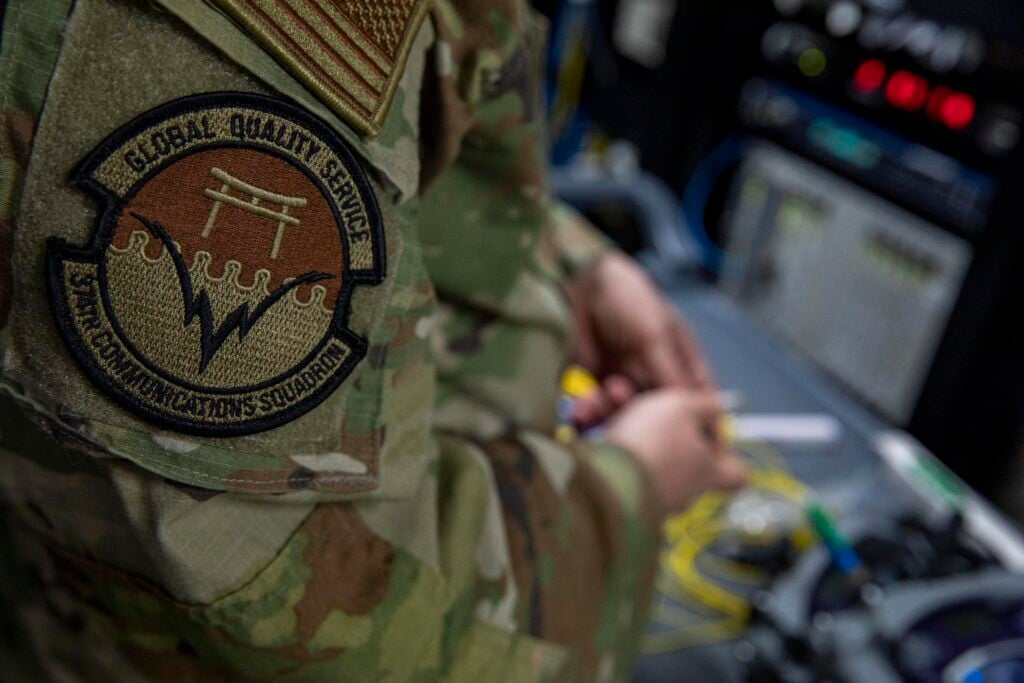 U.S. Air Force Tech. Sgt. Joseph Fredrick Jr, a cyber defense operations airman with 374th Communications Squadron Operating Location Bravo, 374th Communications Squadron, 374th Mission Support Group, and a native of California, prepares a bit error test at Marine Corps Air Station Iwakuni, Japan, April 19, 2024. (U.S. Marine Corps photo by Lance Cpl. David Getz)
“If you’re operating in the Pacific, it doesn’t make a lot of sense to fetch that data from data centers in the continental United States,” Barnett said. “It makes more sense to have that data available in the Pacific closer to the folks that need it.”
The ability to do just that is embodied in Lumen Private Connectivity Fabric (PCF), a secure architecture that integrates fiber, Ethernet, and optical waves — including encrypted ones — to move massive workloads with reliability and speed. It is designed to connect any user, application, or location to the data it needs, wherever that data resides.
“When we talk about PCF, it can be a wavelength or it can be dark fiber,” Barnett said. “It’s the underlying infrastructure and approach to enable ubiquitous connectivity that allows the mass amounts of traffic to flow easily from a sensor to shooter.”
With PCF, Lumen eliminates dependence on the public Internet or costly point-to-point connections, instead offering secure, scalable pathways that connect the DoD to GovCloud providers, hyperscalers, and mission-critical applications across multiple data centers and locations. For the Pentagon, PCF means not just connectivity but resilience, with AI-driven tools able to automatically reroute traffic around vulnerabilities.
DISA and Indo-Pacific modernization
The strategic stakes behind network modernization are most apparent in the Indo-Pacific.
“You hear on the news every day that China is the pacing threat,” Barnett said. “We are working in an environment where we’re seeing the largest military buildup in the Pacific since World War II. We must prepare DISA and the DoD to be ready across all domains.”
That preparation involves more than laying fiber. It requires partnerships with allied carriers in Australia, Japan, and Korea to knit together networks across borders, as well as integrating subsea cables, satellites, and terrestrial systems into a resilient whole. In a theater where milliseconds matter, the need to cache data for edge computing can make the difference between actionable intelligence and delayed response.
The IPTS contract gives the DoD something it has historically lacked in the region: a single, unified provider responsible for knitting together a vast, diverse ecosystem of carriers and infrastructure. For Lumen, the challenge is not just technical but operational — providing the joint and coalition forces access to the data they need securely and reliably, regardless of the conditions.
Ultimately, the modernization effort is about more than bandwidth and latency. It is about enabling missions in a world of accelerating threats. Lumen’s leaders argue that continuous upgrades, encryption at multiple layers, and proactive sensing will give the DoD the resilience it needs.
The Pacific challenge also underscores the importance of network situational awareness. Modern fiber can act as a sensor in its own right, detecting not just tampering but even seismic events.
“With the modems that drive the lasers inside the optronics, we’re now finding that the sensitivity of those lasers could detect the slightest movements,” Barnett explained. “This has applications for public safety and detecting earthquakes or tsunamis. You could detect if someone’s tampering with the fiber or has accidentally dug it up.”
That ability to treat the network itself as a sensor, coupled with AI-driven orchestration that can reroute traffic without human intervention, represents a new level of resilience. For DISA and the DoD, it provides the network situational awareness needed to maintain continuity even in contested environments.
Modernized transport for mission outcomes
As the DoD enters an era of contested domains and great-power competition, secure and resilient data transport is no longer a background issue. It is a front-line requirement. For missions where milliseconds can define outcomes, the ability to move data securely and reliably — from the edge to the cloud to the warfighter — is decisive. Fiber optics, encrypted wavelengths, and a Private Connectivity Fabric provide the backbone for this transformation.
Through the IPTS contract and global hyperscaler partnerships, Lumen is helping DISA and the broader DoD future-ready their networks against evolving threats. Doing so in an era where secure, ultra-low-latency data transport is decisive may well prove as critical as the weapons it deploys.