From Wikipedia, the free encyclopedia
In mathematics, Kruskal’s tree theorem states that the set of finite trees over a well-quasi-ordered set of labels is itself well-quasi-ordered under homeomorphic embedding.
A finitary application of the theorem gives the existence of the fast-growing TREE function. TREE(3) is largely accepted to be one of the largest simply defined finite numbers, dwarfing other large numbers such as [Grah…
From Wikipedia, the free encyclopedia
In mathematics, Kruskal’s tree theorem states that the set of finite trees over a well-quasi-ordered set of labels is itself well-quasi-ordered under homeomorphic embedding.
A finitary application of the theorem gives the existence of the fast-growing TREE function. TREE(3) is largely accepted to be one of the largest simply defined finite numbers, dwarfing other large numbers such as Graham’s number and googolplex.[1]
The theorem was conjectured by Andrew Vázsonyi and proved by Joseph Kruskal (1960); a short proof was given by Crispin Nash-Williams (1963). It has since become a prominent example in reverse mathematics as a statement that cannot be proved in ATR0 (a second-order arithmetic theory with a form of arithmetical transfinite recursion).
In 2004, the result was generalized from trees to graphs as the Robertson–Seymour theorem, a result that has also proved important in reverse mathematics and leads to the even-faster-growing SSCG function, which dwarfs TREE.
The version given here is that proven by Nash-Williams; Kruskal’s formulation is somewhat stronger. All trees we consider are finite.
Given a tree 


Take 


Kruskal’s tree theorem then states:
If 


For a countable label set
Ordinal analysis confirms the strength of Kruskal’s theorem, with the proof-theoretic ordinal of the theorem equaling the small Veblen ordinal (sometimes confused with the smaller Ackermann ordinal).[7]
Suppose that 
There is some 


All the statements 
Friedman defined the following function, which is a weaker version of the TREE function below. For a positive integer 
There is a sequence 

Friedman computes the first few terms of this sequence as 


A sequence of rooted trees labelled from a set of 3 labels (blue < red < green). The 
By incorporating labels, Friedman defined a far faster-growing function.[10] For a positive integer 
There is a sequence 
Kruskal’s theorem asserts that
The sequence begins 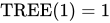
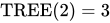


Friedman showed that 

^ a Friedman originally denoted this function by ![{\displaystyle {\text{TR}}[n]}](https://wikimedia.org/api/rest_v1/media/math/render/svg/4be6605b5b3ae1b36735f0a536b0429a8499dd7c)


Citations
- ^ “The Enormity of the Number TREE(3) Is Beyond Comprehension”. Popular Mechanics. 20 October 2017. Retrieved 4 February 2025.
- ^ Simpson 1985, Theorem 1.8
- ^ Friedman 2002, p. 60
- ^ Simpson 1985, Definition 4.1
- ^ Simpson 1985, Theorem 5.14
- ^ Marcone 2005, pp. 8–9
- ^ Rathjen & Weiermann 1993.
- ^ Smith 1985, p. 120
- ^ Friedman, Harvey. “289:Integer Thresholds in FFF”. Ohio State University Department of Mathematics. Archived from the original on 28 February 2024.
- ^ a b c d Friedman, Harvey (28 March 2006). “273:Sigma01/optimal/size”. Ohio State University Department of Maths. Archived from the original on 18 September 2024. Retrieved 8 August 2017.
- ^ Friedman, Harvey M. (1 June 2000). “Enormous Integers In Real Life” (PDF). Ohio State University. Retrieved 8 August 2017.
- ^ Friedman, Harvey M. (8 October 1998). “Long Finite Sequences” (PDF). Ohio State University Department of Mathematics. pp. 5, 48 (Thm.6.8). Retrieved 8 August 2017.
- ^ Friedman, Harvey. “[FOM] 271:Clarification of Smith Article”. Ohio State University Department of Mathematics. Archived from the original on 26 February 2024.
Bibliography
- Friedman, Harvey M. (2002). “Internal finite tree embeddings”. In Sieg, Wilfried; Feferman, Solomon (eds.). Reflections on the foundations of mathematics: essays in honor of Solomon Feferman. Lecture notes in logic. Vol. 15. Natick, Mass: AK Peters. pp. 60–91. ISBN 978-1-56881-170-3. MR 1943303.
- H. Gallier, Jean (September 1991). “What’s so special about Kruskal’s theorem and the ordinal Γ0? A survey of some results in proof theory” (PDF). Annals of Pure and Applied Logic. 53 (3): 199–260. doi:10.1016/0168-0072(91)90022-E. MR 1129778.
- Kruskal, J. B. (May 1960). “Well-Quasi-Ordering, The Tree Theorem, and Vazsonyi’s Conjecture” (PDF). Transactions of the American Mathematical Society. 95 (2). American Mathematical Society: 210–225. doi:10.2307/1993287. JSTOR 1993287. MR 0111704.
- Marcone, Alberto (2005). Simpson, Stephen G. (ed.). “WQO and BQO theory in subsystems of second order arithmetic” (PDF). Reverse Mathematics. Lecture Notes in Logic. 21. Cambridge: Cambridge University Press: 303–330. doi:10.1017/9781316755846.020. ISBN 978-1-316-75584-6.
- Nash-Williams, C. St. J. A. (October 1963). “On well-quasi-ordering finite trees” (PDF). Mathematical Proceedings of the Cambridge Philosophical Society. 59 (4): 833–835. Bibcode:1963PCPS...59..833N. doi:10.1017/S0305004100003844. ISSN 0305-0041. MR 0153601. S2CID 251095188.
- Rathjen, Michael; Weiermann, Andreas (February 1993). “Proof-theoretic investigations on Kruskal’s theorem” (PDF). Annals of Pure and Applied Logic. 60 (1): 49–88. doi:10.1016/0168-0072(93)90192-G. MR 1212407.
- Simpson, Stephen G. (1985). “Nonprovability of certain combinatorial properties of finite trees”. In Friedman, Harvey; Harrington, L. A.; Scedrov, A.; et al. (eds.). Harvey Friedman’s research on the foundations of mathematics. Studies in logic and the foundations of mathematics. Amsterdam ; New York: North-Holland. pp. 87–117. ISBN 978-0-444-87834-2.
- Smith, Rick L. (1985). “The Consistency Strengths of Some Finite Forms of the Higman and Kruskal Theorems”. In Friedman, Harvey; Harrington, L. A. (eds.). Harvey Friedman’s research on the foundations of mathematics. Studies in logic and the foundations of mathematics. Vol. 117. Amsterdam ; New York: North-Holland. pp. 119–136. doi:10.1016/s0049-237x(09)70157-0. ISBN 978-0-444-87834-2.