 Namako takes kicks from gansters like a champ. Source: Author
There are small spoilers for the first half of Demonschool in this article.
It took me a while after watching the *Dark Knight *to really understand what Harvey Dent meant by associating aging with villainy. I understood the theory, but lacked the experience to trust it. Now, as I’ve watched my peers and I transition into proper adulthood, I feel the cold truth behind Dent’s observation more strongly. It was never about the act of aging itself. If I we…
Namako takes kicks from gansters like a champ. Source: Author
There are small spoilers for the first half of Demonschool in this article.
It took me a while after watching the *Dark Knight *to really understand what Harvey Dent meant by associating aging with villainy. I understood the theory, but lacked the experience to trust it. Now, as I’ve watched my peers and I transition into proper adulthood, I feel the cold truth behind Dent’s observation more strongly. It was never about the act of aging itself. If I were to explain his idea, he summed up in 16 words the common endpoint of fighting battles everyday that pit you against something, or someone, itching to to make your life harder — unless you become tougher, meaner, in response.
Bullies can be among the first of these battles to challenge us. From school playgrounds to corporate offices, they can be found everywhere. A timeless archetype so ubiquitous that you’d almost believe they’re natural parts of society. Bullies like to make people unnatural. They like to detonate the worst in and out of others, relentlessly twisting until their targets listen to and speak in aggression; until their targets also subscribe to the myth that the best way to handle bullies is to change yourself by their whims, if not mutate into one.
Demonschool’s Namako is fluent in bullying. It’s a language that tormented her throughout the entirety of high school. It was so all-encompassing that Namako couldn’t make real friends due to keeping her guards up against others, as well as her classmates maintaing their distance in fear of attracting bullies themselves. Years of this experience define the Namako players meet in *Demonschool *— in one way literally, considering that Namako is the nickname her bullies created as a play on her real name Makato Nakamura.
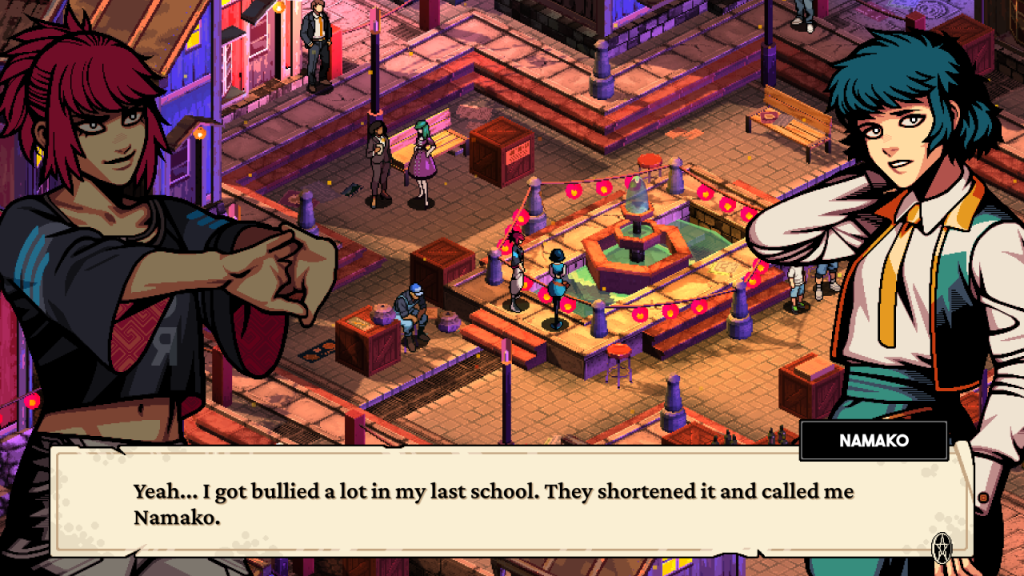 By the way, Namako also means sea slug, Source: Author
For those who haven’t played Demonschool, and even some that have, it might seem cruel to refer to someone by the nickname their tormentors used. But, it’s actually a show of respect in this context. Within the first ten minutes of Demonschool, Namako explicitly asks that protagonist Faye refer to her as Namako. Faye, in a moment that shows why she’ll become Namako’s first best friend, hears her budding friend’s backstory and asks if it’s a reclamation thing. Namako replies with “Actually yes! That’s exactly what I did. Your words have no power over me anymore, WILLIAM.” Corny? A little, yes, but also powerful. It’s moments like this that paint Namako, while sometimes a character that reads as a pushover, as arguably the person to take notes from when learning how to resist bullies without losing yourself.
Part of what makes Namako an interesting study is not just her unabashed acknowledgment of what’s happened to her, but also how she’s dealing with it. Regardless of how anyone feels about her method, she is steadfast in how she reclaims her agency. To Namako, it doesn’t matter who named her — what does matter is that it’s *her *name now. She is still partly what her bullies molded, but the change is under her control. The name is no longer spouted by abusers, but cherished by new friends of Namako’s choosing. It’s an intentional reorganization of the relationship with her immediate world that returns power to her. The name is like a constant assurance that she has the ability to change her surroundings without needlessly mutating herself.
It’s worth noting that being sure of her identity is core to Namako’s character in Demonschool. For instance, she holds a strong dislike of violence. It’s a trait that comes up even outside of childhood trauma stories. From the moment she arrives on the island, Namako frequently protests against the path of fisticuffs. While lack of ability could be a factor, since she admits to not knowing how to fight in the first battle, she consistently recommends the more non-violent alternative whenever Faye and the gang start scheming. However, the RPG avoids belittling this non-violent tendency by making Namako involved in defending herself. She participates in every battle she needs to or is asked to. Plus, given the rowdy crowd she hangs out with that include hotheads like demon-obsessed Faye and no-home-training Destin, it’s safe to assume she doesn’t mind if her pals pick a fight or two. In short, she’s not a pacifist, but has a clear preference toward talking things out and sees violence as a plan C. Namako’s firmness in that stance, paired with not only the numerous in-game situations that test her belief but also her high school background, further reveals her as character experienced in owning her identity.
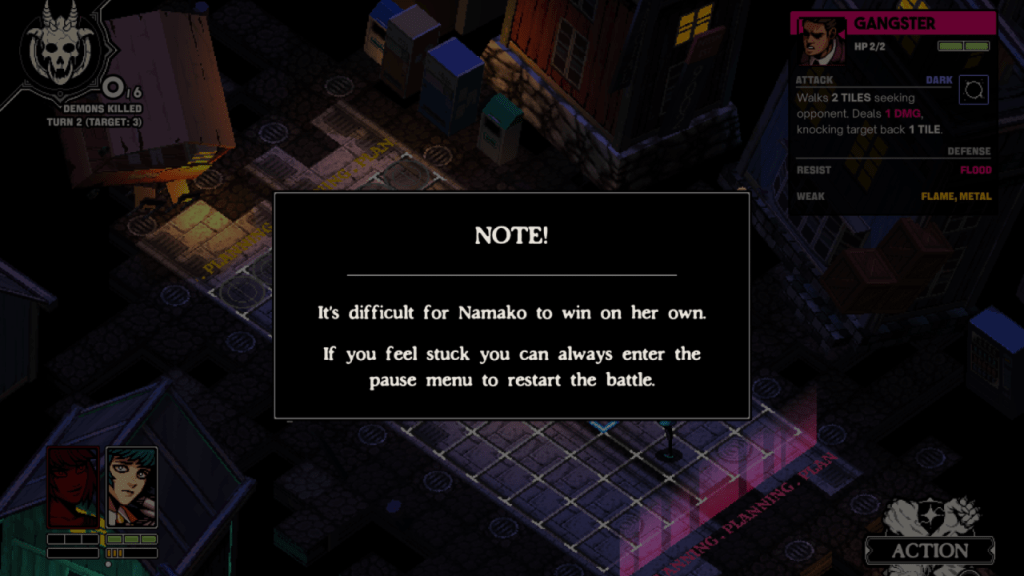 I love it when a game tells you to quit. Source: Author
Demonschool’s battles also help reinforce Namako’s nature to the player. When it comes time to beat down some gangsters or banish a ghost, Namako can rarely do direct damage. In fact, it’s so hard that the game practically tells you to consider restarting the battle if everyone but Namako dies. It’s not impossible to win in this scenario, as I finished a battle with just Namako right after the message appeared funnily enough, but future scraps validated the warning. With the exception of her special attack (which can bring a flood upon several enemies at once) and boss battles that allow her to do damage against the big bad specifically, she’s just not a natural damage dealer. A supermajority of Namako’s utility in battle is setting up enemies for a wicked punch from someone else.
To me, while these mechanics make for a nice moment of ludonarrative harmony, what really hammers Namako’s approach to reclamation as effective is not how the goth fights, but instead who fails to effectively hurt her. Like many RPGs with a large cast, each character in Demonschool has elements they’re strong or weak against in battle. In Namako’s case, she can resist attacks from enemies that do dark damage. And funnily enough, most of the gangsters in Demonschool — who frequently make their problems the club’s problems, try to beat the detective-like curiosity out of Faye and friends, and literally mutate other people on the island into all types of freaky shit — do dark attack damage. As such, whether it be due to clever design or amusing coincidence, this creates a situation where Namako is often the one best suited for taking on the game’s biggest bullies. She is more than useful for setting up team combos — depending on the enemy makeup, she can be the most resilient and reliable person on the battlefield.
Ultimately, everyone will have their own ways to reckon with bullies. The jerks and their victims are diverse. There’s no reason that the ways to deal with assholes would be any less varied. But, if anyone ever needs some pointers or a study guide for surviving bullies, consider hitting Namako up. She knows what she’s doing. She’s survived.
Thanks for reading this article. If you enjoy Exalclaw’s work, subscribe below so the next post comes directly to you for free! And consider leaving a tip to support the site’s work: https://ko-fi.com/exalclaw.