***Current conditions: *After a two-inch dusting over the weekend, Virginia is bracing for up to 8 inches of snow • The Bulahdelah bushfire in New South Wales that killed a firefighter on Sunday is flaring up again • The death toll from South and Southeast Asia’s recent floods has crossed 1,750.
THE TOP FIVE
1. Federal judge rules Trump’s executive order banning wind energy illegal
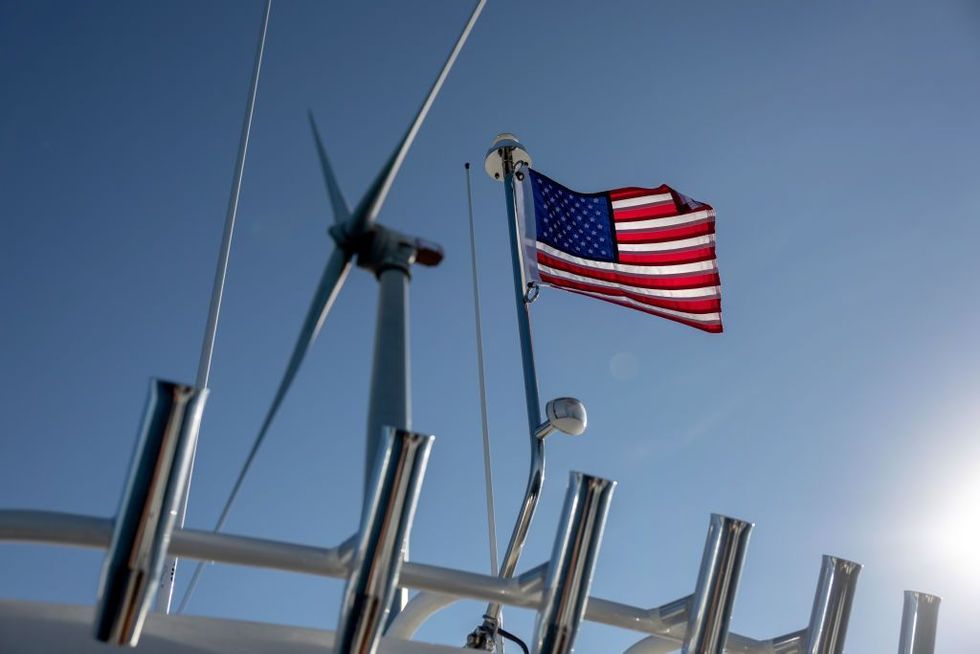 The Block Island Wind Farm, North America’s first offshore turbines.John Moore/Getty Images
President Donald Trump’s Day One executive order directing age…
***Current conditions: *After a two-inch dusting over the weekend, Virginia is bracing for up to 8 inches of snow • The Bulahdelah bushfire in New South Wales that killed a firefighter on Sunday is flaring up again • The death toll from South and Southeast Asia’s recent floods has crossed 1,750.
THE TOP FIVE
1. Federal judge rules Trump’s executive order banning wind energy illegal
The Block Island Wind Farm, North America’s first offshore turbines.John Moore/Getty Images
President Donald Trump’s Day One executive order directing agencies to stop approving permitting for wind energy projects is illegal, a federal judge ruled Monday evening. In a 47-page ruling against the president in the U.S. District Court for the District of Massachusetts, Judge Patti B. Saris found that the states led by New York who sued the White House had “produced ample evidence demonstrating that they face ongoing or imminent injuries due to the Wind Order,” including project delays that “reduce or defer tax revenue and returns on the State Plaintiffs’ investments in wind energy developments.” The judge vacated the order entirely.
Trump’s “total war on wind” may have shocked the industry with its fury, but the ruling is a sign that momentum may be shifting. Wind developers have gathered unusual allies. As I wrote here in October, big oil companies balked at Trump’s treatment of the wind industry, warning the precedents Republican leaders set would be used by Democrats against fossil fuels in the future. Just last week, as I reported here, the National Petroleum Council advised the Department of Energy to back a national permitting reform proposal that would strip the White House of the power to rescind already-granted licenses.
2. Energy Department puts up $134 million for refining rare earths
Back in October, I told you about how the head of the world’s biggest metal trading house warned that the West was getting the critical mineral problem wrong, focusing too much on mining and not enough on refining. Now the Energy Department is making $134 million available to projects that demonstrate commercially viable ways of recovering and refining rare earths from mining waste, old electronics, and other discarded materials, Utility Dive reported. “We have these resources here at home, but years of complacency ceded America’s mining and industrial base to other nations,” Secretary of Energy Chris Wright said in a statement.
If you read yesterday’s newsletter, you may recall that the move comes as the Trump administration signals its plans to take more equity stakes in mining companies, following on the quasi-nationalization spree started over the summer when the U.S. military became the largest shareholder in MP Materials, the country’s only active rare earths miner, in a move Heatmap’s Matthew Zeitlin noted made Biden-era officials jealous.
3. Google and NextEra partner on data centers
NextEra Energy is planning to develop data centers across the U.S. for Google-owner Alphabet as the utility giant pivots from its status as the nation’s biggest renewable power developer to the natural gas preferred by the Trump administration. The Florida-based company already had a deal to provide 2.5 gigawatts of clean energy capacity to Facebook-owner Meta Platforms, and also plans gas plants for oil giant Exxon Mobil Corp. and gas producer Comstock Resources. Still, NextEra’s stock dropped by more than 3% as investors questioned whether the company’s skills with solar and wind can be translated to gas. “They’ve been top-notch, best-in-class renewable developers,” Morningstar analyst Andy Bischof told Bloomberg. “Now investors have to get their head around whether that can translate to best-in-class gas developer.”
Sign up to receive Heatmap AM in your inbox every morning:
4. Another U.S. gas plant is getting carbon capture
In October, Google backed construction of the first U.S. commercial installation of a gas plant built from the ground up with carbon capture. The project, which Matthew wrote about here, had the trappings to work where other experiments in carbon capture failed. The location selected for the plant already had an ethanol facility with carbon capture, and access to wells to store the sequestered gas. Now the U.S. could have another plant. In a press release Monday, the industrial giant Babcock and Wilcox announced a deal with an unnamed company to supply carbon capture equipment to an existing U.S. power station. More details are due out in March 2026.
5. Fusion energy leaders meet with Energy Department
Executives from at least 14 fusion energy startups met with the Energy Department on Monday as the agency looks to spur construction of what could be the world’s first power plants to harness the reaction that powers the sun. The Trump administration has made fusion a priority, issuing a roadmap for commercialization and devoting a new office to the energy source, as I wrote in a breakdown of the agency’s internal reorganization last month. It is, as Heatmap’s Katie Brigham has written, “finally, possibly, almost time for fusion” as billions of dollars flow into startups promising to make the so-called energy source of tomorrow a reality in the near future. “It is now time to make an investment in resources to match the nation’s ambition,” the Fusion Industry Association, the trade group representing the nascent industry, wrote in a press release. “China and other strategic competitors are mobilizing billions to develop the technology and capture the fusion future. The United States has invested in fusion R&D for decades; now is the time to complete the final step to commercialize the technology.” Indeed, as I wrote last month, China has forged an alliance with roughly a dozen countries to work together on fusion, and it’s spending orders of magnitude more cash on the energy source than the U.S.
THE KICKER
Founded by a former Google worker, the startup Quilt set out to design chic-looking heat pumps sexy enough to serve as decor. Investors like the pitch. The company closed a $20 million Series B round on Monday, bringing its total fundraising to $64 million. “Our growth demonstrates that when you solve for comfort, design, and efficiency simultaneously, adoption accelerates,” Paul Lambert, chief executive and co-founder of Quilt, said in a statement. “This funding enables us to bring that experience to millions more North American homes.”