There are many purposes that spots and stripes serve in nature, but how they form has been more of a mystery to scientists. Now, researchers have advanced their breakthrough theory – and it could help us design materials that can respond to the environment and change color on demand.
University of Colorado Boulder (UC Boulder) researchers have closed the gap between math and biology, moving from a neat physics simulation of their animal-pattern theory to something that explains how those crisp yet imperfect designs actually arise in nature.
“Imperfections are everywhere in nature,” said lead researcher Ankur Gupta, from the Department of Chemical and Biological Engineering at CU Boulder. “We proposed a simple idea that can explain how cells assemble to create these variations.”
H…
There are many purposes that spots and stripes serve in nature, but how they form has been more of a mystery to scientists. Now, researchers have advanced their breakthrough theory – and it could help us design materials that can respond to the environment and change color on demand.
University of Colorado Boulder (UC Boulder) researchers have closed the gap between math and biology, moving from a neat physics simulation of their animal-pattern theory to something that explains how those crisp yet imperfect designs actually arise in nature.
“Imperfections are everywhere in nature,” said lead researcher Ankur Gupta, from the Department of Chemical and Biological Engineering at CU Boulder. “We proposed a simple idea that can explain how cells assemble to create these variations.”
How do animals form imperfect patterns
In 2023, the scientists developed a theory of how animal patterns form. This study was primarily a theoretical and computational breakthrough, using Alan Turing’s 1950s reaction–diffusion model – which mathematically explains how chemicals reacting and diffusing can create patterns – and adding a new physical process called diffusiophoresis, where particles or cells get “dragged” along by concentration gradients.
With diffusiophoresis, you get crisp edges (like those on tropical fish or snakes), not the fuzzy lines predicted by Turing’s equations alone. But the 2023 model was essentially a physics simulation – it didn’t deal with how real, living tissues or pigment cells behave or interact, or why natural patterns aren’t perfectly regular.
Fast-forward two years and the researchers have developed their model to better reflect real-world pattern formation. The original findings resulted in shapes that were a little too perfect, which is something you don’t see often throughout nature.
Improving their diffusiopherosis model, the researchers gave individual cells defined sizes and then modeled how each one moved through tissue. These simulations began creating the kind of imperfect patterns that better reflect the real world.
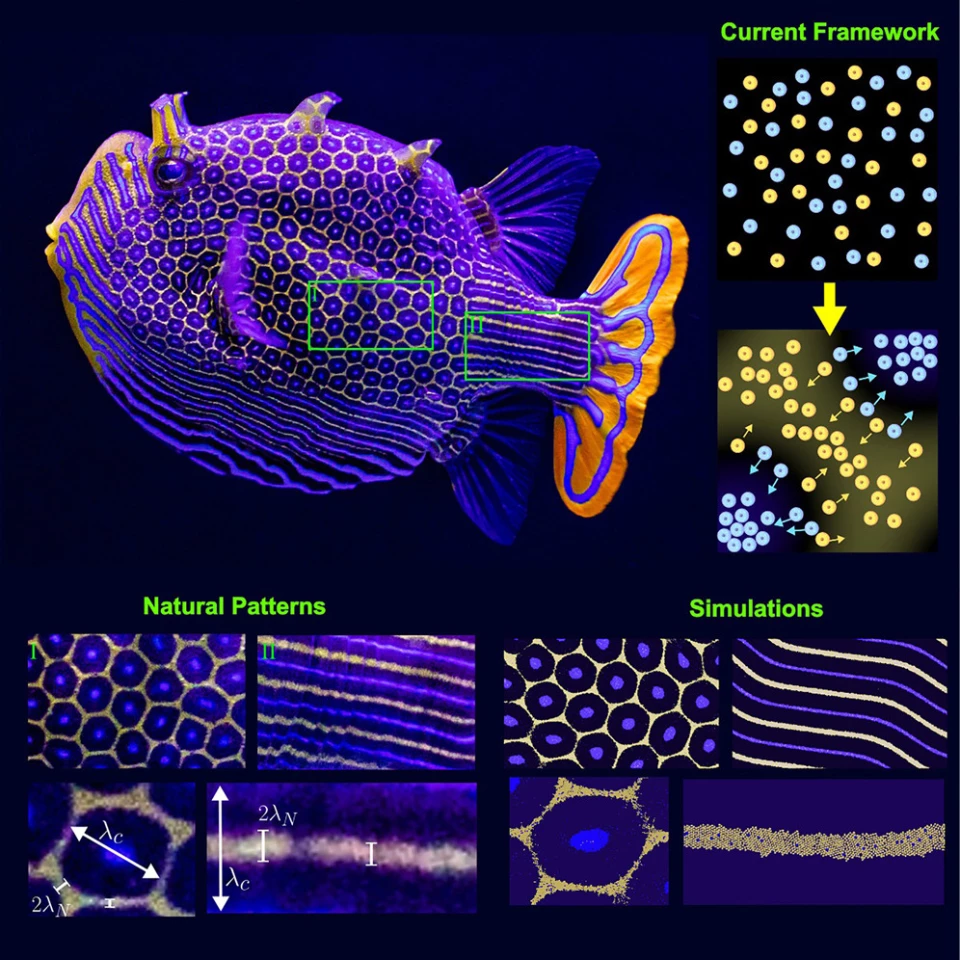
A male ornate boxfish (Aracana ornata), with its natural patterns and the new diffusiophoresis-enhanced reaction-diffusion simulation to recreate those markings
The Birch Aquarium/Scripps Institution of Oceanography and Benjamin Alessio/CU Boulder)
Essentially, the new work uses this physics-based model of diffusiopherosis and adds biological constraints. For example, pigment cells (like chromatophores seen in cephalopods) don’t stay still – they move, divide and respond to gradients. It also models irregular physiology, since real animal bodies aren’t flat sheets, and each curve and fold affects how chemical gradients form and how a uniform pattern can move into asymmetry. The combined physical processes – cellular diffusion, drift and motion – produce slight deviations, or the “beautiful imperfections” the researchers reference in their paper.
“We are able to capture these imperfections and textures simply by giving these cells a size,” Gupta said.
The latest computer simulations offer a new explanation for why nature’s patterns are both orderly and beautifully imperfect, and the findings could reshape how scientists think about biological patterning and even inspire future biomaterials and smart surface designs.
The researchers now hope to incorporate more complex interactions among cells and chemical agents to improve the simulations.
“We are drawing inspiration from the imperfect beauty of natural system and hope to harness these imperfections for new kinds of functionality in the future,” Gupta added.
The research was published in the journal Matter.
Source: University of Colorado Boulder