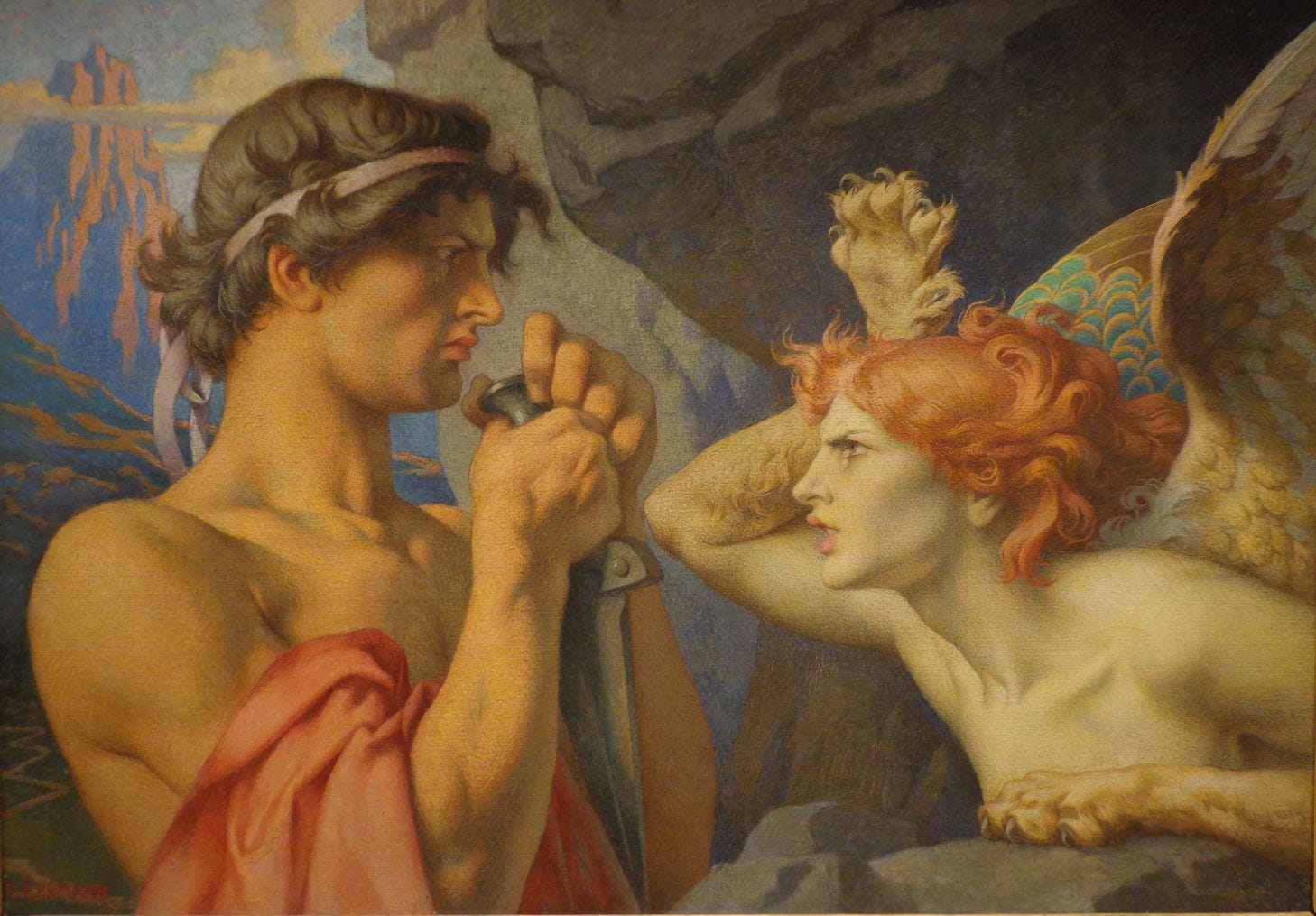
François-Émile Ehrmann (1833-1910), Oedipus and the Sphinx (1903)
The story of Oedipus refuses to die because it asks a question we can never fully answer: what happens when the truth you’ve been running from your entire life turns out to be the path you were always on? Freud made the tale famous for the wrong reasons, reducing a cosmic horror story to a theory about infant desire, but the real power of Sophocles’ work has nothing to do with sexual psychology and everything to do with the terror of self-knowledge. When we say someone has an “Oedipus complex” today, we’re usually talking about attachment issues or developmental phases. When Sophocles wrote Oedipus Rex around 429 BCE, he was writing about a man who becomes a detective investigating his own damnation, who solves the mystery of a plague ravaging his city only to discover he is the plague. That distinction matters enormously.
The original play landed in Athens like a theological bomb. Audiences watched a king renowned for his intelligence, a man who had saved Thebes once before by solving the Sphinx’s riddle, systematically destroy himself through the very qualities that made him great. Oedipus is relentless in his pursuit of truth. He will not be placated, will not let sleeping secrets lie, will not accept comfortable ignorance even when his wife Jocasta begs him to stop digging. The Athenians knew how the story would end before the play even started, yet Sophocles structured the revelation so that each new piece of information tightens the noose. A messenger arrives with what sounds like good news and delivers catastrophe instead. A shepherd tries to save Oedipus with silence and damns him with speech. The playwright understood something about dramatic irony that modern retellings often miss: the audience’s foreknowledge doesn’t diminish the horror but amplifies it, because we watch Oedipus march toward his fate while screaming warnings he cannot hear
Fresco depicting Oedipus killing his father Laius, Egyptian Museum of Cairo
.What makes the myth perpetually disturbing is not the incest or the patricide, though those elements retain their visceral punch. The real nightmare is that Oedipus did everything right according to the logic available to him and still ended up cursed. He heard a prophecy that he would kill his father and marry his mother, so he fled the only parents he knew to protect them. He killed a stranger at a crossroads in what appeared to be self-defense. He married a widowed queen after saving her city, a reasonable reward for heroism. Every choice he made was defensible, even admirable, and every choice fed directly into his destruction. When he finally understands what he has done, he doesn’t kill himself like Jocasta does. He takes her brooch pins and drives them into his own eyes, choosing a living death instead, choosing to see nothing after seeing too much. Thebes, meanwhile, collapses around him. The plague continues, the royal line is shattered, and his children carry pollution in their blood. The city’s salvation required the exposure of its savior as its contaminant. Sophocles gave us a world where knowledge is both the highest virtue and the instrument of absolute annihilation, and we’ve been trying to process that contradiction ever since.
Subverting the Classical
Oedipus and the Sphinx by Jean-Auguste-Dominique Ingres (1864)
Artists have always struggled with what to show and what to leave in shadow when depicting the Oedipus myth. Renaissance painters like Jean-Auguste-Dominique Ingres chose the moment of the Sphinx’s riddle, a scene of intellectual triumph that conveniently sidestepped the incest and violence entirely. Others, like the Baroque dramatists who revived Greek tragedy for European stages, found themselves drawn to Jocasta’s suicide, that instant when maternal love and wifely horror collide in a way that defies rational processing. The visual challenge was immense: how do you represent a man who has violated the most fundamental human taboos without making your audience look away in disgust rather than tragic recognition? Early modern artists solved this problem through displacement. They painted Oedipus at the crossroads, noble and threatened. They sculpted him confronting the Sphinx, heroic and contemplative. They showed him in exile, broken but dignified. What they rarely showed was the moment of discovery itself, that scene in Sophocles where all the careful misdirection falls away and the truth sits naked in the room. The myth’s power made it irresistible to artists, but its content made it nearly impossible to depict honestly.
The Romantics and Victorians found in Oedipus something that both horrified and fascinated them, a story that seemed to confirm their deepest anxieties about the family unit and the animal self lurking beneath civilized behavior. Writers like Shelley and later the French Symbolists saw in the myth a revolt against patriarchal authority that ended in self-destruction, a narrative arc that showed their own ambivalence about social revolution. Victorian England, obsessed with propriety and paralyzed by sexual repression, produced surprisingly lurid adaptations that dwelled on the pollution and contamination aspects of the story. These versions treated Oedipus less as a tragic figure and more as a walking embodiment of moral corruption, someone whose very presence could sicken a city. The myth became a vehicle for expressing what polite society couldn’t say directly: that desire doesn’t follow the rules we set for it, that family structures contain the seeds of their own violation, that the domestic sphere we’ve idealized might be sheltering unspeakable acts. Freud didn’t invent the sexualization of the Oedipus story. He simply named what a century of increasingly anxious retellings had been circling around.
Oedipus Rex by Sophocles. Photograph: Fimonoi Theater
Somewhere in the twentieth century, Oedipus stopped being a victim of fate and became a perpetrator we could judge. Modern adaptations often strip away the prophecy entirely or treat it as a flimsy excuse for actions the protagonist secretly wanted to commit all along. Film versions have portrayed him as arrogant, as willfully blind, as someone whose intelligence was always a cover for moral bankruptcy. When Oedipus becomes simply a criminal or a madman, the myth loses its philosophical teeth. It becomes a story about individual pathology rather than cosmic injustice, about personal failure rather than the impossible position of being human in a world where the gods play dice with our lives. These modern versions offer us the comfort of moral clarity: Oedipus is guilty, we are not, the universe makes sense. Sophocles offered no such comfort. He gave us a protagonist who did everything we would do in his position and was destroyed anyway, not because he was wicked but because he existed at all.
Freud and Beyond
Sigmund Freud, 1921.
Freud’s Oedipus complex has become so embedded in popular culture that most people forget what he actually claimed. He didn’t argue that children literally want to sleep with their parents. He proposed that between ages three and six, children experience their first surge of sexual feelings and, lacking any other framework, temporarily direct those feelings toward their primary caregivers while viewing the same-sex parent as a rival. The drama resolves itself naturally as the child identifies with the same-sex parent and redirects desire outward. That’s the theory, simplified but essentially intact. What artists seized upon wasn’t this developmental stage but the darker implication underneath: that our earliest loves are incestuous, that civilization is built on the repression of these drives, and that every family contains a potential tragedy waiting to activate. Freud gave twentieth-century art permission to treat the family not as a safe haven but as a psychological minefield. Suddenly painters like Egon Schiele could depict twisted, eroticized family portraits and claim they were simply revealing what psychoanalysis had proven was already there. Playwrights like Eugene O’Neill could write “Desire Under the Elms” and “Mourning Becomes Electra,” translating Greek fate into American Freudian pathology, making the unspeakable speakable by wrapping it in the legitimizing language of science.
Jung rejected Freud’s sexual emphasis but offered something potentially more disturbing: the idea that the Oedipus story represents a universal pattern embedded in the collective unconscious, a necessary psychological murder of the old king so the new one can emerge. In Jungian terms, Oedipus isn’t about literal incest but about the hero’s terrifying discovery that the enemy he must defeat to achieve selfhood is his own origin. Lacan took this further into linguistic and symbolic territory, arguing that the myth illustrates our entry into language and law, the moment when the child must abandon the imaginary fusion with the mother and accept the symbolic order of the father. These frameworks sound abstract until you see how artists have deployed them. Filmmaker Pier Paolo Pasolini’s “Oedipus Rex” isn’t about Greek tragedy at all but about his own relationship with his mother and his search for a father figure in fascist Italy. Painter Francis Bacon’s screaming popes and distorted bodies channel Oedipal rage without depicting the myth directly, using psychoanalytic concepts as permission to show human figures destroying themselves from the inside out. The myth became a skeleton key that unlocked permission to explore any dark family secret, any buried trauma, any rage at the people who made us.
Jung in about 1935
Contemporary artists have pushed these psychological readings into territory that makes even Freud look restrained. Installation artist Louise Bourgeois created entire rooms exploring maternal engulfment and paternal absence, massive spider sculptures that literalize the devouring mother Freud only hinted at. Playwrights like Sarah Kane wrote works where familial violence and sexual abuse sit right on the surface, no Greek drapery to soften the impact, claiming the Oedipal tradition as justification for showing what therapy culture now tells us to process and name. The myth has become a cultural permission slip for excavating the worst possibilities of family life: the parent who damages through love, the child who carries rage they can’t articulate, the secrets that everyone knows but nobody speaks. Modern therapy tells us to heal these wounds through talking, through exposure, through integration. Modern art influenced by Oedipal psychology seems less interested in healing than in demonstrating that some wounds don’t close, that the family remains the site of our most primal and unresolvable conflicts, and that knowing the source of the damage doesn’t necessarily diminish its power. We’ve moved from Greek fate to Freudian drives to contemporary trauma theory, but the artistic conclusion remains remarkably consistent: the family that creates us also contains the mechanism of our undoing, and we spend our lives either fleeing that truth or crashing directly into it.
Good writing about difficult subjects shouldn’t be locked away. If this exploration of prophecy, fate, and the myths we can’t escape added something to your understanding, consider helping us keep this work freely available. Supporting independent writing means supporting the idea that complex ideas belong to everyone, not just those behind paywalls.