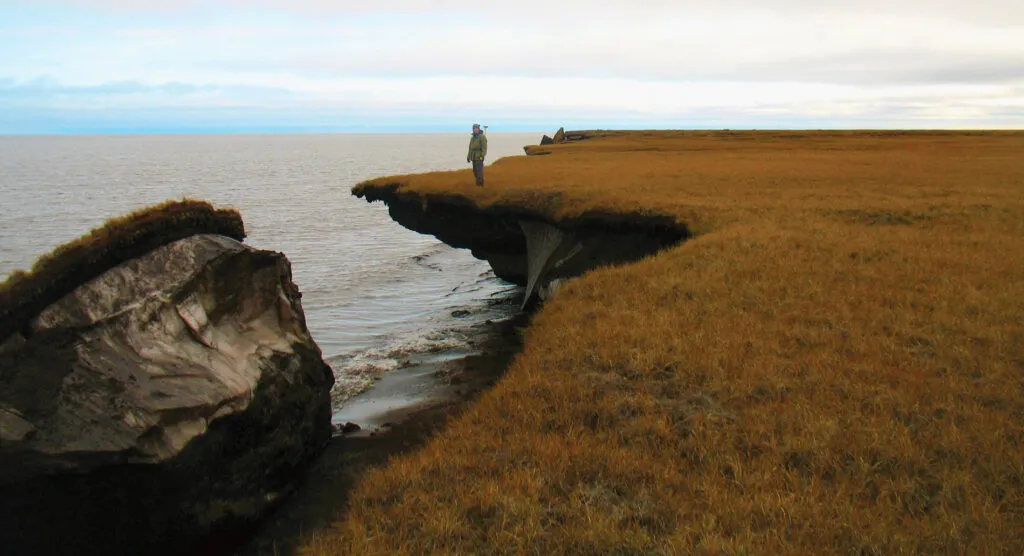
 US Geological Survey (USGS) researcher Benjamin Jones examines a collapsed block of ice-rich permafrost on Barter Island along Alaska’s Arctic coast. Photo courtesy of USGS / Christopher Arp, public domain image.
Solar power. The history of a magazine. The impact of DOGE cuts on medical research. Russian trolls. Cyberstorms. Newly found research results from Fukushima. The possibility of annexing Greenland. Autocracy and academia. Civilization itself.
What’s the common thread between them?
Each subject appeared in the bi-monthly magazine of the Bulletin of the Atomic Scientists this year, and each made the short-list of best magazine articles of 2025—whether “best” is define…
US Geological Survey (USGS) researcher Benjamin Jones examines a collapsed block of ice-rich permafrost on Barter Island along Alaska’s Arctic coast. Photo courtesy of USGS / Christopher Arp, public domain image.
Solar power. The history of a magazine. The impact of DOGE cuts on medical research. Russian trolls. Cyberstorms. Newly found research results from Fukushima. The possibility of annexing Greenland. Autocracy and academia. Civilization itself.
What’s the common thread between them?
Each subject appeared in the bi-monthly magazine of the Bulletin of the Atomic Scientists this year, and each made the short-list of best magazine articles of 2025—whether “best” is defined as the most popular, most in-depth, most off-the-beaten trail, or just plain most interesting.
At least two articles were picked from each issue, covering the broad subject areas of nuclear weapons & energy, climate change, biosecurity, and disruptive technologies.
So non-subscribing readers can see why these pieces were chosen, we’ve made the articles below completely free, in their entirety, for the next few weeks.
Of course, if you want to read the rest of the year’s premium content—and be sure of never missing out in the future—you can subscribe to the bi-monthly magazine for less than $5 per month.
The recent past and foreseeable future of the Bulletin of the Atomic Scientists: a conversation
By John Mecklin
Not many magazines manage to survive long enough to celebrate their 80th birthday—especially these days, when so much has changed. After all, when this publication was started, there was no interstate highway system, television was largely a curiosity confined to the basements of backyard tinkerers, and what was to become Silicon Valley was best-known as the site of the world’s largest collection of fruit canneries. So, what’s the magazine’s secret? A look behind the scenes.
The brightest light at the end of the tunnel
By Bill McKibben
For nearly as long as the Bulletin has been warning about the dangers of nuclear weapons, it has been championing solar power and other forms of renewable energy sources for the sake of the planet. In 1951, just six years after its founding, the magazine published an article about the possibilities of solar power; in 1970 it published its first feature article on climate change. If humanity survives the next 100 years, it will likely be due to the solar revolution—a source of optimism in dark times for fighting climate change.
By Dan Drollette Jr.
How seriously should the world take the Trump administration’s threats to annex the lands of other countries “one way or another?” In this interview, Daniel Immerwahr, author of How to Hide an Empire, says that while a land grab may seem an arbitrary and fanciful notion, it reflects a deeper and darker desire: the dismantling of the post-war international order and its norms.
Autocracy and the university in America today
By Leon Botstein
From its immigration and deportation policies to its highly publicized assault on several of America’s leading universities, the Trump administration seems determined to upend decades of close cooperation between the US federal government and higher education. The president of Bard College examines what this could mean for the future of scientific research, educational standards, democracy, and the United States—and calls for a renewed and reformed university and college system after the end of the Trump era.
Six ways AI could cause the next big war, and why it probably won’t
By Zachary Burdette, Karl Mueller, Jim Mitre, and Lily Hoak
The likelihood of tools powered by artificial intelligence directly triggering a major war appears limited. But there are specific pathways that could increase the risk of conflict. Technological breakthroughs will inevitably lead to destabilizing shifts in the balance of power, and AI could distort human strategic judgment in ways that fuel misperceptions and miscalculations.
Cyberstorm on the horizon: David E. Sanger on what two recent breaches reveal about modern warfare
By Sara Goudarzi
In 2023 and 2024, there were two cyber espionage operations against the United States that were traced back to Chinese groups. “Volt Typhoon” focused on shutting down critical American infrastructure—presumably in the wake of a Chinese invasion of Taiwan. The other, “Salt Typhoon,” was an extremely sophisticated operation that used the country’s telecommunications networks to spy on Americans. David E. Sanger, chief Washington correspondent for The New York Times, who has reported extensively on the topic, describes how cyber operations factor into the geopolitical landscape and future wars. And on how the US can best prepare for similar breaches on the horizon.
By Dan Drollette Jr.
The National Institutes of Health, or NIH, faces cuts of 35 percent, requested by billionaire Elon Musk’s so-called Department of Government Efficiency (DOGE). Consequently, researchers have had to struggle with getting reimbursed for routine expenses such as lab mice—especially after DOGE put a one-dollar spending limit on the use of government credit cards. Years of work are being put at risk, says former NIH director Monica Bertagnolli. In this interview, she explains what the cuts mean, for science and the public.
Interview: The ‘holy grail’ of pandemic preparedness—the search for a universal vaccine
By Matt Field
Scientists have been pursuing a universal vaccine against influenza for decades, both to protect against seasonal influenza and potential flu pandemics. Whereas seasonal flu vaccines target a constantly shape-shifting protein on influenza viruses and therefore must be updated each year to match currently circulating strains, a universal vaccine might target an unchanging part of the virus. Government investment has been crucial in this area of pandemic preparedness research but may be uncertain going forward, given an anti-vaccine bent to the new presidential administration.
Amplifying doubt: How Russian trolls leveraged pandemic uncertainty for strategic gain
By Maksim Markelov
Russian state-sponsored trolls seized on the moment of uncertainty posed by COVID-19—not to promote any coherent counter-narrative, but to make coherence itself elusive. Their strategy was not to persuade but to confuse, amplifying deep-seated anxieties and contradictions, and fostering ideological polarization. By strategically amplifying both vaccine skepticism and criticism of government failure and so-called overreach, this operation did not merely seek to instill doubt in a particular version of reality. Rather, it aimed to erode faith in the very possibility of a shared reality altogether. This deliberate amplification of uncertainties carries consequences that extend far beyond COVID-19.
Is scientific reticence hindering climate understanding?
By David Spratt
The bulk of climate research has tended to underplay worst-case scenarios, preferring cautious projections and scholarly reticence. This reticence is clearly displayed in the work of the IPCC, which consistently errs on the side of “least drama,” and downplays the more extreme possibilities. Increasing numbers of scientists have spoken out on the dangers of such an approach.
“Fragile, impermanent things”: Joseph Tainter on what makes civilizations fall
By Jessica McKenzie
Do civilizations have tipping points that determine their rise and fall? “Once a complex society enters the stage of declining marginal returns, collapse becomes a mathematical likelihood, requiring little more than sufficient passage of time to make probable an insurmountable calamity,” says Joseph Tainter, the author of a seminal book on the topic. But collapse is not an absolute, he says —just that there’s “an enormous job to do” to counter it.
How Fukushima’s radioactive fallout in Tokyo was concealed from the public
By François Diaz-Maurin
When a Japanese radiochemist found very high concentrations of radioactive cesium microparticles in air samples from Tokyo, he worried immediately about public safety. But his research was kept from publication for years.
By Rodney C. Ewing, Bernd Grambow
Despite more than 50 years of research on the safety of geological disposal of radioactive waste, the research community has not achieved a clear understanding of repository safety. Scientists and repository experts need to increase their understanding of the overall system’s safety, especially the importance of redundancy in the multi-barrier concept of geological disposal to assure the isolation of radioactive waste from the environment over a very long time.