An imminent Indian ballistic missile test highlights escalation risks in the Indian OceanExpert commentjon.wallace
A possible test of India’s K4 submarine-launched missile, and the presence of Chinese research ships, highlights how deterrence dynamics among nuclear-armed states are making the wider Indian Ocean region more dangerous.
An imminent Indian ballistic missile test highlights escalation risks in the Indian OceanExpert commentjon.wallace
A possible test of India’s K4 submarine-launched missile, and the presence of Chinese research ships, highlights how deterrence dynamics among nuclear-armed states are making the wider Indian Ocean region more dangerous.
</div>
In early December, India issued four Notices to Airmen (NOTAMs) warning of a long-range missile test it would conduct over the Indian Ocean.
The first indicated a 3,500-kilometer danger zone. The second notice revised that range to 1,000 kilometres and delayed the test window to 11 December. The third re-extended the zone to 3,550 kilometres and rescheduled the test again for 17–20 December. A fourth moved the test to 22–24 December.
NOTAMS of this kind can indicate a test of a submarine-launched ballistic missile (SLBM). This could therefore be a test of India’s K4 SLBM, which is nuclear-capable and has a range of 3,500 kilometres.
At the same time, China has deployed a number of research vessels across the northern, central and eastern Indian Ocean. These ships are thought to be equipped with sensors capable of tracking missile launches and supporting operations. There is now speculation that the repeated cancelations may be a response to the increased presence of Chinese vessels, raising the spectre of an India–China stand-off.
India–China friction in the Indian Ocean is not new. But the alignment of India’s high-profile strategic missile testing and China’s expanded maritime presence marks a clear uptick in interactions between nuclear powers in the region. The immediate question is how to interpret these developments and what they mean for regional and global security.
There is a legitimate concern that China is becoming increasingly assertive as it expands its security footprint across the Indian Ocean.
But policymakers’ fixation on competition with China overlooks the growing risks of nuclear escalation across the wider Indian Ocean region, by numerous players: developments which raise the risk of miscalculation, misperception, and unintended escalation.
China’s presence is a risk amplifier, but not the leading threat
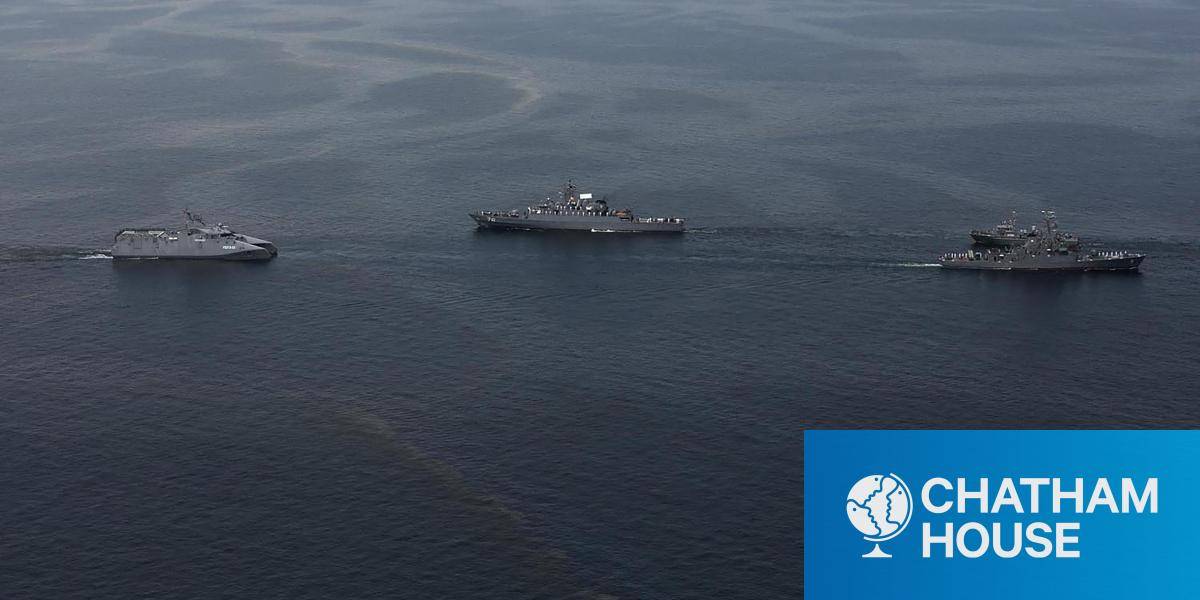
China is now an undeniable player in the Indian Ocean. As of 2020, China has become the largest trading partner in the Indian Ocean region and regularly conducts naval deployments and exercises. For example, in March China conducted a trilateral naval exercise with Iran and Russia called ‘Maritime Security Belt’.
These activities are often interpreted as evidence of a coherent Chinese strategy to militarize the region. However, closer examination of Chinese policy thinking suggests something else: China does not have an Indian Ocean strategy.
Today Chinese activity in the Indian Ocean is fragmented and decentralized. In this theatre state-owned enterprises, provincial governments, financial institutions, and the PLA Navy often pursue projects independently. These entities are often responding to incentives within China’s domestic political economy rather than as part of a top-down coordinated, coherent security strategy.
This disorganization does not mean China is a benign actor. But increasing activity fuels anxiety, particularly among China’s strategic competitors in the Indian Ocean region. Research vessels, port developments, and logistics arrangements have the potential to occupy a grey zone between commercial and military activity.
And even when there is no concrete evidence of Chinese military basing, Chinese loans and grants to regional countries can feature non-transparent loan terms, collateralized infrastructure, and long-term lease agreements that create suspicion. The tension between China’s economic rationale and these external perceptions of its security strategy has become the defining dynamic of Beijing’s engagements in the Indian Ocean.
Overall, China’s position in the region is hardening in response to perceived threats from its rivals. But a tendency by some policymakers to conflate Chinese economic projects with covert military operations risks unnecessary escalation and deepening mistrust.
A crowded ocean
Such risks are not confined to India and China. During 2025, Iran threatened to strike a joint US–UK military base in the Chagos Archipelago, China conducted live-fire drills off the coast of Australia, and the US interdicted a ship carrying military-related goods from China to Iran.
Meanwhile France maintains a permanent military presence throughout its Indian Ocean territories, while Russia periodically transits nuclear-capable submarines through the region. The result is a maritime theatre where regional conflicts, great power rivalries, and nuclear deterrence increasingly intersect.
As more nuclear armed states engage in the same body of water, the signals sent by their movements and activities become increasingly dangerous.
Risk reduction
Reducing escalation risks in the Indian Ocean does not require resolving regional rivalries. But the significant risks must be managed more responsibly. Countries operating in the Indian Ocean should prioritize improving crisis communication channels to manage maritime incidents.
Updating…frameworks to account for dual-use platforms or grey zone incidents could help reduce the likelihood of escalation.
</div>
Such crisis management must be adapted to the realities of maritime conflict. Escalation at sea often unfolds rapidly and without clear attribution. Existing political and military hotlines should therefore clarify processes for ambiguous naval encounters, anti-submarine operations, or missile tests conducted far from national coastlines. For example, navy-to-navy communication channels (at the working level) could provide a means to signal intent and de-escalate incidents prior to a crisis.