Oman, eastern Yemen, and the fragile geometry of neutrality
chathamhouse.org·5d
Preview
Report Post

Oman, eastern Yemen, and the fragile geometry of neutrality Expert comment sfarrell.drupa…

Yemen’s neighbour has learned the painful lesson that neutrality in the conflict next door offers no immunity, only the hope of containment.
Oman, eastern Yemen, and the fragile geometry of neutrality Expert comment sfarrell.drupa…

Yemen’s neighbour has learned the painful lesson that neutrality in the conflict next door offers no immunity, only the hope of containment.

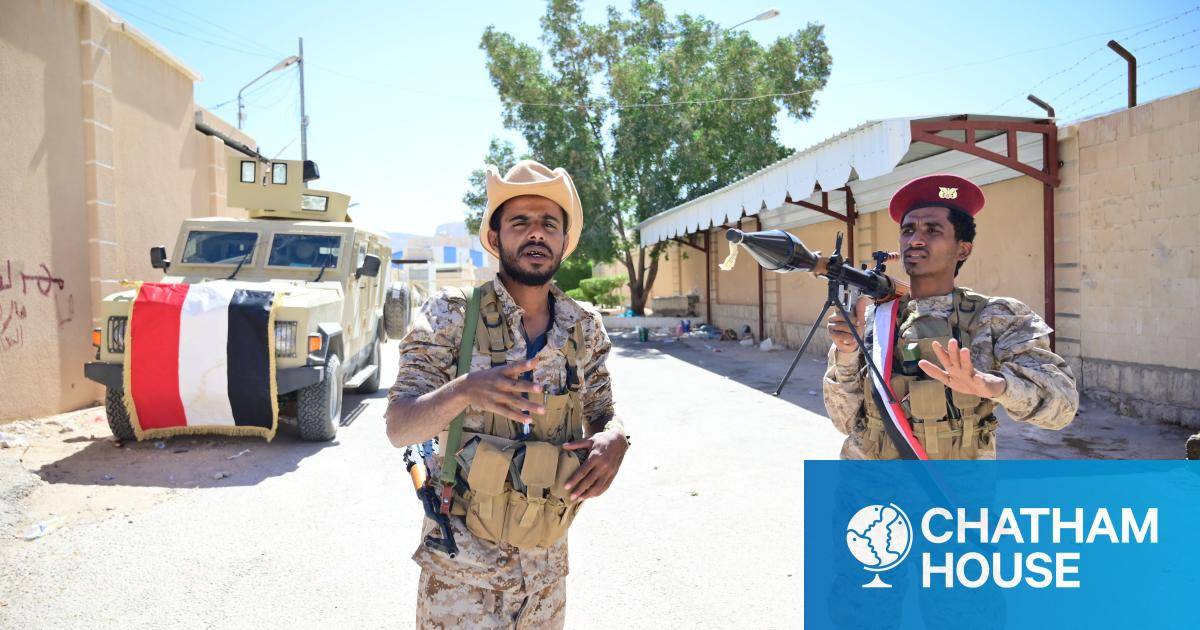
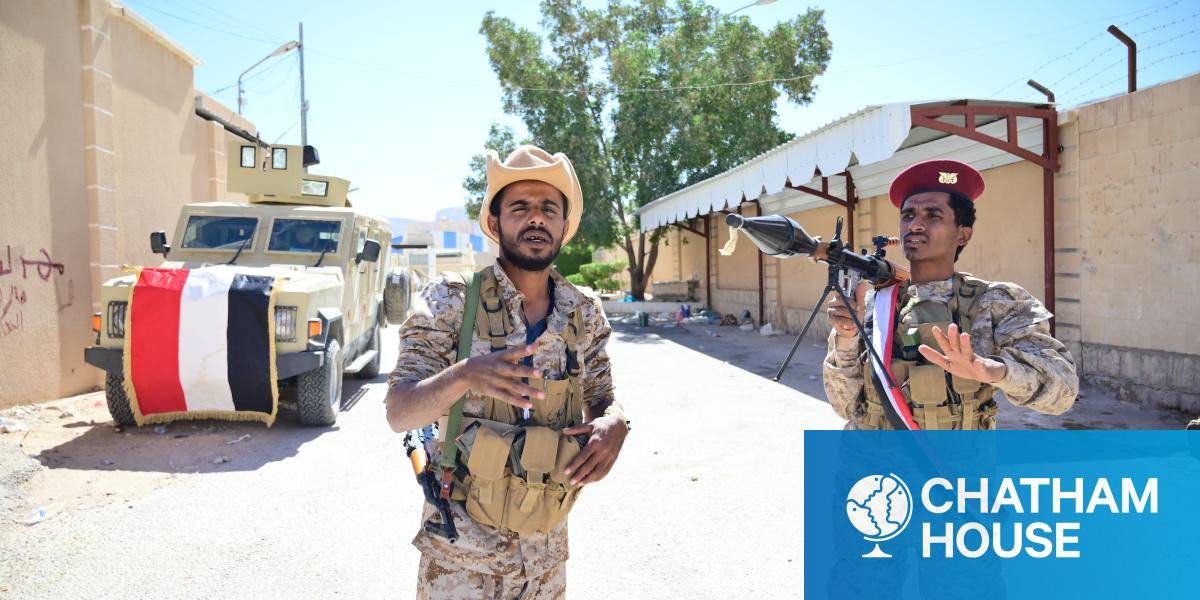
Two members of Yemen's Pro-government Homeland Shield forces, one posing with an RPG
        </div>

In the closing days of 2025 Yemen experienced another dramatic reversal in its already convoluted war. After a decade of joint military intervention, Saudi Arabia and the United Arab Emirates found themselves on opposing sides of a conflict they had once waged together.

The rupture was triggered when the UAE-backed Southern Transitional Council (STC) launched a sweeping campaign to seize control of eastern Yemen, capturing the vast governorates of Hadhramaut and Al-Mahra, which together account for more than half of Yemen’s landmass.

 Alarmed by the implications of a secessionist authority consolidating along its southern border, Saudi Arabia moved decisively.

  </div>

The STC’s advance was short-lived. Alarmed by the implications of a secessionist authority consolidating along its southern border, Saudi Arabia moved decisively. Riyadh pressed the internationally recognized Yemeni government to expel the UAE from the coalition, conducted air strikes on UAE military assets inside Yemen, and provided direct military support to operations that ultimately expelled STC forces from both governorates.

The episode marked a humiliating turn for Saudi Arabia more than a decade into Yemen’s devastating civil war. That conflict began in 2014 when Iran-backed Houthi rebels ousted President Abdrabbuh Mansur Hadi from the capital, Sanaa. The following year a Saudi and UAE-led coalition launched Operation Decisive Storm, aimed at retaliating against the Houthis and restoring Hadi’s government.

The Saudis now find themselves accused not only of presiding over one of the world’s worst humanitarian disasters, but also of confronting a former ally on the very battlefield they helped to create.

Yet limiting the extent of their humiliation was not Riyadh’s only concern. The emergence of a secessionist authority along its 700-kilometre southern border – particularly in Hadhramaut, with which it has deep tribal, economic, and security ties – constituted a strategic shock.

        <img loading="lazy" srcset="https://www.chathamhouse.org/sites/default/files/styles/uncropped_tiny/public/2026-01/2025-01-06-yemen-hadhramaut-almahra-oman-map.jpg?itok=qY8mGUuE 400w, https://www.chathamhouse.org/sites/default/files/styles/uncropped_small/public/2026-01/2025-01-06-yemen-hadhramaut-almahra-oman-map.jpg?itok=ipgiQGlu 750w, https://www.chathamhouse.org/sites/default/files/styles/uncropped_medium/public/2026-01/2025-01-06-yemen-hadhramaut-almahra-oman-map.jpg?itok=RHf9-1J9 1000w, https://www.chathamhouse.org/sites/default/files/styles/uncropped_large/public/2026-01/2025-01-06-yemen-hadhramaut-almahra-oman-map.jpg?itok=H_tToBjp 1300w, https://www.chathamhouse.org/sites/default/files/styles/uncropped_huge/public/2026-01/2025-01-06-yemen-hadhramaut-almahra-oman-map.jpg?itok=0p2FFPTr 1600w" sizes="100vw" width="3215" height="270" src="https://www.chathamhouse.org/sites/default/files/styles/uncropped_tiny/public/2026-01/2025-01-06-yemen-hadhramaut-almahra-oman-map.jpg?itok=qY8mGUuE" alt="A map showing Yemen in the region.">

Oman’s alarm

No country, however, was more immediately unsettled than Oman.

The STC’s seizure of Al-Mahra, Yemen’s easternmost governorate which shares a 300-kilometre border with Oman, represented Muscat’s most acute external national security threat in decades.

For the normally quiet and stable sultanate, the appearance of the flag of the former People’s Democratic Republic of Yemen on its doorstep reopened deep historical anxieties. Independent South Yemen once fuelled the Dhofar insurgency that plunged Oman into nearly a decade of war during the 1970s.

The development also created the perception in Oman that it was now encircled 

  </div>

The development also created the perception in Oman that it was now encircled – by the UAE itself in the north and, via UAE proxies in Yemen, from the west.

A neighbouring, but not intimate, country, the UAE has been a source of concern for Oman for decades. These were compounded by mounting fears of potential refugee flows from eastern Yemen, the disruption of delicate mediation channels with Iran and the Houthis, and the erosion of Muscat’s carefully cultivated regional neutrality.

Most unsettling of all, the crisis cast doubt on Saudi Arabia’s long-standing assurances that it would not alter the strategic balance along Oman’s borders.

For days, until Riyadh moved forcefully against the STC and politically against Abu Dhabi, Saudi-Omani relations entered an unusually tense and uncertain phase. In fact, for the first week Omani officials wondered if this was a plot that was  actually coordinated between UAE & Saudi Arabia.

Security - and reward - in neutrality

Oman’s reaction must be understood within the context of its distinctive posture in the Yemen war. When the Saudi-UAE led coalition launched its intervention in March 2015, Oman was the only GCC state that refused to join the military alliance. Instead, it positioned itself as a neutral intermediary, hosting senior Houthi officials and becoming a central channel for negotiations, prisoner exchanges, and de-escalation efforts.

Furthermore, when Yemeni borders and airports were shut down by the coalition, Oman opened its borders as transit hubs for hundreds of thousands of Yemenis who transited through the country to, and out of, Yemen.

Oman has become indispensable to nearly every actor in the conflict

  </div>

This approach paid dividends. Over the past decade, Oman has become indispensable to nearly every actor in the conflict – from Saudi Arabia and Iran to the United States, the Houthis, the United Nations, and the ICRC. Most recently, Muscat helped broker the truce between Washington and the Houthis that paused Houthi attacks on Red Sea shipping before US President Trump made a historic visit to Riyadh in early 2025.

Oman’s perceived neutrality was neither accidental nor purely altruistic. It reflected a deep historical understanding of Yemen’s resistance to external coercion, the limits of military force, and Muscat’s own complex relationship with Tehran, Riyadh, and Abu Dhabi. Unlike the UAE, Oman and Saudi Arabia also share a preference – however strained – for the preservation of a single Yemeni state, not least because neither possesses a legally binding border agreement with a future independent South Yemen.

Similar Posts

Loading similar posts...

Keyboard Shortcuts

Navigation
Next / previous item
j/k
Open post
oorEnter
Preview post
v
Post Actions
Love post
a
Like post
l
Dislike post
d
Undo reaction
u
Recommendations
Add interest / feed
Enter
Not interested
x
Go to
Home
gh
Interests
gi
Feeds
gf
Likes
gl
History
gy
Changelog
gc
Settings
gs
Browse
gb
Search
/
General
Show this help
?
Submit feedback
!
Close modal / unfocus
Esc

Press ? anytime to show this help