President Trump’s ambition to rebuild Venezuela’s oil sector will be challenging, especially if prices continue to fall
chathamhouse.org·4d
Preview
Report Post

President Trump’s ambition to rebuild Venezuela’s oil sector will be challenging, especially if prices continue to fall Expert comment jon.wallace

Robust long-term oil demand is needed to justify significant investment, but is called into question by the growing popularity of electric vehicles.

President Trump’s ambition to rebuild Venezuela’s oil sector will be challenging, especially if prices continue to fall Expert comment jon.wallace

Robust long-term oil demand is needed to justify significant investment, but is called into question by the growing popularity of electric vehicles.

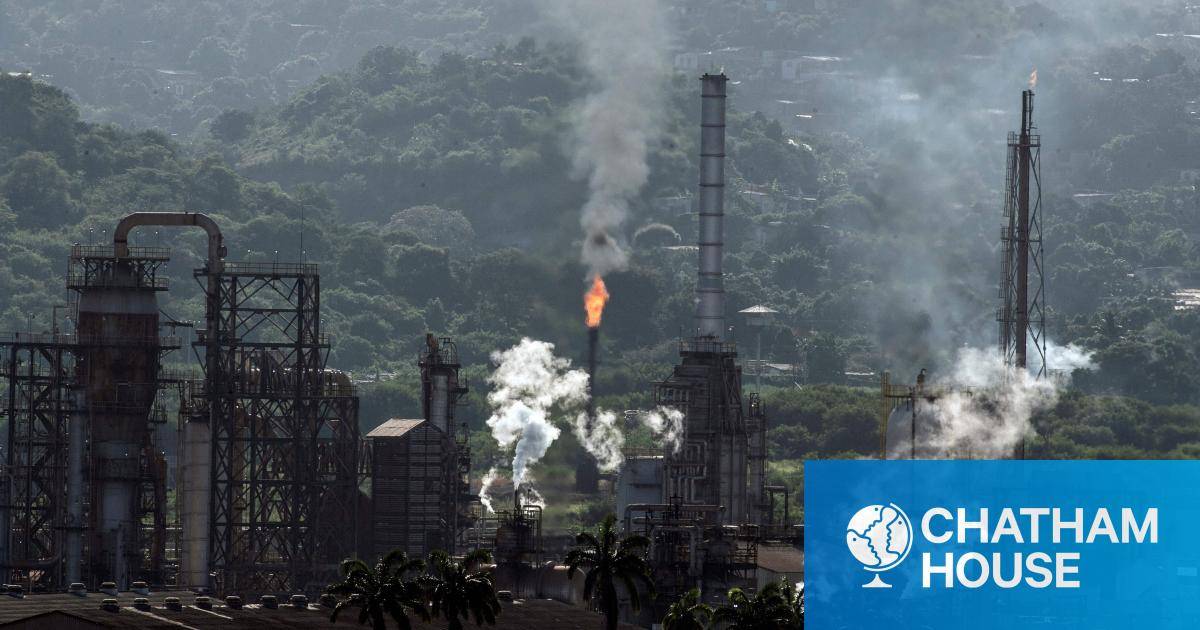
View of an oil refining plant of state-owned Petroleos de Venezuela, with smoking chimney
        </div>

In a press conference following the US attacks on Venezuela, and the capture of President Nicolás Maduro, US President Donald Trump announced that American oil and gas companies would invest in the Venezuelan oil sector and extract the ‘tremendous amount of wealth’ in the ground. 

For the world’s leading military power to assert the right to develop the resources of another sovereign nation is extraordinary: a further step away from an international system based on rules and norms, towards one in which might makes right. But the American president sees economic opportunity. 

Venezuela is estimated to hold the world’s largest proven reserves of crude oil (19.4 per cent in 2024). But it is currently a minor producer, pumping 960,000 barrels of oil per day (b/d) in 2024 – around 1 per cent of global production – down from 3.3 million b/d in 2006. President Trump hopes to get Venezuelan oil flowing again. But this will not come cheap.

Venezuela’s oil production infrastructure is in a state of severe disrepair after years of underinvestment, corruption and sanctions. Tripling Venezuelan production by 2040, from 1 million to 3 million barrels of oil a day (b/d), would cost an estimated $183 billion, according to Rystad Energy

Falling oil prices

The economics of Venezuelan oil are challenging. Extracting the viscous, sticky crude that constitutes most of the country’s reserves requires special processes, such as steam injection. And transporting through pipelines requires the addition of diluents to ease flow. This makes it more expensive to produce than lighter crudes, such as those originating in Saudi Arabia. 

Heavy crudes also tend to sell at a discount, due to the complex refining techniques needed to convert them into consumer products such as petroleum and diesel. 
Nevertheless, given the scale of Venezuela’s oil reserves, this could be justified in a seller’s market: after all, the world consumed around 104 million b/d in 2025. The problem is that price trajectories increasingly point in the other direction, as supply outpaces demand. 

Since the highs of mid-2022, following the post-lockdown surge and the spike brought about by Russia’s illegal invasion of Ukraine, the price of Brent has been in gradual decline. Geopolitical shocks have caused violent swings, but there is a clear downward trajectory. 

American oil and gas companies have prioritized shareholder returns over upstream investment. Low oil prices will not encourage them to change course.

  </div>

This was acknowledged, coincidentally, in the 5 January bulletin of the US Energy Information Administration, with the headline: ‘Crude oil prices fell in 2025 amid oversupply’. 

Since the shale gas revolution of the 2010s, American oil and gas companies have prioritized shareholder returns over upstream investment. Low oil prices will not encourage them to change course.

What is driving falling oil prices? Weak global economic growth is one reason. But this is not the only factor. While the imperative to reduce planet-warming emissions has slipped down the global policy agenda, low-carbon technologies, like solar panels and electric vehicles, have been progressively eating into fossil fuel demand, slowing oil and gas demand growth. 

This can be seen in Europe, where wind, solar and batteries are gradually eroding the need for gas to generate electricity. And in China, the ongoing boom in electric vehicles – not just cars, but buses and trucks too – is reducing the need for oil in the world’s second largest oil consumer.

The proportion of electric and hybrid vehicles as a share of all new vehicle sales in China reached 50 per cent over Jan–Sept 2025, up from only 6.5 per cent in the same period in 2020. Consequently, oil demand in China’s transport sector has likely already peaked, with a peak in overall Chinese oil demand expected to follow soon. 

China is a frontrunner, but electric transport is growing sharply in many countries. One reason is that electric cars are becoming more appealing to drivers, with cheaper models entering the market, and as major improvements in battery capacity, coupled with better availability of charging infrastructure, ease ‘range anxiety’. 

Electric vehicles are also attractive to policymakers, especially those in oil-importing countries. Switching from oil to electricity can boost energy security, by limiting the leverage of foreign suppliers, protecting against volatile oil prices, and reducing currency risk (oil is priced in dollars).

Electrifying transport – the largest sectoral consumer of oil – dampens oil demand at a time when global supply is increasing, with new production coming online in Argentina, Brazil, Guyana and the US itself. 

This suggests that prices will continue to fall. And while theoretical future improvements in the global economy could yet boost oil demand, the oil demand lost through combustion engines being swapped for electric vehicles is likely to be permanent.

American oil companies’ perceptions

The Venezuelan oil bonanza promised by President Trump has, so far, received a muted public response from the American oil and gas majors. The president indicated on Monday that, if anticipated profits do not materialize, corporate losses could be reimbursed by the government. That would constitute a massive public subsidy of some of the world’s largest and most profitable companies.
Similar Posts

Loading similar posts...

Keyboard Shortcuts

Navigation
Next / previous item
j/k
Open post
oorEnter
Preview post
v
Post Actions
Love post
a
Like post
l
Dislike post
d
Undo reaction
u
Recommendations
Add interest / feed
Enter
Not interested
x
Go to
Home
gh
Interests
gi
Feeds
gf
Likes
gl
History
gy
Changelog
gc
Settings
gs
Browse
gb
Search
/
General
Show this help
?
Submit feedback
!
Close modal / unfocus
Esc

Press ? anytime to show this help