
Ethereum emerged as a general purpose financial backend reducing the cost and complexity of building financial services while improving their speed and security. For decades the internet accelerated communication but did not create a neutral system for defining ownership or enforcing obligations. Ethereum solves these problems by embedding them in software with economic and cryptographic guarantees. Originally, the infrastructure was designed to be operated by humans. The rise of AI introduced agents as tools that assist humans on performing tasks. As AI agents transition to act autonomously, their interaction with financial infrastructure demands a rethinking of the interface design. Most Ethereum libraries were designed for human developers who then review transactions before signing. These offer no guarantees against modes of failure that are unique to autonomous operations.
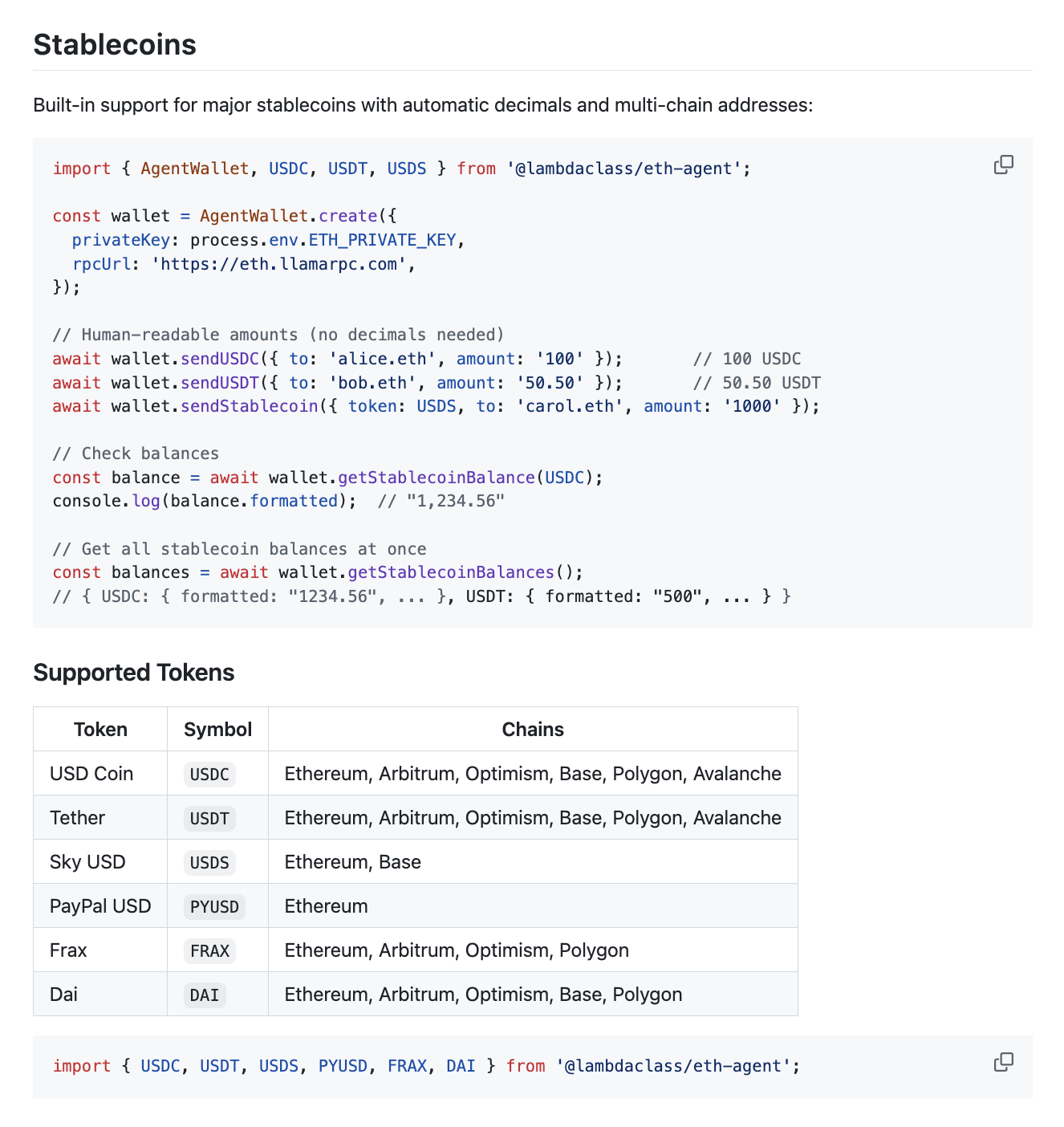
To address this architectural gaps, we built eth-agent, a typescript SDK designed from first principles for autonomous Ethereum interaction, with safety constraints that are not optional middleware but fundamental to the execution model.
This is part of a larger endeavour to help Ethereum become the backbone of the modern financial systems. We are building ethrex (a minimalistic performant Ethereum execution client written in Rust, that can also be used as L2 client and that is built from scratch as a ZK native client), ethlambda (a consensus client for Lean Ethereum), lambda-vm with Aligned (a zero-knowledge virtual machine that will allow us to prove correctness of the execution of ethrex in the framework of Lean Ethereum), lambdaworks and now eth-agent.