Bell’s inequality, which was formulated by John Bell in 1964, highlights one of the strangest features of quantum mechanics: entanglement, a phenomena which connects the physical attributes of two particles that can be infinitely distant from one another. In this article we will describe the experiment conceived by John Bell, the predictions of this experiment as derived from quantum mechanics, and why they prove the phenomena of entanglement is real.
Electron spin and photon polarization
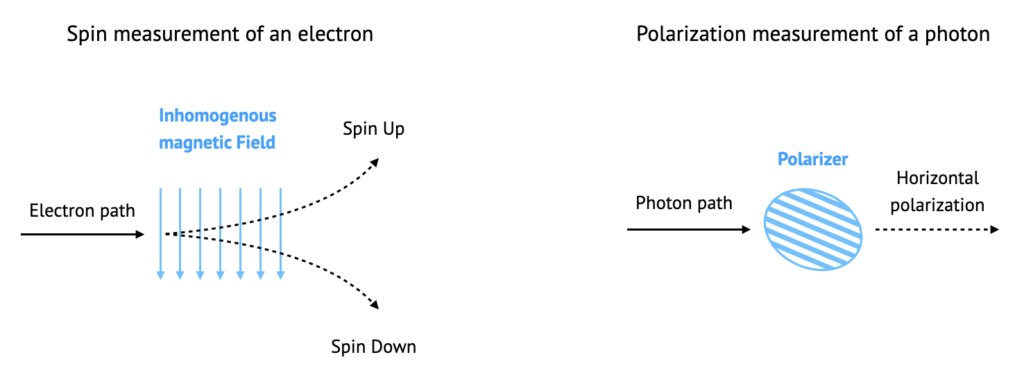
The Bell experiment can be performed either on photons or electrons. In the case of photons, the property of the particle that is measured is the polarization of the photon, which corresponds to the direction of the electric field to which the photon belongs. In the case of the electron, the property that is being measured is the spin of the electron, which determines how a magnetic field would affect it. A detailed description of these properties is beyond the scope of this article, however we will describe how they are measured and what experiments actually show.
In the case of a photon the polarization can be measured by a polarizer, in which case the polarization will either turn out to be horizontal if the photon passed through the polarizer, or vertical if it got blocked by the polarizer. If a photon passed the polarizer, then it is guaranteed to pass any subsequent polarizer with the same orientation, and get blocked by any subsequent polarizer with a perpendicular orientation. If the subsequent polarizer is oriented at 45o relative to the first polarizer, then the photon will pass it with 50% probability. For other angles the probability for passing the polarizer will change depending on the exact angle.
In the case of an electron, the spin can be measured using a Stern-Gerlach device. This device emits an inhomogeneous magnetic field perpendicular to the motion of the electron along a segment of the electrons trajectory, causing a change in the electrons direction of motion. Due to the magnetic field the electron can either move up, in which case we say it has a spin up, or down, in which case we say it has a spin down. As before, if an electron was measured to have spin up, it is guaranteed that in all subsequent measurements it will also measure with spin up, and vice versa for spin down. If however a subsequent measurement will be taken such that the magnetic field is oriented at 90o degrees relative to the first magnetic field, then with 50% probability the electron will be detected either as having spin up or down (relative to the rotated measurement device). Again, for other angles of rotation the probability to be detected in either spin depends on the exact angle.