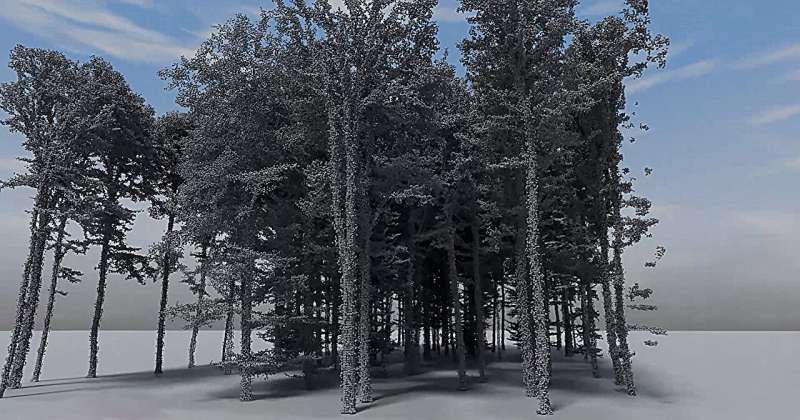
Existing algorithms can partially reconstruct the shape of a single tree from a clean point-cloud dataset acquired by laser-scanning technologies. Doing the same with forest data has proven far more difficult. But now a team from Purdue University’s Department of Computer Science and Institute for Digital Forestry and Germany’s Kiel University has introduced a new AI method for isolating and reconstructing forest trees that they call TreeStructor.
The team introduced TreeStructor in an article published in IEEE Transactions on Geoscience and Remote Sensing. The paper’s first author, Xiaochen Zhou, who earned his Ph.D. in computer science from Purdue this year, has posted a dynamic visualization that shows how the system works.
Challenges in reconstructing natural structures
Urban structures, furniture, cars and other human-built products display a high degree of symmetry, making them easier to detect from point-cloud datasets collected by light detection and ranging (lidar) and other remote sensing technologies. But nature tends to produce irregular stochastic structures—those that contain randomized characteristics.
"Symmetries are usually missing in stochastic structures," said co-lead author Bedrich Benes, professor and associate department head of computer science at Purdue. "That makes them extremely difficult to reconstruct. And that means most methods that work for artificial structural reconstruction usually fail on vegetation. However, vegetation includes many repeating parts at different scales—a small twig is similar to a large branch—and this is the key idea behind TreeStructor."
People can instantly discern the structure of individual trees from a point-cloud forest dataset. "Your eyes will send data to the brain, the brain will literally connect the dots, and you perceive the data as a three-dimensional structure," Benes said.