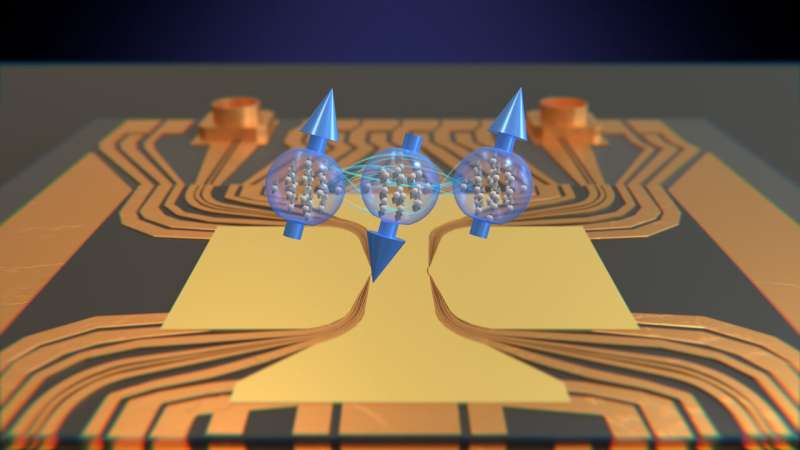
Researchers at the University of Basel and the Laboratoire Kastler Brossel have demonstrated how quantum mechanical entanglement can be used to measure several physical parameters simultaneously with greater precision.
Entanglement is probably the most puzzling phenomenon observed in quantum systems. It causes measurements on two quantum objects, even if they are at different locations, to exhibit statistical correlations that should not exist according to classical physics—it’s almost as if a measurement on one object influences the other one at a distance.
The experimental demonstration of this effect, also known as the Einstein-Podolsky-Rosen paradox, was awarded the 2022 Nobel Prize in physics.
Now, a research team led by Prof. Dr. Philipp Treutlein at the University of Basel and Prof. Dr. Alice Sinatra at the Laboratoire Kastler Brossel (LKB) in Paris has shown that the entanglement of spatially separated quantum objects can also be used to measure several physical parameters simultaneously with increased precision. The researchers published their results in Science.
Improved measurements through entanglement
"Quantum metrology, which exploits quantum effects to improve measurements of physical quantities, is by now an established field of research," says Treutlein.
Fifteen years ago, he and his collaborators were among the first to perform experiments in which the spins of extremely cold atoms were entangled with each other. The entanglement allowed them to measure the direction of the atomic spins (which can be imagined as tiny compass needles) more precisely than would have been possible with independent spins without entanglement.
"However, those atoms were all in the same location," Treutlein explains. "We have now extended this concept by distributing the atoms into up to three spatially separated clouds. As a result, the effects of entanglement act at a distance, just as in the EPR paradox."