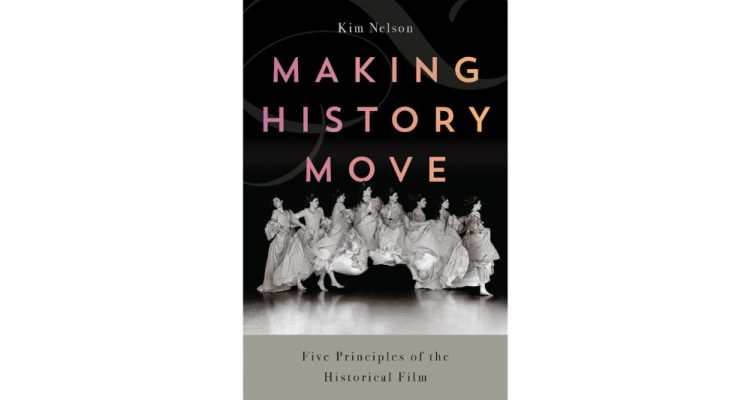
Making History Move: Five Principles of the Historical Film by Kim Nelson
The latest book by Canadian scholar Kim Nelson, Making History Move: Five Principles of the Historical Film, proposes a novel and systematic approach to the study of the relationships between cinema and history. This field of study, which should not be confused with the history of cinema, has grown considerably since it first emerged as a subject of academic research in the 1970s, with the pioneering work of the French scholars Marc Ferro and Pierre Sorlin. In the English-speaking world, a growing number of scholars have been interested in this field, with American Robert Rosenstone as the most prominent one, with numerous publications since the 1980s, the most comprehensive being his book History on Film/Film on History (2006).1 The common thread of these works lays on the defense of the film as a medium to research into the past and filmmakers as historians, a rather controversial position for most of “professional historians” working in written history.
Nelson has been very active in this field, from organizing several international symposia at the University of Windsor to recently co-editing The Routledge Companion to History and the Moving Image.2 In Making History Move, Nelson now proposes a methodology for analyzing what is commonly referred to as “historical film” and what she prefers to call “moving histories.” This term encompasses for the author both fiction and documentary films dealing with historical events. In the case of fiction cinema, Nelson specifies that they must be “realist works that historicize, meaning they speak to historicity: real events and people from the past,” while excluding “mainstream fictional renderings set in the past as a backdrop” (p. 16).
The Vindication of Historiophoty
In the introduction, Nelson vindicates the concept of “historiophoty,” coined by Haden White in 1988, as the most appropriate term for studies on history and cinema, a claim that I also made in the introduction to my book Filming History from Below: Microhistorical Documentaries.3 White defined historiophoty as “the representation of history and our thought about it in visual images and filmic discourse.”4 The author considers historiophoty to be the moving image’s answer to historiography, which deals with the study of history in the written form. Despite White’s notoriety in historiographical debates, his proposed term did not take hold, likely due to the resistance of most professional historians to accept cinema as a legitimate instrument of historical research. Nelson adopts White’s proposal and updates it by clearly delineating its meaning and setting it upon a solid analytical foundation.