Spotlight
Narayan on Dec 17, 2025
Last updated Dec 17, 2025
Narayan Prasad on Dec 17, 2025
Last updated Dec 17, 2025
The article was developed in collaboration with Epsilon3, a paying participant in the satsearch trusted supplier program. It catalogs Epsilon3’s insights into best practices when drafting work instructions and test procedures for space missions.
Jump to
Spotlight
Narayan on Dec 17, 2025
Last updated Dec 17, 2025
Narayan Prasad on Dec 17, 2025
Last updated Dec 17, 2025
The article was developed in collaboration with Epsilon3, a paying participant in the satsearch trusted supplier program. It catalogs Epsilon3’s insights into best practices when drafting work instructions and test procedures for space missions.
Jump to
- How procedures have evolved in space missions
- When engineering excellence meets documentation reality
- The high-volume advantage space doesn’t have
- Practical solutions for every organization size
- The future with Epsilon3
- Additional resources
On September 23, 1999, Mars Climate Orbiter vanished into the Martian atmosphere, taking $327 million and the entire Mars Surveyor ’98 program with it. The headlines blamed unit conversions, but that oversimplified a more fundamental failure. Mars Climate Orbiter’s loss wasn’t just about units. It was about procedures.
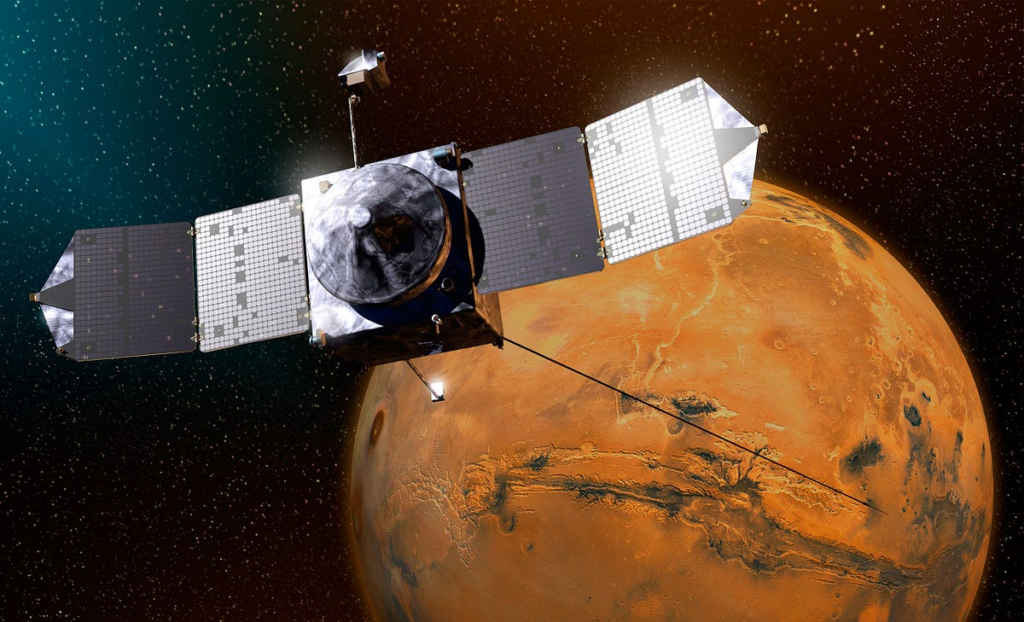
Mars Climate Orbiter mission failure exemplifies system procedural failures (source: Medium).
The breakdown revealed systemic procedural failures at multiple levels. NASA had provided Lockheed Martin with code called “Small Forces” that was wrong from day one, outputting data in pound-seconds (lbf-s) rather than the required metric units (Newton-seconds). Neither the company nor space agency caught the error in quality control. More importantly, no one from Guidance, Navigation and Control (GNC) was included on the spacecraft design team, creating a vehicle that was going to be inherently difficult to navigate. When team members raised concerns about the spacecraft’s dangerously-low approach trajectory and requested a correction burn 24 hours before orbital insertion, management denied the request because the concerns weren’t “properly filed” through official channels. The technical expertise existed to save the mission, but the procedural systems for capturing, evaluating, and acting on critical information failed completely.
Every space professional reading this has lived through some version of this story. Whether it is a technician questioning a procedure during engine testing, discovering that your avionics team’s “standard” data format isn’t what the communications team expected, or watching a critical test halt because nobody documented the handoff between analysis tools. The engineering was sound, the hardware performed flawlessly, but the human systems broke down. The procedures that connect engineering intent to operational reality failed at the critical moment.
Software failures in spaceflight have not yet killed people (not counting the Nedelin disaster), but given the steady occurrence of failures, it seems to be only a matter of time until this happens – as such, the human element in writing, reviewing, and executing procedures has never been more critical. We aren’t just documenting processes anymore. We are encoding institutional knowledge for an industry scaling from artisanal to industrial production. As launch cadence increases across the industry, the competition is shifting beyond just reaching orbit to ensuring mission success, crew safety, and infrastructure reliability. The stakes now encompass not just completing scientific objectives, but preventing loss of life, avoiding debris that threatens other spacecraft, and maintaining the space-based services that underpin the global economy.
How procedures have evolved in space missions
Chris Kraft built Mission Control around immediate human feedback loops. When Apollo 13’s oxygen tank exploded 56 hours into the mission, flight controllers developed entirely new procedures to turn the lunar module into a lifeboat in just hours, something that typically would have taken months. According to IEEE Spectrum’s investigation of the incident, Flight Director Gene Kranz held ultimate authority with a simple mandate: “The flight director may take any action necessary for crew safety and mission success”. This concentration of decision-making authority enabled rapid procedural adaptation in real-time.
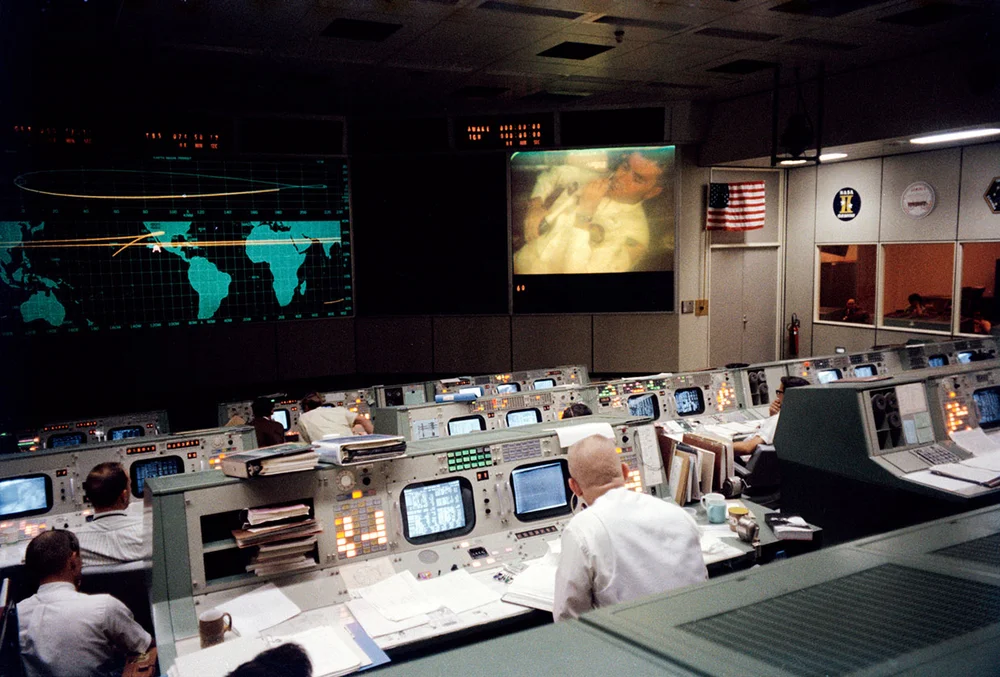
Calm before the storm – mission control a few minutes before the explosion that would cripple Apollo 13’s spacecraft (source: IEEE Spectrum).
Today’s space operations have moved in the opposite direction. Modern spacecraft operate with pre-loaded command sequences and autonomous response protocols that must anticipate every scenario without human intervention. The GPS constellation, operated by the U.S. Space Force’s 2nd Space Operations Squadron, exemplifies this evolution. The constellation requires continuous monitoring by global ground stations, but the satellites themselves execute complex orbital maintenance, timing corrections, and failure detection autonomously.
Unlike Apollo’s real-time collaborative problem-solving, today’s flight operations procedures need to be written to account for every contingency in advance. These procedures become the primary interface between engineering intent and operational reality, but the feedback loop to refine these procedures often spans months rather than minutes.
This creates a procedural planning challenge that exists alongside the technical, funding, and regulatory pressures that dominate most space teams’ daily concerns. Teams know they need comprehensive procedures, but they lack the tools, time, or systematic approach to create them effectively. The result is procedures that cover expected scenarios but fail during edge cases, and even when technically correct, remain static documents that can’t evolve with team experience or adapt as programs grow more complex.
Astronauts in the Mercury, Gemini, and Apollo programs were all highly technical and experienced, given that most were military test pilots with engineering degrees and extensive flight experience. This meant that NASA had to consider just one type of person when developing procedures and checklists. Today, when SpaceX flies crew missions, instructions need to be written for astronauts ranging from military test pilots to civilian mission specialists with scientific expertise, to paying customers with no technical background whatsoever. The same procedure must work for someone who has flown aircraft, someone who has spent their career in a laboratory, and someone whose only qualification is the ability to afford a ticket. The need for this procedural flexibility pushes documentation systems to their limits in ways that early mission planners never had to consider.
Today’s space workforce spans thousands of companies rather than concentrated centers like Apollo-era NASA. Each organization develops its own procedural approaches, often unknowingly recreating solutions that others have already solved. While this distribution has accelerated innovation, it has also fragmented best practices. A successful NewSpace company might excel at rapid iteration but struggle with the systematic documentation needed to preserve institutional knowledge when key personnel leave.
When engineering excellence meets documentation reality
Attend a procedure review meeting at any legacy prime contractor and you’ll find a pattern: engineers presenting procedures documented in binders to review boards, extensive approval processes, and change cycles measured in months. The separation between procedure writers and test conductors has feedback loops that sometimes never close. The engineer writes what they think should happen; the technician discovers what actually happens; but the feedback takes so long to reach the writer that the next test runs with the same flawed procedure.
Traditional aerospace documentation systems evolved to prioritize what NASA defines as technical excellence: “an effort to ensure that well-considered and sufficient technical thoroughness and rigor are applied to programs and projects under an uncompromising commitment to safety and mission success”. These systems typically involve formal review boards, extensive approval chains, and change processes that can span weeks or months. The methodical approach ensures quality control and regulatory compliance but creates bottlenecks when procedures need rapid iteration based on test results or operational feedback.
The commercial space sector faces interdisciplinary communication challenges that didn’t exist in traditional aerospace’s more centralized structure. The 2014 Virgin Galactic SpaceShipTwo accident illustrates how procedural communication failures compound across disciplines. The NTSB investigation found that while the immediate cause was the co-pilot prematurely unlocking the feather system, the developer of the craft “put all their eggs in the basket of the pilots doing it correctly” – a failure that involved multiple teams: the design team didn’t build in safeguards, the procedures team didn’t include adequate warnings in manuals, and the training team’s simulator didn’t replicate the operational environment. Each team had valid technical requirements, but they documented and communicated their safety-critical information in ways that didn’t effectively reach the right people at the right time.
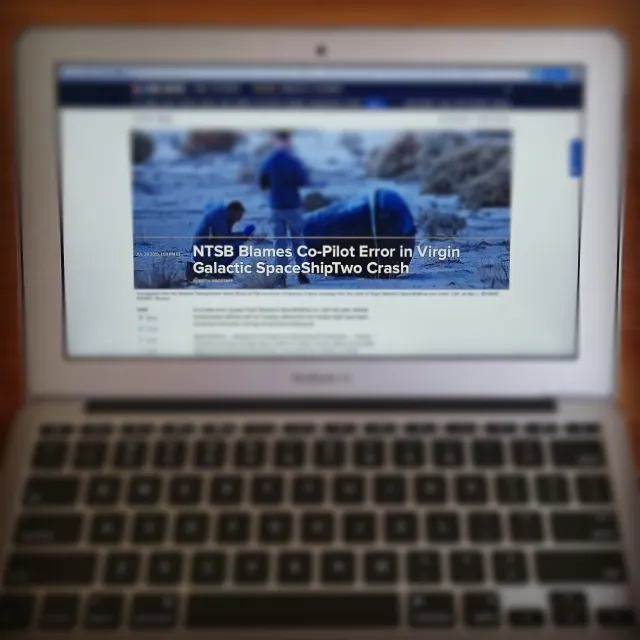
News report of the Virgin Galactic crash blaming ‘human error’ (source: Steven Shorrock).
Consider NASA’s approach to engine testing procedures, which divide operations into precisely timed zones. The procedure might specify a 15-second data calibration period, but experienced test conductors know that certain propellant combinations require additional thermal equilibrium time. As NASA’s LLAMA project demonstrated, even after fifty-one successful tests, a single procedural deviation during restart led to catastrophic failure. The procedure, though technically correct, didn’t account for operational constraints that experienced personnel understood, but never documented.
The startup “Speed versus Safety” challenge creates a false choice for NewSpace companies. Commercial space funding pressures demand rapid iteration that traditional documentation systems cannot support. Most companies choose speed, creating technical debt that compounds as teams grow from perfect communication at 5-7 people to chaos at 50 people without systematic procedures. By the time companies realize they need systematic procedures and tools to maintain them, their culture is already set and retrofitting becomes exponentially harder.
Engineering schools typically emphasize technical theory over practical communication skills. While programs include lab work and hands-on projects, students are primarily evaluated on technical outcomes rather than their ability to document procedures for replication or present results in ways that enable project continuity. This creates a critical gap between academic training and industry reality, where communicating technical work clearly enough for others to build upon is essential to mission success. Unlike established prime contractors with dedicated technical writing teams, most commercial space companies lack the resources for specialized documentation expertise, forcing engineers to handle communication tasks they weren’t trained for.
The high-volume advantage space doesn’t have
The semiconductor industry achieved procedural standardization through manufacturing scale that space hasn’t achieved. When you are producing millions of parts based on identical processes, you can afford to perfect every procedural step through systematic refinement. Automotive manufacturing similarly achieved systematic procedural control through standards like IATF 16949. The key enabler is production volume: automotive companies can standardize processes because they manufacture thousands of similar vehicles using repeatable assembly procedures.
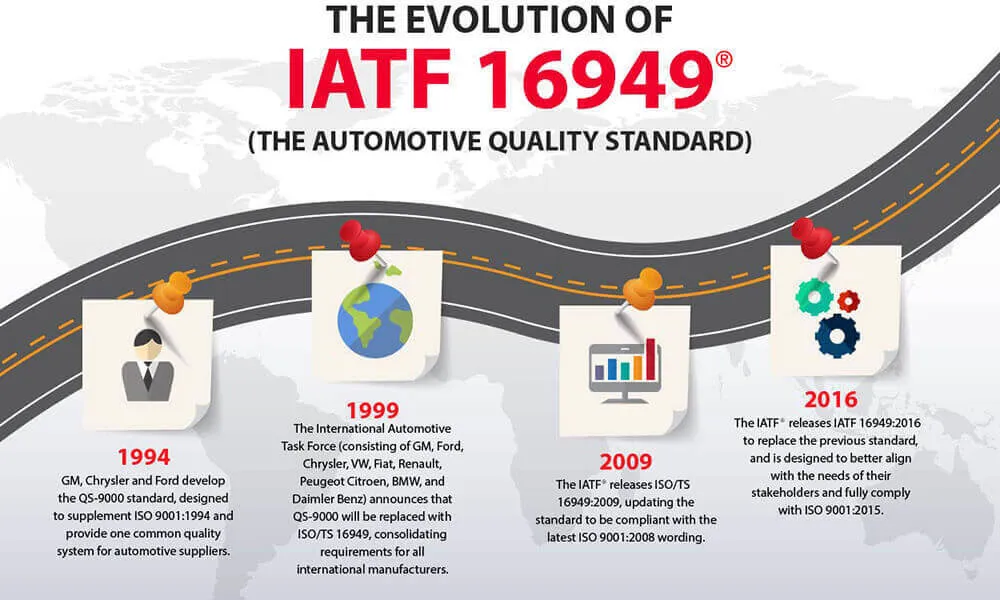
*The evolution of IATF 16949 in the automotive industry (source: TechSparks). *
Nuclear and the Oil & Gas industries developed extensive procedural documentation systems driven by regulatory requirements and the catastrophic costs of process disruption. These industries maintain large teams of technical writers specifically because procedural failures create safety and financial risks that justify the investment.
The space industry operates at the opposite end of the process repetition spectrum. This creates both the challenge and opportunity for better procedural tools. Despite the 223 launches deploying over 2,800 satellites in 2023 and an increase to 254 launches in 2024, the actual scale varies dramatically across market segments. While companies like SpaceX and emerging constellation operators in Earth Observation have achieved meaningful repetition, most space missions still remain effectively one-off prototypes with very low process repetition rates. LEO communications constellations represent the vanguard of scaled space operations, but they are still the exception rather than the rule.
Practical solutions for every organization size
For Space Startups (5-50 people)
Your first 20 hires determine your culture forever. Prioritize hiring engineers who can communicate clearly over pure technical specialists. Implement version control for procedures, naming conventions that scale beyond tribal knowledge, and technical writer roles when you hit 20-30 people.
Most space startups fail this transition not because their rockets don’t work, but because the person who knows how to troubleshoot the Ground Support Equipment quits on the same day as a critical test, taking years of undocumented knowledge with them.
For Mid-Size Companies (50-500 people)
You need dedicated procedural infrastructure before your next funding round, not after. Focus on cross-team communication standards and feedback loops that actually close. At this scale, your biggest risk is operational drift: when your structures team assumes the propulsion team updated the center of gravity calculations, but they assumed GNC would have computed and shared it – and nobody documented who was actually responsible.
The communication patterns you establish now determine whether you scale to 1,000 people or remain stuck. Implement systematic procedures while you have agility, because retrofitting becomes exponentially more expensive.
For Large Organizations (500+ people)
You are dealing with vendor integration, regulatory compliance, and handoffs between multiple organizations. NASA currently “satisfies approximately 36% of mission direct-to-ground service minutes through commercial ground network providers”. When your flight operations team in Colorado Springs expects telemetry data formatted one way, but your commercial ground station partner in Norway delivers it another way, and your mission-critical maneuver window closes in 47 minutes, procedural ambiguity becomes a $200 million problem.
Handling External Partners
Digital audit trails are becoming mandatory for aerospace primes. When you are handing off a GEO satellite from manufacturer LEOP operations to operator nominal operations, procedural gaps cost millions. Your procedures must now work seamlessly across organizations that have never worked together before, where miscommunication during handoffs can compromise mission objectives and require costly recovery operations.
The future with Epsilon3
As the industry matures, the emerging competition is on delivering measurable performance: images captured per day, data quality metrics, serviceable throughput, and operational uptime.
This urgency becomes even more critical as we integrate AI and autonomous systems into space operations. Research has found that of the historical incidents analyzed, 85% were from software producing erroneous output rather than stopping. Since automated systems are more likely to fail by giving wrong answers than by breaking, robust, human-written procedures remain essential to catch these silent errors before they cascade into mission-critical problems.
Your most worthy competition is likely the one building better communication systems around their product – be it hardware or software. Companies that can scale their human expertise through systematic procedures will capture the growing commercial space market. While others struggle with knowledge gaps and communication breakdowns, teams incorporating mature procedural frameworks will execute faster, fail less frequently, and recover more quickly when problems arise.
The time to act is now. Evaluate your organization’s procedural maturity honestly: can a new team member execute your critical processes without tribal knowledge? If not, you’re carrying hidden technical debt that could determine your survival in the next industry or financial downturn. Whether your rocket can reach orbit is an engineering problem you’ve already solved; whether your team can make it happen day in and day out is what will determine your future. This applies equally to engineers writing test procedures, managers coordinating missions, and CTOs scaling their technical systems.
Laura Crabtree, CEO of Epsilon3 provided her unique insights for this article. The Epsilon3 team includes engineering and design professionals from Northrop, Google, and SpaceX, where they ran operations first-hand to bring American astronauts to the ISS.
Epsilon3 modernizes space missions by building the industry standard of operational software. Epsilon3’s software platform manages complex operational procedures, saving operators time and reducing errors. The platform supports a majority of a project’s life cycle from integration and testing through live operations.
Here is a selection of tools & modules available within Epsilon3’s software suite purpose-built for advanced engineering, manufacturing, testing, and operations.

The Epsilon3 OS for Space Operations is a web-based, electronic procedures solution for operators who need to create, process, and track complex procedures. It is designed to streamline communication and help operators to reduce errors through intelligent error checking and automation. It also enables users to increase performance over time with detailed metrics and reports.

The Epsilon3 Plan tool is designed to visualize schedules, timelines, and dependencies to track the critical path in the space industry. It helps to easily plan and manage tasks by scheduling procedures, events, and operations in an interactive Gantt view with powerful filtering, organization, and editing capabilities. All while leveraging customers’ existing procedures and operations.
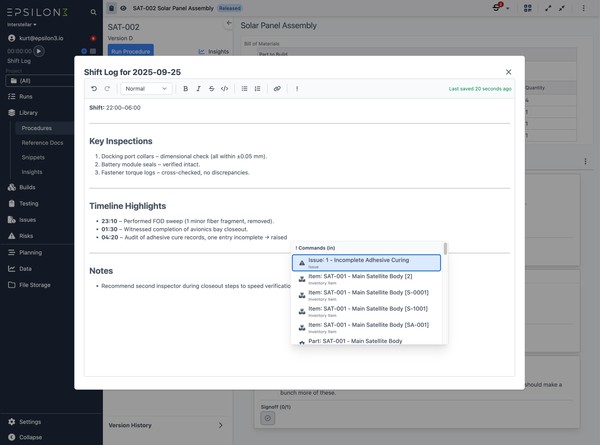
The Epsilon3 Shift tool captures key updates, events, and decisions in real time to keep every shift aligned. With Epsilon3 Shift Logs, nothing gets lost in transition—ensuring complete visibility and continuity across your operations.
For more information, check out Epsilon3’s capability hub on satsearch.
Additional resources
- Managing both AIT and TT&C workflows in a single integrated environment – with Epsilon3 (podcast)
- Spacecraft builds and MissionOps: a 2025 perspective with Epsilon3
- Streamlining TT&C operations through automation – with Epsilon3 (podcast)