
Open source projects usually begin with a simple belief: software becomes more capable, more resilient, and more meaningful when it is created in the open. For Penpot, this belief is not a slogan. It is the foundation of the entire product. Openness guides how features are imagined, how decisions are reached, how the community participates, and more recently, how Penpot approaches AI.
As AI continues to reshape creative work, many design tools have introduced intelligent features developed behind closed doors. Penpot is choosing another way. Instead of presenting a finished idea of what AI should do, …
Open source projects usually begin with a simple belief: software becomes more capable, more resilient, and more meaningful when it is created in the open. For Penpot, this belief is not a slogan. It is the foundation of the entire product. Openness guides how features are imagined, how decisions are reached, how the community participates, and more recently, how Penpot approaches AI.
As AI continues to reshape creative work, many design tools have introduced intelligent features developed behind closed doors. Penpot is choosing another way. Instead of presenting a finished idea of what AI should do, the team invites the community to explore what AI could do. Much of what makes a design meaningful is never written directly into a file.
As Àlvaro Tejero noted at Penpot Fest, a design carries intent and relationships that are not recorded in the code, yet designers recognize them instantly.
The new MCP Server sits at the heart of this mindset. It is not a product announcement but an invitation to explore together what AI assisted design may become.
Why Open Collaboration Matters for Design Tools
The design industry moves quickly. New practices and technologies appear at a steady pace, and the boundary between design and development becomes thinner every year. In this environment, a tool shaped by a small closed team can begin to feel rigid or disconnected from real daily work.
Penpot follows a different philosophy. Openness is not only about releasing source code. It is about creating room for meaningful contribution. Transparent processes and extensible tools prevent ideas from getting trapped inside a single company. Instead, ideas improve through real world feedback and experimentation. This is especially true in design, where meaning comes from context, emotion, and intent as much as from visible elements. As Tejero observed, people naturally understand more from a design than what is written in data or coordinates.
This environment allows contributors to influence the direction of the product rather than only requesting features. That level of collaboration is difficult to match in proprietary ecosystems, and it becomes even more valuable when AI enters the picture. The pace of AI development is too fast for a closed roadmap to anticipate everything. A community can imagine far more.
How Community Collaboration Shapes Penpot
Anyone who has followed Penpot in recent years has seen the community shape the tool in visible ways. Large features such as Design Tokens and Variants were influenced and often stress tested by designers and developers long before they reached a stable release.
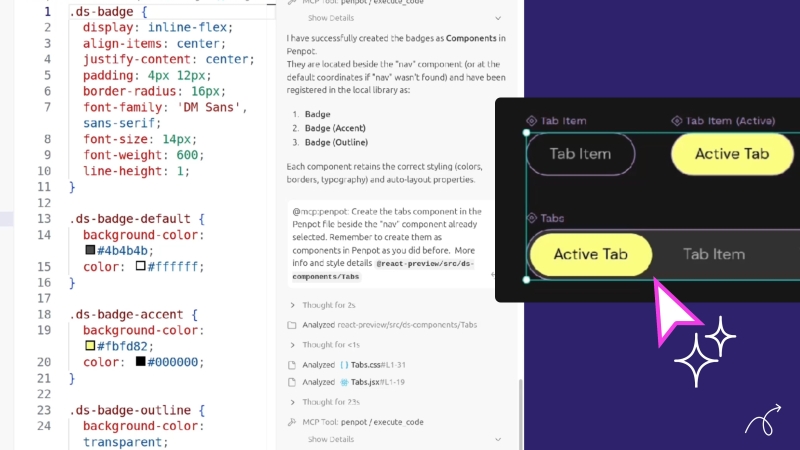
The beta testing cycles illustrate this well. Each major feature is shared early with the community, who try it in real projects, break it in unexpected ways, and offer feedback that helps refine the experience long before final release. Decisions are made publicly and discussed with openness, always grounded in real workflows.
The same collaborative spirit appears in the API ecosystem. By exposing the Plugin API and treating it as a first class extension point, Penpot encourages experimentation. Developers have already created workflow automation, integrations with code tools, accessibility helpers, and early AI agents that inspect designs through the plugin layer. These experiments inform the product and help the team understand emerging needs.
This culture of transparency and participation makes the next step possible.
The MCP Server: A New Layer for Co Creation
At Penpot Fest 2025, the team presented an early preview of the MCP Server. It is a new interface that allows AI agents and tools to interact with Penpot designs through a flexible and model independent protocol. Instead of relying on screenshots or private interfaces, an AI system can use the same Plugin API available to humans, only with faster access to Penpot’s structured design model.
This opens a door to workflows that were not possible before. In community demos, AI agents could analyze design systems, extract style rules, refactor naming, generate semantic HTML and CSS, update styles from documentation, build Storybook setups, and even turn rough sketches into more structured components.

Penpot built the MCP Server around a simple idea: AI becomes more reliable when it can understand explicit design structure. As Tejero noted, large language models have limits, but they can work far more accurately when they receive organized information. By exposing Penpot’s internal graph of relationships instead of raw pixels, the server makes semantic understanding possible.
This preview is intentionally open ended. The MCP Server does not dictate how AI should behave. It provides a foundation that designers, developers, and toolmakers can explore and adapt. This is why it was released early. As Tejero explained, the goal was to let people test it, challenge it, and share how they would like to use it.
By sharing the server at this stage, Penpot is essentially saying: Here is a foundation. Help us imagine what should be built on top of it.
Why Penpot Is Asking for Use Cases
Because AI in design workflows is still new, no one can fully predict which ideas will become essential. Some designers want help cleaning layer structures. Others want alignment between design and code. Others want refactoring, naming consistency, documentation syncing, or tools that explore high level ideas.
**Instead of guessing, Penpot wants to hear directly from the people who will use these tools. **The team already understands the foundational pieces the MCP Server needs, but they want to learn which specific use cases excite the community most. Penpot is reaching the point where the server will evolve from a flexible, generic interface into something shaped by real, use-case-driven development—and community input is what will guide that transition.
These questions are answered best through collaboration with a community that already includes designers, frontend developers, open source contributors, educators, and creative coders.
The MCP Server becomes a catalyst for that collaboration: a flexible foundation that can grow in directions no single roadmap can predict.
Possible Use Cases
Below are some of the early MCP Server experiments shown in the Penpot demos. They illustrate how AI agents can work directly with Penpot’s structured design model to automate real tasks across design and code workflows.
Design to code
An AI agent can read the structure of a Penpot design — its components, layout, and tokens — and turn that into clean, semantic HTML and CSS. This moves beyond simple export: the agent understands the design’s relationships and produces code that reflects them.
Prototype interactions
Instead of manually wiring up interactions, an AI agent can generate an interactive prototype from the design. It can take existing assets or HTML files and connect them into a functioning experience, helping teams explore behavior earlier in the process.
Scribble to design
A rough sketch can be used as the basis for an actual structured layout. The agent interprets the scribble’s visual intention and produces a more refined design that follows the same general structure, giving designers a faster way to move from idea to draft.
Design System documentation + Design tokens
An agent can inspect a design or design system, identify token usage and structure, and generate documentation automatically. This makes it easier to maintain a shared source of truth and keep teams aligned as systems grow.
These experiments barely scratch the surface. They show how the MCP Server turns Penpot into a playground for automation, creativity, and entirely new workflows, where AI doesn’t replace the designer, but removes the friction between imagination and execution.
Do you see the incredible possibilities yet?
How You Can Get Involved
If you care about the future of design, design systems, creative tooling, or AI assisted workflows, Penpot welcomes your perspective. Whether you design complex interfaces, enjoy automation, or experiment with AI agents, your ideas can help guide the growth of the MCP Server.
You can contribute by:
- Sharing your use cases and ideas
- Testing workflows when the beta opens
- Joining discussions in the Penpot community
- Exploring the Plugin API or early MCP examples
- Offering feedback on workflows, naming, or design to code processes
To join the conversation around early experiments and use cases, you can visit the community discussion space. (You’ll need to sign up for free to access the thread.)
Even small ideas can influence the direction of the project. Many of Penpot’s most impactful features began as lightweight experiments or casual conversations within the community.
Looking Ahead
What makes Penpot special is not only its technology but the way it is built, with transparency, care, and a genuine belief in shared ownership. As the team steps into the world of AI, that philosophy becomes even more important. Instead of releasing a polished assistant, Penpot is creating space for exploration and collective invention.
The MCP Server is only the beginning. The future of design tooling will not be defined by a single company or model. It will be shaped by the people who use these tools every day. Penpot is choosing to build that future openly, and if you are curious about where AI and design are headed, this is an ideal moment to participate.