December 18, 2025
3 min read
In the era of mega constellations, spacecraft typically have less than a week to avoid crashes
By Jeremy Hsu edited by Clara Moskowitz
Maciej Frolow/Getty
Join Our Community of Science Lovers!
The space around Earth has become increasingly cluttered with decades o…
December 18, 2025
3 min read
In the era of mega constellations, spacecraft typically have less than a week to avoid crashes
By Jeremy Hsu edited by Clara Moskowitz
Maciej Frolow/Getty
Join Our Community of Science Lovers!
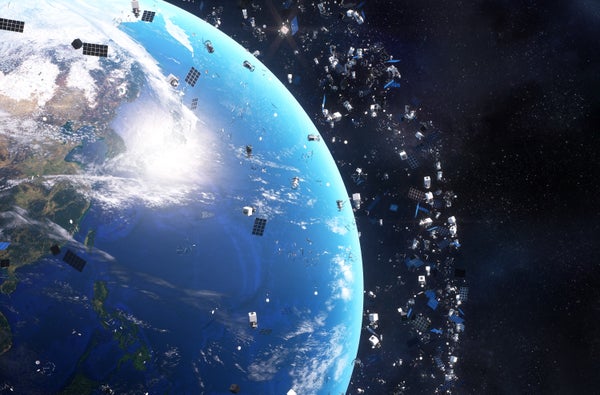
The space around Earth has become increasingly cluttered with decades of accumulated debris left over from rocket launches, derelict satellites and the occasional antisatellite weapon test—not to mention growing mega constellations of thousands of active satellites. This influx of traffic means satellite operators have a fast-shrinking window of time to avoid a catastrophic collision in an emergency.
“While we had many months in the past, we now have less than a week for a close passage of serious concern—quite possibly a major collision,” says Aaron Boley, an astronomer at the University of British Columbia.
A new “Collision Realization and Significant Harm (CRASH) Clock” measure, described by Boley and his colleagues in a preprint posted to the server arXiv.org, shows how the rise of mega constellations has created an “orbital house of cards.” The clock uses statistics to estimate how long spacecraft now have to avoid a dangerous close pass or a collision, Boley says.
On supporting science journalism
If you’re enjoying this article, consider supporting our award-winning journalism by subscribing. By purchasing a subscription you are helping to ensure the future of impactful stories about the discoveries and ideas shaping our world today.
That reaction window has shrunk considerably since satellite mega constellations took off with the launch of SpaceX’s first Starlink satellites in 2019. The researchers’ latest, unpublished calculations suggest that the CRASH clock value stood at about 5.5 days as of June 2025, compared with 164 days back in January 2018. The clock suggests the average satellite in low-Earth orbit currently faces a 17 percent chance of a close approach that could lead to a collision within 24 hours, which means satellites must make more frequent evasive maneuvers than they used to.
“As a concept, the CRASH Clock is powerful because it turns ‘space is getting crowded’ into a time-based metric people can understand,” says Aaron Rosengren, a mechanical and aerospace engineer at the University of California, San Diego, who was not involved in the study. “The exact number matters less than the trend.”
The calculation looks at the current orbits of all cataloged objects and makes simplified assumptions about factors such as satellite distributions in orbit. It doesn’t account for different maneuvering policies or risk thresholds among satellite operators.
Spacecraft may not always be able to act quickly enough to avoid a crash, especially if software glitches or powerful solar storms interfere. In 2019 a European Space Agency science satellite had to dodge a SpaceX Starlink satellite, in part because of a “bug” in the communication system used between the agency and Starlink. More recently, this month SpaceX described a near miss between one of its Starlink vehicles and a newly launched Chinese satellite.
The risk of collision and the cascading buildup of space debris—described as Kessler-Cour-Palais Syndrome—is only growing as companies and governments launch more satellites into similar orbits. The more than 9,000 Starlink satellites that are currently active account for about two thirds of all active satellites. Rivals such as Amazon’s Project Kuiper and Chinese companies are also racing to build their own mega constellations. Future plans for orbital space mirrors and space data centers may further complicate the situation.
The challenge is to coordinate collision avoidance among so many independent organizations that use different tools for monitoring space and do not all share information equally, Rosengren says. “The biggest driver is simple arithmetic,” he adds. “Far more satellites in the same orbital bands means far more close approaches, and the screening and response workload grows extremely fast.”
It’s Time to Stand Up for Science
If you enjoyed this article, I’d like to ask for your support. Scientific American has served as an advocate for science and industry for 180 years, and right now may be the most critical moment in that two-century history.
I’ve been a Scientific American subscriber since I was 12 years old, and it helped shape the way I look at the world. SciAm always educates and delights me, and inspires a sense of awe for our vast, beautiful universe. I hope it does that for you, too.
If you subscribe to Scientific American, you help ensure that our coverage is centered on meaningful research and discovery; that we have the resources to report on the decisions that threaten labs across the U.S.; and that we support both budding and working scientists at a time when the value of science itself too often goes unrecognized.
In return, you get essential news, captivating podcasts, brilliant infographics, can’t-miss newsletters, must-watch videos, challenging games, and the science world’s best writing and reporting. You can even gift someone a subscription.
There has never been a more important time for us to stand up and show why science matters. I hope you’ll support us in that mission.