Current geopolitical crises have caused us to lose sight of climate change. Nevertheless, it remains one of the greatest long-term threats to human coexistence on Earth. The "climate gas" CO2, which accelerates global warming, plays a major role in this. Scientists from Saarland University and htw saar have now shown how CO2 can be stored efficiently and cheaply using high-tech materials in a review article in the journal Advanced Functional Materials.
 **
**
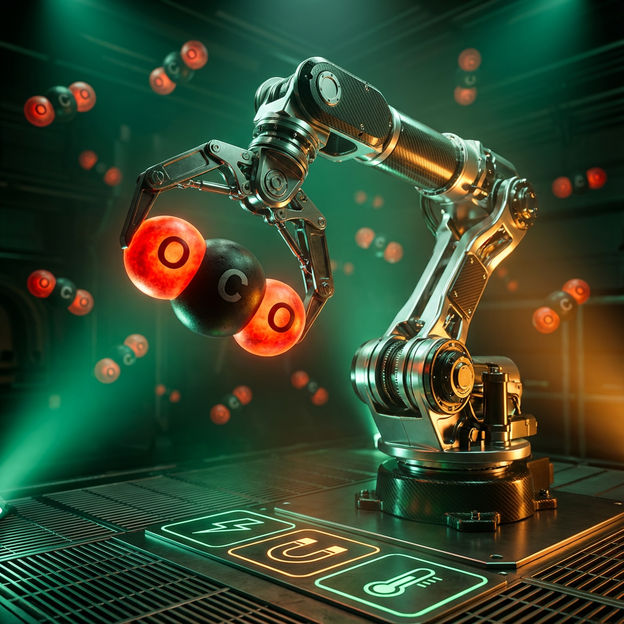
The AI-generated image (Higgsfield/Nano Banana Pro with its own share of image material) shows the basic topic of th…
Current geopolitical crises have caused us to lose sight of climate change. Nevertheless, it remains one of the greatest long-term threats to human coexistence on Earth. The "climate gas" CO2, which accelerates global warming, plays a major role in this. Scientists from Saarland University and htw saar have now shown how CO2 can be stored efficiently and cheaply using high-tech materials in a review article in the journal Advanced Functional Materials.
**
The AI-generated image (Higgsfield/Nano Banana Pro with its own share of image material) shows the basic topic of the now published paper: different methods of "capturing" CO2.
© Gallei-Lab
It is a kind of Holy Grail of the (applied) sciences: Scientists around the world are searching for the most efficient methods possible to collectCO2 as it is produced and then either store it safely, destroy it or recycle it. There are currently common methods for capturing and storingCO2 (carbon dioxide). However, these CCS technologies are all very expensive processes (costing between 50 and 150 dollars per ton ofCO2) with limited effectiveness. Even processes to removeCO2 that has already been emitted from the atmosphere (Negative Emission Technologies, NETs) cannot noticeably reduce the amount of the "greenhouse gas" on their own.
New ways are therefore needed to tackle this pressing problem, as climate change is progressing rapidly, unaffected by storms, droughts and melting ice. In addition to the undisputed best approach of releasing as little carbon dioxide as possible, scientists are therefore also researching additional methods to get the still enormousCO2 emissions under control. Here, resource-saving on-site solutions must be used for direct generation, as well as mobile carbon capture technologies.
In addition to CCS and NET, another option for binding the gas is the use of so-called stimuli-responsive organic materials. Markus Gallei, Professor of Polymer Chemistry at Saarland University, knows what is behind this. Together with his colleague Jian Zhou and Marc Deissenroth-Uhrig, Professor of Renewable Energies at htw saar, he recently published a review article on this type ofCO2 capture in the high-ranking specialist journal "Advanced Functional Materials". This has now even made it onto the cover of the current printed edition.
"The focus of these technologies is on the ‘switchability’ to absorb or releaseCO2," explains Markus Gallei. By exposing a certain material to a stimulus, this material can absorbCO2 and release it again in a targeted manner when the stimulus is triggered. Such a stimulus can be temperature, electricity, mechanical stress, light, the pH value or even magnetism. "These stimuli can also be combined with each other. In this way, we could develop compact, efficient systems with intelligent plastics and organic materials that require much less energy than current systems. This is one of the main problems with current CCS systems," says Markus Gallei, who has focused his research on the development of efficient polymers. Some of his research projects deal with the question of howCO2 can be bound and, above all, released again in the most resource-efficient way possible.
"It is crucial that theCO2 for such stimulus-responsive materials is as pure as possible in order to be able to use it," explains the chemist. This is why these processes are not suitable for all man-madeCO2 sources. "Steel production, for example, produces a lot of other substances besidesCO2. These methods would not be the best here. But compact systems on this basis could be used for ‘mobile burners’ or in smaller industrial companies," explains Markus Gallei.
"Of course, you could ask: ’What’s new about this?" admits the chemistry professor. After all, he and his colleagues are not reporting anything new in a strictly scientific sense in the article; they are "only" summarizing the state of the art in this field. "But until now, there really has been no such overview in the specialist literature. None of the technologies we focus on are yet established, but we believe they offer great potential." The fact that the article was published in a highly respected journal such as Advanced Functional Materials (impact factor 19) and even made the front page is proof that Markus Gallei, Marc Deissenroth-Uhrig and Jian Zhou were right in their assessment.
It is also no coincidence that three authors from Saarland came up with the idea. "The work was created as part of the ENFOSAAR project, which is funded by the Saarland Transformation Fund," says Markus Gallei. In this 23 million euro network, htw saar and the university are working together with the Fraunhofer IZFP, the IZES Institute and the DFKI to research how the transformation can succeed in coping with climate and structural change. "Thanks to the transformation fund, Saarland can therefore play a leading role in tackling the issues of the future," summarizes Markus Gallei.
If their work can serve as an overview and inspiration for other scientists around the world for their own research, a lot will have been gained. After all, getting a grip on theCO2 concentration in the atmosphere does not require a single Holy Grail to solve the problem on its own. Rather, there are many small "grails" that have to work together to get the gas out of the air or prevent it from getting there in the first place. And some of these "little grains" could have their origins in the Saarland.