 Credit: Pixabay/CC0 Public Domain
A research team led by Professor Youngwook Kim from the Department of Physics and Chemistry, DGIST, in collaboration with the research team of Professor Gil Young Cho at KAIST, have discovered a new memory principle that enables information to be written and erased electrically by stacking ultrathin materials, such as graphene, in a sandwich-like structure.
This research achievement, published in the journal Nature Communications, is expected to contribute to the development of ultralow-power electronic devices, which consume minimal electricity, as well as components for next-generation quantum …
Credit: Pixabay/CC0 Public Domain
A research team led by Professor Youngwook Kim from the Department of Physics and Chemistry, DGIST, in collaboration with the research team of Professor Gil Young Cho at KAIST, have discovered a new memory principle that enables information to be written and erased electrically by stacking ultrathin materials, such as graphene, in a sandwich-like structure.
This research achievement, published in the journal Nature Communications, is expected to contribute to the development of ultralow-power electronic devices, which consume minimal electricity, as well as components for next-generation quantum computers.
Why thinner devices need new memory
The semiconductor components of smartphones or computers, which we use every day, must also be slimmed drastically to make the devices thinner and lighter. However, the conventional ferroelectric materials used for information storage have limitations: their performance degrades sharply as thickness decreases, and they often require complex processes. Therefore, research has been actively conducted on new approaches that can realize memory properties (ferroelectricity) in ultrathin materials without using traditional ferroelectric materials.
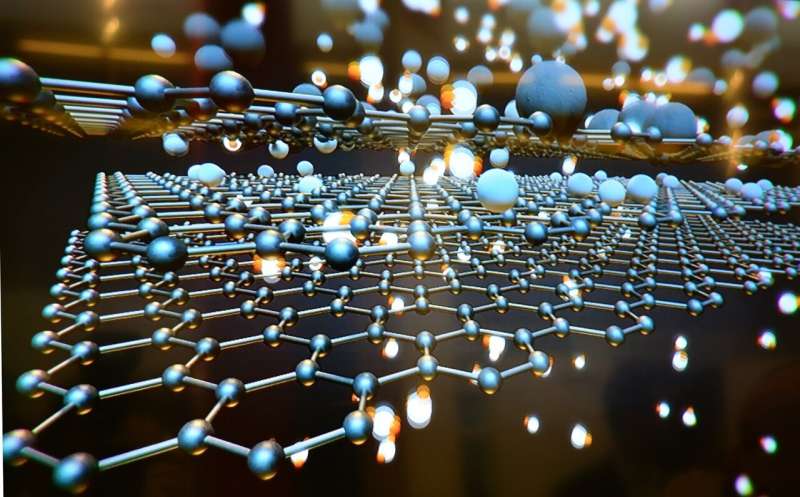
The research team has resolved this issue through a counterintuitive approach that artificially induces ferroelectricity by combining non-ferroelectric materials. They devised a breakthrough structure in which an ultrathin insulating layer (hBN) is inserted like a sandwich between graphene—often called a dream material—and α-RuCl₃.
The team confirmed that, remarkably, charges at the interface spontaneously rearrange in this structure, giving rise to electric dipoles that can store information much like a ferroelectric material, and information can be recorded and erased electrically, as if turning a switch on and off.
 Device structure and transport characteristics before and after top-gate fabrication. Credit: Nature Communications (2026). DOI: 10.1038/s41467-025-68072-x
Performance at ultralow temperatures and beyond
The operation of the device developed by the research team was most stable at around −243°C (30 K), and it exhibited outstanding non-volatility, retaining stored information for more than five months even with the power turned off.
In addition, this phenomenon can be controlled solely through electrical interactions and is unaffected by the strength or orientation of external magnets (magnetic fields), making it significantly more stable and efficient than conventional approaches. This outcome demonstrates that ferroelectricity can be realized through simple stacking alone, without any structural deformation.
"This study is significant in that it has discovered a new physical property that enables electrical control simply by stacking materials, without any artificial structural deformation," stated Professor Youngwook Kim.
"Looking ahead, we expect this technology to accelerate the development of memory devices for quantum computers operating at ultralow temperatures or next-generation ultralow-power semiconductors."
Publication details
Soyun Kim et al, Ferroelectric switching of interfacial dipoles in α-RuCl3/graphene heterostructure, Nature Communications (2026). DOI: 10.1038/s41467-025-68072-x
Citation: Stacked graphene sandwich reveals switchable memory without traditional ferroelectrics (2026, February 3) retrieved 3 February 2026 from https://phys.org/news/2026-02-stacked-graphene-sandwich-reveals-switchable.html
This document is subject to copyright. Apart from any fair dealing for the purpose of private study or research, no part may be reproduced without the written permission. The content is provided for information purposes only.