Forget Thing T. Thing from The Addams Family (yes, that’s the full name); modern science has officially brought us a detachable robot hand that can actually skitter across the floor, grab you a beer, and creep the heck out of your guest…
Forget Thing T. Thing from The Addams Family (yes, that’s the full name); modern science has officially brought us a detachable robot hand that can actually skitter across the floor, grab you a beer, and creep the heck out of your guests.
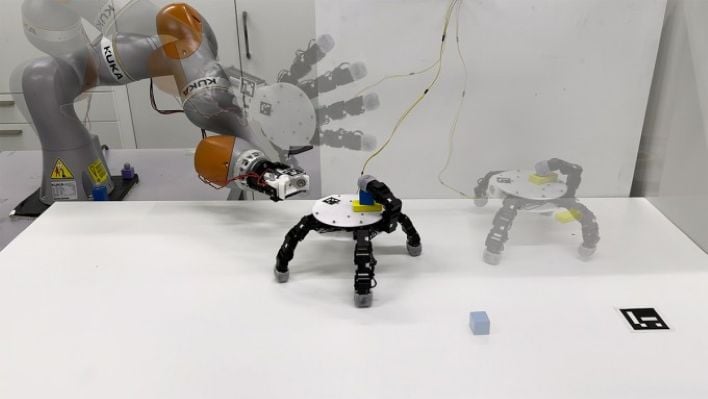
In an engineering development that straddles the line between revolutionary and nightmare fuel, researchers from the Swiss Federal Institute of Technology Lausanne and MIT have unveiled a robotic hand capable of detaching itself from its arm to complete tasks solo. This isn’t just a gimmick for a haunted house; it’s a major leap in modular robotics. The contraption, which looks like a standard prosthetic hand until it decides to walk away, uses its own fingers as legs to scuttle across surfaces, reaching tight spots where the larger robotic arm simply cannot fit.
According to the study, the hand operates through a marriage of hand anatomy and artificial intelligence. When attached to its parent arm, it functions as a high-precision gripper. But when the task requires mobility, the hand disconnects and transforms. By bending its fingers in a coordinated sequence, it can crawl over obstacles or slip into narrow gaps.
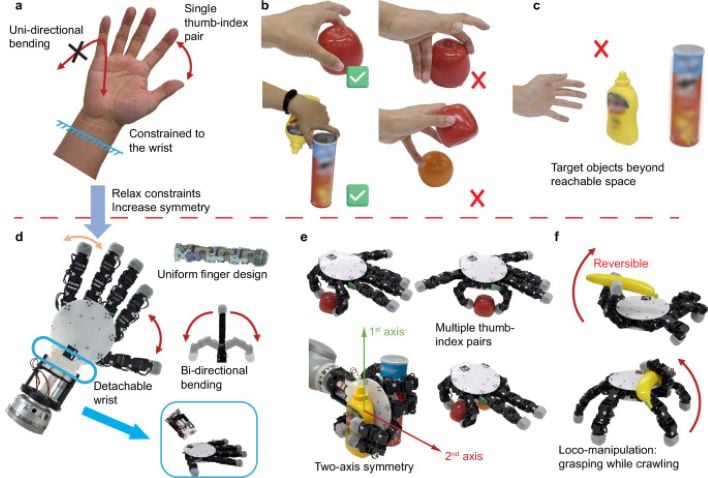
To make this possible, the team employed advanced genetic algorithms to discover the most efficient way for a hand to move without a body. They discovered that while human hands are designed primarily for grasping, a slight tweak in the joints allows them to mimic the movement patterns of insects or small mammals. The AI-driven control system manages the transition between grasp mode and crawl mode seamlessly, ensuring that the hand doesn’t accidentally drop what it’s holding while it’s trying to walk back. This allows the hand to explore environments autonomously, mapping out areas and performing manipulations before returning to dock with the main arm like a miniature, five-fingered spider.
While the sight of a disembodied hand scurrying across a laboratory floor is inherently amusing (or unsettling, depending on your point of view), the practical applications are immense. Aside from industrial repair, such technology could revolutionize search-and-rescue missions, allowing a main robot to stay in a safe zone while its "scout hands" investigate rubble or collapsed structures. It also holds great promise for advanced prosthetics, where a wearer might send their hand across a table to grab a remote control without having to stand up.
Photo credits: Xiao Gao et al
AL
Tech enthusiast, YouTuber, engineer, rock climber, family guy. ’Nuff said.