China’s enormous growth in distance running neatly mirrors the country’s rise as an economic power, says Juliana Liu for Bloomberg Opinion.
Participants take part in the Beijing Marathon, at Tiananmen Square in Beijing, China October 29, 2023. (REUTERS/Tingshu Wang)
22 Jan 2026 05:58AM
HONG KONG: China came late to the running craze. Its first international marathon was held in Beijing in 1981, with only professionals participating. It would take almost two decades for amateurs to be allowed to take part.
Now, just scoring a place to compete is usually the hardest part of the race. It’s easier to get into Harvard than to snag a half-marathon spot in Wuxi, an eastern industrial powerhouse that centres its runs around a b…
China’s enormous growth in distance running neatly mirrors the country’s rise as an economic power, says Juliana Liu for Bloomberg Opinion.
Participants take part in the Beijing Marathon, at Tiananmen Square in Beijing, China October 29, 2023. (REUTERS/Tingshu Wang)
22 Jan 2026 05:58AM
HONG KONG: China came late to the running craze. Its first international marathon was held in Beijing in 1981, with only professionals participating. It would take almost two decades for amateurs to be allowed to take part.
Now, just scoring a place to compete is usually the hardest part of the race. It’s easier to get into Harvard than to snag a half-marathon spot in Wuxi, an eastern industrial powerhouse that centres its runs around a beautiful lake.
Take the annual Hong Kong Standard Chartered Marathon last Sunday. Waves of runners swept past Victoria Harbour and other well-known landmarks under balmy skies in one of the largest sporting events in Asia. But for mainland Chinese competitors, the real joy was the chance of snagging a coveted spot.
With a record 120,000 people competing for 74,000 places, it was inevitable that many were disappointed. Still, an acceptance rate of 62 per cent is considerably higher than the 3 per cent to 11 per cent reported in China’s most popular races.
The enormous growth in distance running neatly mirrors the country’s rise as an economic power. Reaching an annual per capita income of US$5,000 (rising to US$13,300 in 2024), which happened around 2011, was often cited as the catalyst for the explosion of interest in sports.
THE APPEAL OF RUNNING
The competition for marathon slots will get only stiffer this year as China reduces the number of races to improve safety, crowd control, and overall management. Last year, more than 100 events were either postponed or cancelled after a number of safety issues alarmed authorities.
Tapping the brakes on a wildly oversubscribed sport makes sense, but it would be a mistake to simply crack down. Once the proper rules are enforced, well-prepared cities should be allowed to restore marathons or community runs to encourage healthy lifestyles, boost consumption, and support a flourishing sports-related industry.
During China’s go-go years of getting rich, everyone seemed too busy to exercise. But the wellness trend started taking off 15 years ago. A-list influencers of that era, such as real-estate billionaires Pan Shiyi of Soho China and Wang Shi of China Vanke, began to run marathons and share updates on social media. Like elsewhere, long-distance running appeals to Chinese because it’s accessible and social - and can be suitable for people of all ages.
In 2014, the broader sports industry was elevated to national importance under President Xi Jinping, who believes fitness is key to individual and state rejuvenation. The General Administration of Sports ceded the approval process for commercial events to cities, paving the way for a boom. The country hosted 1,828 marathons and long-distance races in 2019, attracting more than seven million runners, up from 51 events five years earlier.
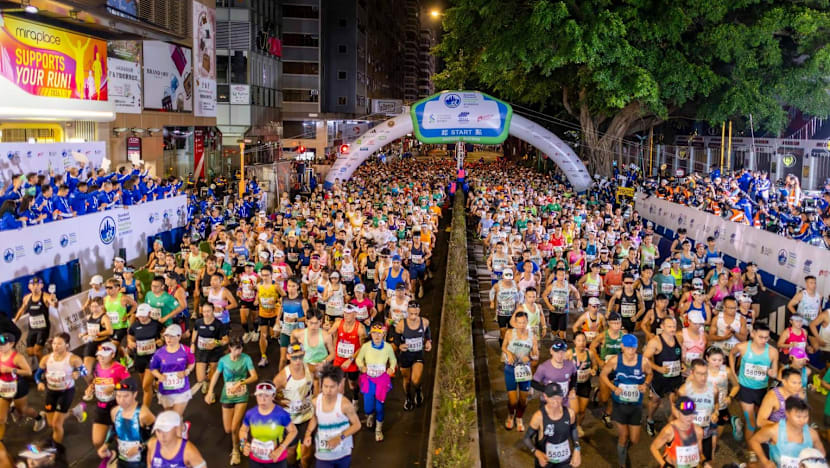 More than 70,000 runners took to the streets for the Standard Chartered Hong Kong Marathon on Jan 18, 2026. (Photo: Facebook/Standard Chartered HK Marathon)
China’s sports obsession survived the pandemic, with some determined marathoners running circles in their living rooms during rolling lockdowns. While marquee events like the Beijing Marathon were cancelled for two years, some races were allowed to go ahead - leading to a disaster in 2021. That year, 21 ultra-marathoners, including some top champions, died from hypothermia after extreme weather struck a trail run in the northwestern province of Gansu. More than two dozen officials were punished for being negligent and allowing the runners to go on a mountain race without adequate gear.
Races gradually resumed three years ago. But a series of unrelated incidents last year involving an underage runner, alleged rule-breaking pacers, and complaints about crowd control seemed to push the authorities to prick the marathon bubble by cancelling races. In October, the Chinese Athletics Association released new rules reminding organisers of their legal responsibility for enforcing safety regulations and applying stricter vetting to smaller-scale runs.
HURDLES REMAIN
Setting up sports events can require significant resources, including public services. On Sunday in Hong Kong, buses had to be rerouted, while police were helping with managing the streets and crowds. And with so many competitors, medical emergencies were inevitable. A total of 59 runners were taken to hospitals, with two in critical condition. Such incidents are not unusual for a race of this size.
Taking part in a marathon is estimated to cost about 3,000 yuan (US$430) per person, when factoring in expenses like travel, accommodation, and food. A city like Wuxi stands to earn nearly US$30 million from a single race. At a time when consumer apathy plagues the economy - requiring the government to pump tens of billions of dollars a year into industrial subsidies to get things going - it seems foolish to ignore the needs of people who want to spend.
Their support has powered the fortunes of a slew of sportswear makers, which are faring much better than general clothing retailers. Foreign players like Nike and Adidas were the first to benefit. But their own missteps and the rise of guochao, or “China chic”, has fuelled sales at Chinese firms Anta Sports Products, Li Ning and Xtep International Holdings.
Of the five well-heeled mainland runners I met on Sunday, all complained about a lack of access. One had applied for 10 races this year and was accepted only to the Hong Kong marathon. Another has given up on homegrown competitions for now and plans to travel to Japan in March.
It may take time for sports authorities in China to assess applications from cities that want to hold events, but those properly equipped to undertake the necessary preparations should be allowed to resume their activities. The economics that underpinned the decade-long boom haven’t changed. People have cut their consumption overall but are spending more on their favorite sports and the experiences associated with them.
China is right to bet big on its sports economy, which it plans to grow into a 7 trillion yuan (US$1 trillion) industry by 2030. That’s roughly double the amount recorded in 2023. And while it was necessary to put a halt on marathon madness to deal with safety fundamentals, policymakers shouldn’t go too far. They should recognise the opportunity they have - and run with it.
Source: Bloomberg/sk