[The content of this article has been produced by our advertising partner.]
Manulife has launched a global Longevity Institute with a C$350mn (HK$1.96bn) commitment through 2030, sharpening its focus on how people live longer lives with better health and financial resilience.
The initiative is a response to global trends. People are living longer, yet some may spend many of those added years facing health challenges or financial uncertainty. Manulife believes this is the moment to address that gap in a more structured and coordinated way. The Longevity Institute supports work across three pillars – research, advocacy and community partnerships.
Research focuses on evidence-based insight into healthy ageing and financial readiness, advocacy promotes awareness of health and…
[The content of this article has been produced by our advertising partner.]
Manulife has launched a global Longevity Institute with a C$350mn (HK$1.96bn) commitment through 2030, sharpening its focus on how people live longer lives with better health and financial resilience.
The initiative is a response to global trends. People are living longer, yet some may spend many of those added years facing health challenges or financial uncertainty. Manulife believes this is the moment to address that gap in a more structured and coordinated way. The Longevity Institute supports work across three pillars – research, advocacy and community partnerships.
Research focuses on evidence-based insight into healthy ageing and financial readiness, advocacy promotes awareness of health and long-term planning, and community partnerships support practical programmes in local markets, including Hong Kong.
Karen Leggett, Manulife’s global chief marketing officer, said the Institute formalises work that has been developing across the group over time. She said: “Empowering health, wealth and longevity is a core part of Manulife’s ambition. It reflects our values and our commitment to the communities where we operate.”
Longer lives bring new challenges for individuals and institutions alike, she said. People are required to plan for extended retirements, manage health risks over a longer horizon and consider how purpose and independence can be sustained in later years.
Insurers, in turn, must balance prevention and preparedness with long-term risk management. This context requires a different approach to product design, health partnerships, customer engagement and education programmes, she said.
Global thinking, local application
Although the Longevity Institute operates globally, Leggett said its relevance depends on how insight is applied locally. Patterns of ageing, health systems and family expectations vary from one region to the next, limiting the effectiveness of a single approach.
“Global direction matters, but it only works if it can be adapted to local conditions,” she said. “Markets such as Hong Kong provide valuable insight into how people think about ageing, independence and responsibility.”
Hong Kong has emerged as one of the places where longevity thinking is being applied in practice. High life expectancy, changing family structures and rising attention to mental well-being have increased interest in preventive healthcare and early support.
For Manulife Hong Kong and Macau, the city provides an environment where health innovation, financial and retirement planning and community partnerships intersect. Patrick Graham, chief executive officer of Manulife Hong Kong and Macau, said customer expectations have shifted.
“Customers want access to care and practical support that helps them stay healthy and financially secure throughout their lives. That expectation now goes beyond traditional insurance protection,” he said.
What Hong Kong consumers are telling insurers
.png "Celia Ling, chief marketing officer, Manulife Hong Kong and Macau (left), and Jeanie Ho, head of Hong Kong and Macau retirement, Manulife (right), present key findings from the Manulife Asia Care Survey 2025.")
Celia Ling, chief marketing officer, Manulife Hong Kong and Macau (left), and Jeanie Ho, head of Hong Kong and Macau retirement, Manulife (right), present key findings from the Manulife Asia Care Survey 2025.
Consumer insight has informed how Manulife Hong Kong and Macau applies its longevity strategy in the city. Findings from the Manulife Asia Care Survey 2025 show that people define health in broader terms than simply avoiding illness.
Seventy-seven per cent of respondents said health meant living independently and being able to do what matters to them. Many indicated they would prefer a more fulfilling life even if it meant living to age 75 rather than the average 80.
The survey also reveals a close relationship between physical wellness, mental well-being and financial security. Eighty-three per cent of respondents view family support as vital to mental health, while seventy-seven per cent believe mental well-being influences how long they expect to stay healthy.
The role of family and emotional support in helping people age well is evident in the findings, said Celia Ling, chief marketing officer for Manulife Hong Kong and Macau, noting a change in how people think about ageing.
She added that separate co-research conducted with Mind HK, a local mental health charity, shows the scale of mental health challenges in the city, estimating that nearly half of residents reporting symptoms of anxiety, depression or both.
“Independence, purpose and meaningful experiences are what people look for nowadays. Living well on their own terms requires confidence in both health and finances,” said Ling.
Alongside the Longevity Institute as a framework, local-specific findings from the Asia Care Survey and the co-study with Mind HK have guided how Manulife Hong Kong and Macau designs health, protection and retirement solutions for customers.
Longevity planning, she noted, considers access to healthcare, mental well-being and family dynamics apart from income considerations.
Health access as part of longevity planning
On top of research and insight, Manulife Hong Kong and Macau has invested in partnerships that improve access to healthcare, with Graham describing access as an important factor in long-term resilience.
One area of focus has been enhancing medical access in the Chinese Mainland. Manulife Hong Kong and Macau’s partnership with New Frontier Group enables cashless services for day-case surgeries at United Family Hospitals and for inpatient surgeries within Prosper Health’s medical network in the Chinese Mainland.
The objective of the arrangement is to provide greater certainty around costs and easier access to treatment when care is sought across the border.
A Cancer Drug Support Service has been introduced to allow eligible customers to access certain oral cancer medications in Shenzhen, with appointments and logistics supported by Manulife Hong Kong and Macau’s case managers.
At the same time, Manulife Hong Kong and Macau has expanded its hospital access to cover more than thirty-eight thousand public and private medical facilities across the Chinese mainland.
Manulife Hong Kong and Macau recently signed a memorandum of understanding with Bupa. The collaboration focuses on developing a more integrated healthcare network, supporting greater access, choice and convenience for customers in Hong Kong.
.png "Manulife Hong Kong and Macau and Bupa have signed a MoU, with the intention of forming a strategic collaboration in Hong Kong to create a more robust, integrated healthcare network, offering customers greater access and choice.")
Manulife Hong Kong and Macau and Bupa have signed a MoU, with the intention of forming a strategic collaboration in Hong Kong to create a more robust, integrated healthcare network, offering customers greater access and choice.
Community partnerships and early support
Longevity thinking is also applied through community programmes, particularly in mental health and emotional well-being. Manulife Hong Kong and Macau has worked with Mind HK since May 2024 under a multi-year partnership focused on public awareness and early support.
A joint study with the mental health charity estimated that nearly half of Hongkongers show signs of anxiety, depression or both, with more than one in six reaching moderate to severe levels. Mental well-being plays a key role in quality of life and long-term health.
Under the partnership, Manulife Hong Kong and Macau supports mental health programmes focused on awareness, stigma reduction and accessible support. Thousands have already benefited from these initiatives.
The new Manulife x Mind HK Free In-Person Well-being Check-in programme has already been launched, offering early assistance for adults1 who may not yet be ready to seek clinical care.
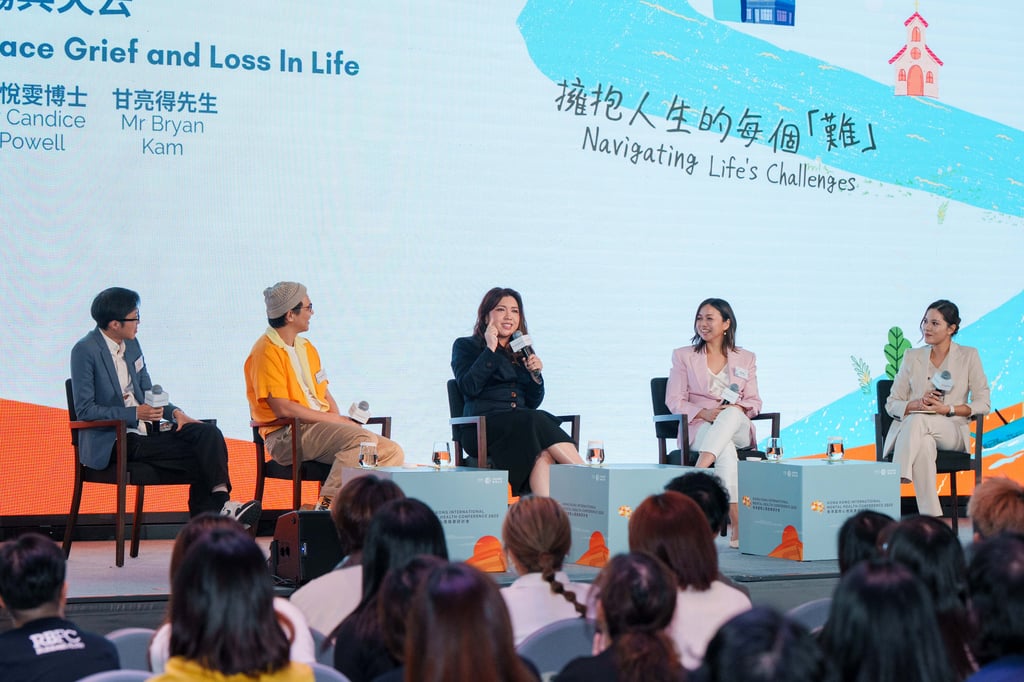
Band vocalist 6@RubberBand (second from left), singersongwriter Serrini (centre) and Dr Candice Powell, CEO of Mind HK (second from right), took part in a panel discussion at the Hong Kong International Mental Health Conference 2025, with Manulife Hong Kong and Macau serving as the headline sponsor.
Manulife Hong Kong and Macau has also collaborated with the local charitable organization JUST FEEL to enhance students’ emotional well-being. The multi-year partnership supports a range of initiatives, including the Compassionate School Programme, fostering teacher community, developing practical teaching tools and public engagement activities such as My Flag Day.
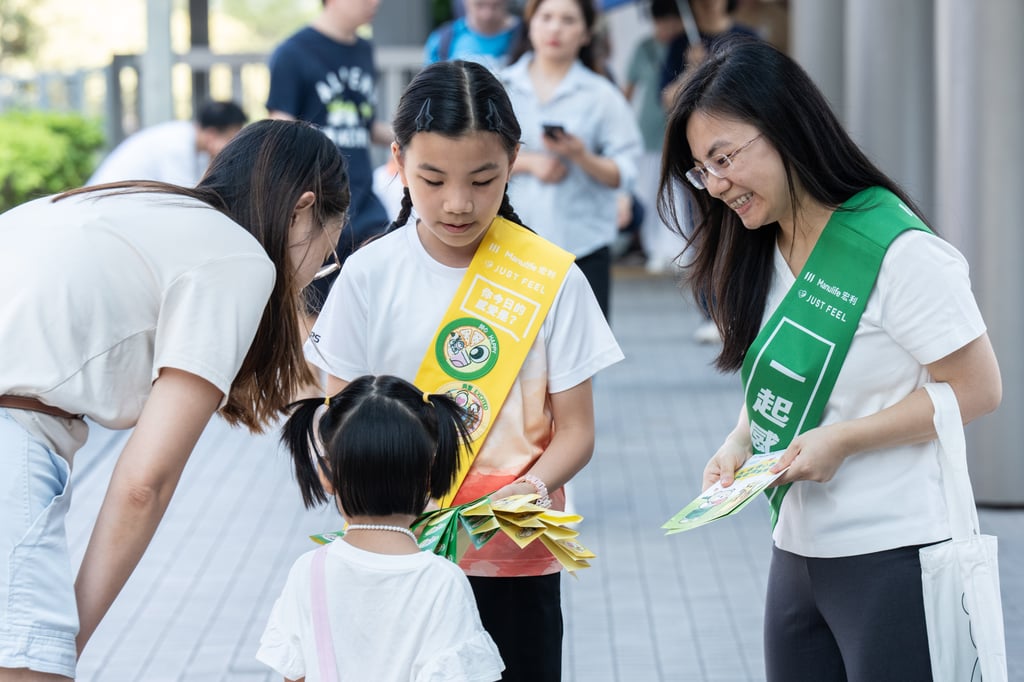
The family volunteers from Manulife Hong Kong and Macau and nine JUST FEEL partner schools invited the public to share their feelings and actively distributed the Feeling Flags.
Measuring outcomes and internal culture
In order for longevity initiatives to deliver lasting value, outcomes need to be measured and applied across the organisation. Leggett said the Longevity Institute was designed to ensure insight leads to action rather than remaining theoretical.
“Research gives us a clearer understanding of how people experience ageing, health and financial pressure,” she said. “What matters is how those insights are applied, whether through product design, partnerships or customer engagement.”
According to Leggett, outcomes are assessed across several dimensions, including customer engagement, health-related behaviours and financial preparedness.
This draws on longevity preparedness research alongside indicators linked to claims experience and long-term risk. Prevention and early support contribute to improved outcomes for both customers and insurers.
At a local level, Graham said this approach is reflected in how Manulife Hong Kong and Macau works with employees and customers in the city.
“Our commitment to the city and its people is about supporting both health and financial security,” he said. “An integrated approach to health and wealth helps people live well over the long term.”
Company-wide, well-being check-in days, training for employees and agents and tools that encourage open discussion have been introduced. Graham said employees value support that helps them manage pressure and maintain balance.
“When people feel supported in their health and well-being, they are better able to stay engaged and perform at their best,” he said.
Agents have a role to play, too. Training options are being explored to help agents recognise early signs of emotional difficulty and respond appropriately, given their position as trusted advisers who are often among the first to hear when customers are struggling.
Turning longevity strategy into action
Globally, the Longevity Institute provides a practical framework for turning insight and partnerships into action across markets, while allowing Manulife to take a broader view of ageing, health and financial preparedness and remain responsive to regional differences, according to Leggett.
That global approach is now being applied in Hong Kong, where an ageing population is already exerting pressures on healthcare systems.
“Hong Kong is ageing at an unprecedented pace, with life expectancy among the highest in the world and the proportion of older residents set to rise sharply in the decades ahead,” said Graham.
An earlier study by the Insurance Authority estimates that the city faces a protection gap of about HK$6.9tn, or HK$1.9mn per economically active adult. As the insurer serving one in three people in the city, he believes Manulife Hong Kong and Macau has both a responsibility and an opportunity to help narrow that gap through stronger health, protection and retirement readiness.
As Hong Kong prepares for longer lives and changing health needs, the focus remains on prevention, preparedness and practical support, said Graham.
That approach will be discussed further at the upcoming inaugural Longevity Insights Forum in Hong Kong, where research, industry perspectives and local experience will be brought together to examine how longevity thinking can be applied in practice.
Remark: “Manulife” refers to Manulife Financial Corporation. “Manulife Hong Kong and Macau” refers to Manulife (International) Limited.
1Registrants are required to fill out the application form to register their interest and test eligibility.