In 2019, during a trip to Marrakech, Gary He (New York, 41 years old), a photojournalist based in the Big Apple, went into a McDonald’s. It was Ramadan, and he saw that they had an iftar kit — the meal eaten to break the day’s fast, just after sunset — with harira soup, dates, chebakia, and a yogurt and milk drink. He had been pondering for years how a global fast-food chain with more than 43,000 restaurants scattered around the world, according to Statista, offered specialties from the places where it operated; perhaps, he thought, that had been…
In 2019, during a trip to Marrakech, Gary He (New York, 41 years old), a photojournalist based in the Big Apple, went into a McDonald’s. It was Ramadan, and he saw that they had an iftar kit — the meal eaten to break the day’s fast, just after sunset — with harira soup, dates, chebakia, and a yogurt and milk drink. He had been pondering for years how a global fast-food chain with more than 43,000 restaurants scattered around the world, according to Statista, offered specialties from the places where it operated; perhaps, he thought, that had been one of the secrets of its success. He found that there was very little information on the subject, so he decided it was time to do some research, delve deeper, and solidify his findings into a project.
Six years, more than 50 countries, six continents, and thousands of shots later, the photojournalist has published his book, McAtlas: A Global Guide to the Golden Arches, in which he challenges the notion that the multinational is a kind of homogenizing, monolithic juggernaut that steamrolls the local culture of the country it enters. “There’s some truth to that!” he clarifies. “But it’s not all McNuggets and Big Macs. There are also bowls of rice, spaghetti, macaroni, and falafel,” he explains. He attributes this to the fact that the business is structured more like a network of local business owners — “with access to similar branding resources, of course” — and less like a beehive. “I think this mechanism has allowed the brand to expand its customer base abroad, beyond those interested in a particular slice of American culture,” he reflects via email.
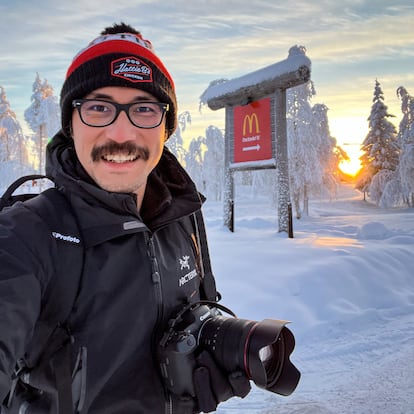
He defends his thesis with a selection of 250 photographs of an anthropological nature, full of local idiosyncrasies and accompanied by data, locations, and historical context. One shows the façade of the McDonald’s on Connaught Place, in the heart of New Delhi, as a couple of tuk-tuks, with their typical green and yellow colors, pass by. Opening a restaurant that sells hamburgers in India, where most of the population doesn’t eat cows, was quite a challenge, overcome thanks to the substitution of lamb for beef. “Years later, they developed products adapted to local tastes, such as the McAloo Tikki and the Veg Pizza McPuff,” He adds.
McDonald’s declined to participate in his project. “They’re very busy running their empire, so it was a completely independent journalistic initiative of mine,” jokes the photographer, who bought the food he photographed himself. “This added an element of authenticity; I photographed real items, just as a customer would see them, not carefully staged and curated advertising photos,” he explains. He would order the food and take it to the hotel, where he had already set up a makeshift studio, arranging his order on colored cardboard laid out on the floor. “I wish I had pictures of myself comically running from the restaurants to the hotel,” he remarks.
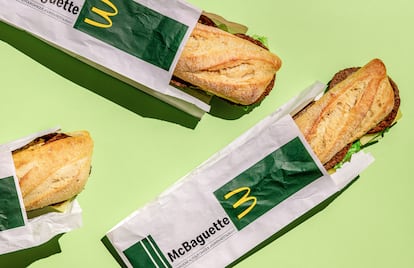
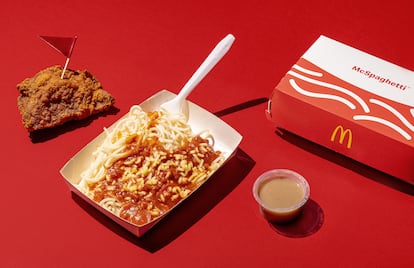
The McBaguettes he ordered in France were the first product he intentionally immortalized on colored paper, with a single flash. That’s when he knew this would be the esthetic for his images. “It allowed me to standardize the food photography in the book, so that only the differences between the various menus would be noticeable,” he explains. The formal similarities between the portrait of the baguette against a green background and the open McSpaghetti box against a red background are evident, for example. “Where do you think it comes from?” he asks about this latter culinary offering. “It’s not from Italy, but from the Philippines, where a local chain was already serving a very popular spaghetti dish at children’s birthday parties when McDonald’s arrived,” he explains.
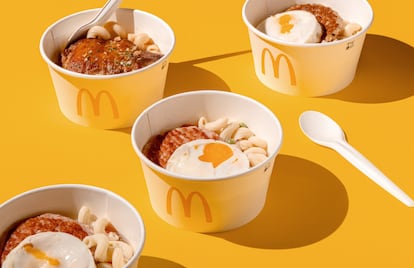
He traveled to Shenzhen, to the first McDonald’s that opened in China. “It opened when Shenzhen was a special economic zone, to see if Western companies could integrate into a country with a reputation for being closed,” he explains. Thirty-five years later, he reveals, the Asian country is the chain’s fastest-growing market. He also visited a restaurant in Hong Kong, where he ordered a macaroni soup that filled him with nostalgia. “My parents are originally from southern China, and when I was a child, they would make me this dish, which is very popular in Hong Kong’s cha chaan teng [traditional tea houses]. So, when I learned that McDonald’s had its own version of this specialty, I was flooded with childhood memories."
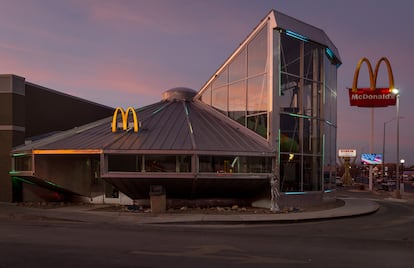
The majority of the images in McAtlas were taken over the three years following the Covid-19 pandemic. Regarding the Roswell, New Mexico location — the supposed crash site of an extraterrestrial spacecraft — he explains that it’s called UFO McDonald’s and has perfectly blended in with the space theme of a town where even the streetlights are shaped like alien heads. Regarding Méqui 1000 — the 1,000th McDonald’s to open in Brazil, in a historic house on Paulista Avenue in São Paulo — he mentions that it offers an exclusive special menu. This menu includes banana cake, guarana soda, and Coca-Cola ice cream, all while enjoying music from a live DJ.
Denton House is a late 18th-century mansion located in New Hyde Park, New York. Of all the locations featured in the book, it’s the closest to He’s home. “I didn’t even have to take a plane,” he says happily. And it’s probably also the most elegant. It was bought by the fast-food chain, which intended to demolish it and build a standard restaurant on the site, but residents mobilized to save the building, successfully getting it declared a historic landmark. After that, the company opted to renovate it and open the restaurant. “I think my work shows how, to survive and thrive worldwide, a global brand adapts to the will and tastes of its local customers,” He concludes.
Two James Beard Awards
Gary He published McAtlas: A Global Guide to the Golden Arches with Parla Publishing in November 2024. In June 2025, it won two James Beard Awards, the prestigious awards recognizing cookbooks and books related to food and beverages in the United States. These accolades, in particular, have generated "a lot of excitement" for the book, according to its author. So much so that he expects to hear about its international distribution "very soon."
*Sign up for our weekly newsletter to get more English-language news coverage from EL PAÍS USA Edition *