The Unexpected Effectiveness of One-Shot Decompilation with Claude (via) Chris Lewis decompiles N64 games. He wrote about this previously in Using Coding Agents to Decompile Nintendo 64 Games, describing his efforts to decompile Snowboard Kids 2 (released in 1999) using a "matching" process:
The matching decompilation process involves analysing the MIPS assembly, inferring its behaviour, and writing C that, when compiled with the same toolchain and settings, reproduces the exact code: sam…
The Unexpected Effectiveness of One-Shot Decompilation with Claude (via) Chris Lewis decompiles N64 games. He wrote about this previously in Using Coding Agents to Decompile Nintendo 64 Games, describing his efforts to decompile Snowboard Kids 2 (released in 1999) using a "matching" process:
The matching decompilation process involves analysing the MIPS assembly, inferring its behaviour, and writing C that, when compiled with the same toolchain and settings, reproduces the exact code: same registers, delay slots, and instruction order. [...]
A good match is more than just C code that compiles to the right bytes. It should look like something an N64-era developer would plausibly have written: simple, idiomatic C control flow and sensible data structures.
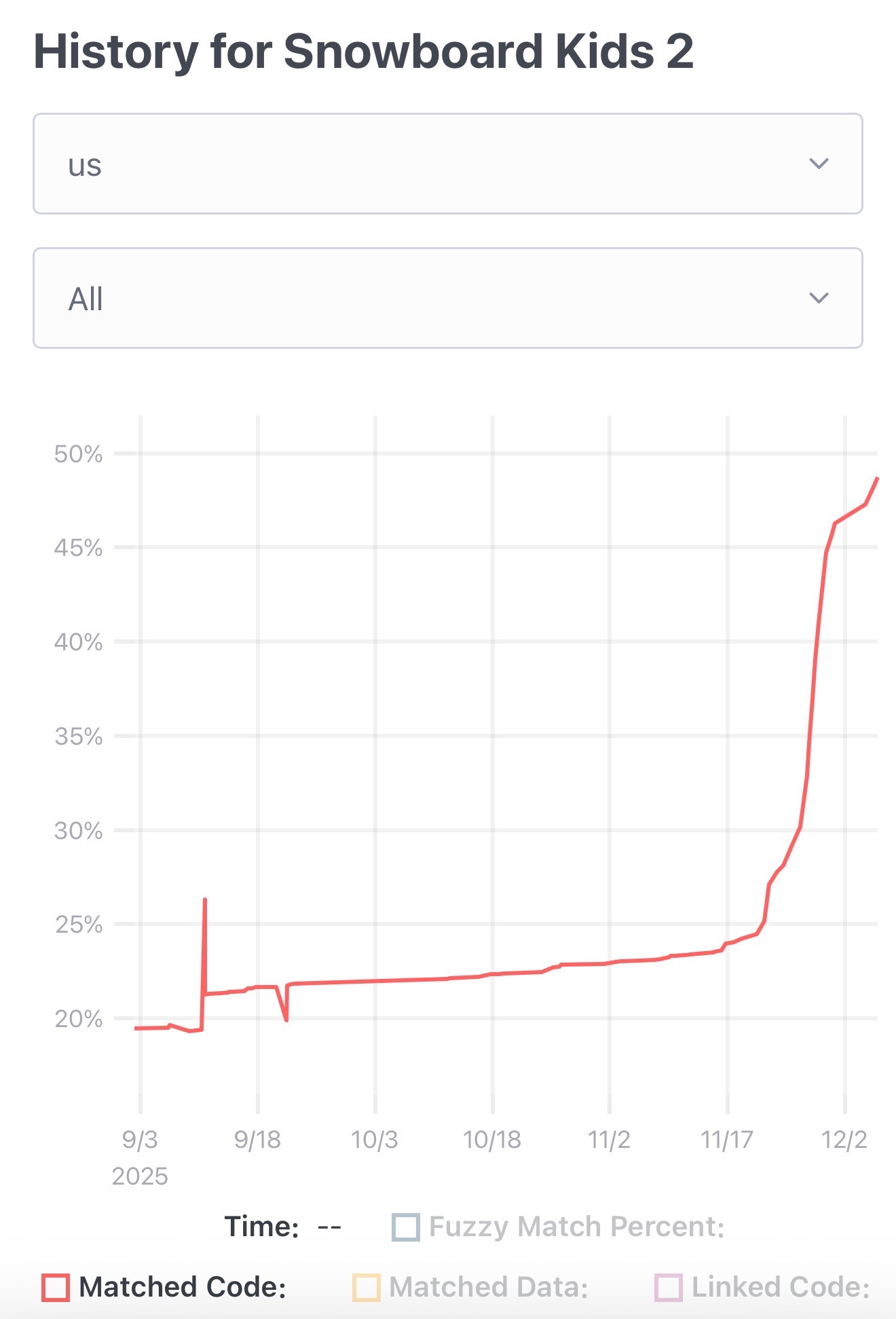
Chris was getting some useful results from coding agents earlier on, but this new post describes how a switching to a new processing Claude Opus 4.5 and Claude Code has massively accelerated the project - as demonstrated started by this chart on the decomp.dev page for his project:
Here’s the prompt he was using.
The big productivity boost was unlocked by switching to use Claude Code in non-interactive mode and having it tackle the less complicated functions (aka the lowest hanging fruit) first. Here’s the relevant code from the driving Bash script:
simplest_func=$(python3 tools/score_functions.py asm/nonmatchings/ 2>&1)
# ...
output=$(claude -p "decompile the function $simplest_func" 2>&1 | tee -a tools/vacuum.log)
score_functions.py uses some heuristics to decide which of the remaining un-matched functions look to be the least complex.