54 minutes ago
Ashitha NageshBBC News
Gerry McCann says hounding by press took ‘huge toll’ on family
Madeleine McCann’s father is calling for greater scrutiny of the UK’s media, saying that his family was subjected to "monstering" by sections of the press.
He said the media "repeatedly interfered with the investigation" into his daughter’s disappearance in 2007 and believes this has hindered the search for her.
Gerry McCann told BBC Radio 4’s Today programme that more than a year on from Labour coming into power, "press regulation is no longer a priority".
He wants a resumption of the cancelled second phase of the Lord Leveson Inquiry, which would have examined unlawful action by the media, plus journalists’ relationships with politicians and police. It was scrapped by the …
54 minutes ago
Ashitha NageshBBC News
Gerry McCann says hounding by press took ‘huge toll’ on family
Madeleine McCann’s father is calling for greater scrutiny of the UK’s media, saying that his family was subjected to "monstering" by sections of the press.
He said the media "repeatedly interfered with the investigation" into his daughter’s disappearance in 2007 and believes this has hindered the search for her.
Gerry McCann told BBC Radio 4’s Today programme that more than a year on from Labour coming into power, "press regulation is no longer a priority".
He wants a resumption of the cancelled second phase of the Lord Leveson Inquiry, which would have examined unlawful action by the media, plus journalists’ relationships with politicians and police. It was scrapped by the Tories in 2018.
Madeleine disappeared at the age of three during a family holiday in Portugal and has never been found.
In a rare interview, Mr McCann said that for months after her disappearance his family had "journalists coming to the house, photographers literally ramming their cameras against our car window when we had two-year-old twins in the back who were terrified".
"We are lucky we survived. We had tremendous support - but I can promise you, there were times where I felt like I was drowning. And it was the media, primarily," he told the BBC.
"It was what was happening and the way things were being portrayed, where you were being suffocated and buried, and it felt like there wasn’t a way out."
Mr McCann and his wife, Kate McCann, are among more than 30 people to have signed a letter being sent to Prime Minister Sir Keir Starmer and calling on him to reverse the decision not to hold the second phase of the Leveson Inquiry.
Among the other signatories are the families of Hillsborough victims, and the mother of TV presenter Caroline Flack.

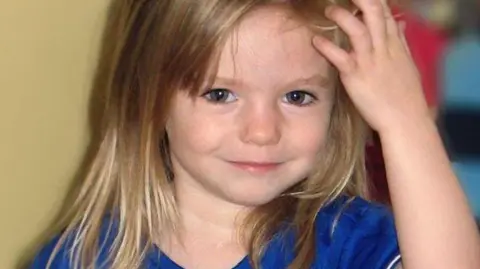
Madeleine McCann disappeared in 2007, then aged three
The letter, seen by the BBC, requests a meeting with the prime minister, saying: "We understand that you recently had time to meet News Corp chairman Lachlan Murdoch.
"We hope you will now meet with some of the British citizens whose lives have been upended by the illegal practices and abuses associated with his company."
Mr McCann told the Today programme: "It’s quite obvious that press barons can meet the prime minister, but the people who have suffered at the hands of them can’t."
News UK, the UK branch of News Corp, declined to comment.
The first part of the Leveson Inquiry was held from 2011 to 2012, in the wake of the phone-hacking scandal.
Its findings were published in 2012, and led to the creation of the industry-funded press regulator Ipso.
Mr McCann told the BBC that the inquiry’s second phase had "almost certainly" not happened because he believes that politicians in the UK are fearful of the press.
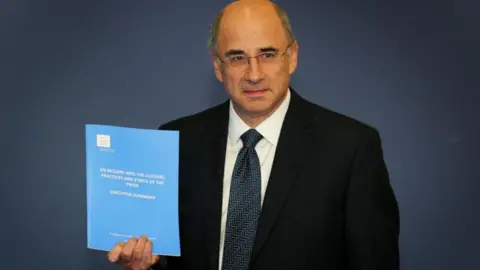 PA Media
Lord Leveson’s report in 2012 recommended a self-regulation body for the press
He said that in the run-up to last year’s general election, Labour politicians had committed to implementing the recommendations made in the first part of the Leveson Inquiry, and that he was "extremely disappointed" that they hadn’t done so.
"We’re over a year into the government, and there haven’t been any changes," he said.
"It’s not acceptable to me now, more than a year on, that Leveson and press regulation is no longer a priority."
A DCMS spokesperson told the BBC it "recognises that for victims and their families, incidents of harassment and intrusion from the media cause significant distress".
"The Culture Secretary has met with individuals and families who have experienced this intrusion in the past and the government is committed to ensuring that these failings are never repeated," they said.
‘We put our morals aside’
Mr McCann added that he and his wife had "supped with the Devil" by working with the Sun in 2011, in order to have the investigation into Madeleine’s disappearance reviewed - illustrating the newspaper’s influence.
"There was a front page letter published in The Sun, and [then-prime minister] David Cameron ordered the review," he said.
"That’s the power they had. So we put our morals aside to work with them to achieve what we wanted."
Criticising media coverage of the investigation, he said: "Published material which should have been confidential, should be passed on to the police, witness statements, many other things that have gone out," he said.
"So if you were the perpetrator, you knew a lot more than you should have done - and as a victim, as a parent, it’s absolutely dismaying."
‘Making stories up’
Mr McCann gave a witness statement at the Leveson Inquiry on behalf of himself and his wife in November 2011.
In it, he described news outlets "making stories up" about them, as well as a "sustained, inaccurate and malicious series of headlines in a number of papers which gave the impression that we were in some way responsible for or involved in Madeleine’s disappearance".
He also said around the time their daughter disappeared, the now-closed News of the World newspaper had published complete transcripts from Kate McCann’s personal diary.
That diary had been seized by police in Portugal as part of their investigation into Madeleine’s disappearance, and the couple were "unsure as to how the [News of the World] obtained a copy", the inquiry heard.
In his interview with the Today programme, Mr McCann said: "Madeleine’s been missing for 18 years, and the bottom line is, we still don’t know what’s happened to her."
He added that there is "no evidence".
"I don’t even mean ‘convincing’ evidence - there is no evidence to say she’s dead," he said.
"Now we fully understand she may be dead, it may even be probable, but we don’t know that."
A spokesperson for press regulator Ipso told the BBC that it can intervene directly in cases of press harassment.
"We encourage anyone with concerns about press behaviour to contact us for help," it said.