©ヤマシタトモコ・祥伝社/アニメ「違国日記」製作委員会
One evening, a few months ago, I opened a blank Word document and just started writing. I hadn’t kept a journal since high school, but my brain, overflowing with thoughts, needed release. I spewed words nonstop for about an hour, saved the document, and haven’t opened it since. Nobody else has looked at it, not even my therapist. It was for me that existed in that moment, and it served its purpose. I don’t need anything else from those words right now.
I thought about that blip of messy and furious catharsis when Makio recommends that Asa keep a journal. She barely knows her niece at that point, and she surely…
©ヤマシタトモコ・祥伝社/アニメ「違国日記」製作委員会
One evening, a few months ago, I opened a blank Word document and just started writing. I hadn’t kept a journal since high school, but my brain, overflowing with thoughts, needed release. I spewed words nonstop for about an hour, saved the document, and haven’t opened it since. Nobody else has looked at it, not even my therapist. It was for me that existed in that moment, and it served its purpose. I don’t need anything else from those words right now.
I thought about that blip of messy and furious catharsis when Makio recommends that Asa keep a journal. She barely knows her niece at that point, and she surely doesn’t know if she’s a writer or not. Nevertheless, Makio recognizes something in her, and she, like all writers, knows how powerful the act of writing can be. Longtime readers will no doubt recognize that I sometimes use these reviews to process ideas and emotions that may be only tangentially related to the episode at hand. I may even be doing that at this very moment. All I know is that it’s something I have to do. It’s a blessing and a curse. It’s an incantation that can diagnose, cure, or exercise. And Makio the witch passes this very magic down to her niece with a frazzled yet selfless kindness.
Three episodes in, I have a vault stuffed with compliments that I wish to pay Journal with Witch, both as a story and as an adaptation. I’m sad I can only dole them out one at a time. But the single aspect that keeps bowling me over is its quiet emotional intelligence. This is a story about Asa coming to terms with the loss of her parents while Makio comes to terms with their brand new relationship. Neither character arrives at the narrative with the equipment necessary to process the complexity of their situation. However, Journal with Witch gently takes their, and the audience’s hands, and patiently guides them down this winding path, sidestepping both melodrama and triteness with a deft touch. We learn how to find poignancy in the practice of making gyoza, and we discover the therapeutic potential of conjugation. Taken as a whole, this story feels like one of the precious few anime written by an adult, for adults.
On the other hand, Journal with Witch finds strength in not centering itself solely on its adult characters. Asa is just as important a protagonist as Makio is. She flounders from a lack of life experience, while Makio fumbles with routines she needs to unlearn. Both parts of this story are necessary because the narrative’s big picture stresses the importance of bonds formed between women, both within their cohorts and across generational lines, both familial and friendly. This isn’t surprising to see from a josei manga, but we shouldn’t overlook how rare it is to get an anime adaptation of a story so laser-focused on female relationships without the additional baggage of romance or sensationalized storytelling. While I’m a big fan of romantic and/or sensationalized stories about women, I also believe it’s important to tell a variety of tales, and we need a lot more in the vein of this one.
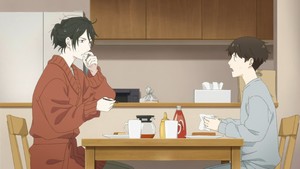
Despite its dearth of peers, Journal with Witch pulls the weight of several equivalent series with the amount of confidence and craft on display. The nonlinear storytelling in the premiere correctly places the funeral scene at its climax, when Makio gives in to her heroic impulses, and Asa accepts this ripcord out of her downward spiral into utter numbness. Daigo’s presence in the second episode primes us for Emiri’s in the third. Shared meals accumulate like building blocks filling in the contours of Asa and Makio’s relationship—contrast the lifelessly photogenic sushi at the funeral against Makio’s messy yet rustic sausage toast concoction. Reflections, meanwhile, are a consistent visual motif providing a window into the painful past. Their visit to Asa’s old apartment lets the presence of the dead linger mostly unspoken, save for a few pointed interjections that cause Makio’s old wounds to throb. Hauntings, by nature, are lonely experiences, but Makio and Asa can fend off ghosts when they are lonely together.
I like, too, that Journal with Witch pairs Makio’s writing with Asa’s singing. It shrugs off rote narratives about Makio taking Asa under her wing as her protege. It’s the creation of art that’s important, not the form the art takes. Asa’s creative release does not have to be the same as her aunt’s, as Makio discovers firsthand when she sees her doodle in the journal. However, Makio’s penchant for storytelling definitely rubs off on her niece. As Asa works through all of these new emotions and experiences, her brain whisks her away to fictitious scenes that help ground her. She narrativizes her life in the way I used to imagine my internal monologue being penned perpetually on some cosmic tome. It’s a distancing act, but with that distance comes perspective.
While perspective helps, it doesn’t heal. Makio and Asa originally bond due to their similarly muted responses to the suddenness and violence of the tragedy. Whereas others might judge or consider them heartless, Makio helps Asa understand that their feelings—in this case, their ways of grieving—aren’t for the benefit of others. Makio only says goodbye to her sister when she is alone in a room filled with garbage. Asa’s emotions only overflow when she’s stripped of her agency to carry her sadness on her own. Makio gives her a choice. Her school doesn’t. At the same time, though, her fight with Emiri allows Asa her first chance to be angry. She blows up because she needs to, and because she isn’t her aunt. Makio could get away with never fighting her friends, and when she realizes that Asa isn’t the same, she diplomatically revises her prior advice. I do not doubt that their relationship will continue to be a series of amendments and revisions born out of frustration and love.
As much as I’d like to continue praising Tomoko Yamashita’s original work and Kohei Kiyasu’s adaptation for the screen, I’d be gravely remiss not to touch on the anime’s strengths as cinema. In a word, it is intricate. Makio’s room is a cluttered palace that is all too familiar to me (and, I assume, to other writers), and the show renders it in exquisite, lived-in detail. Wardrobe choices are muted and deliberate, grounding the audience in reality, and the character designs similarly eschew exaggeration in favor of familiarity. The animation also homes in on the minutiae of gestures and expressions as a means of drawing the audience into these characters’ lives. Miyuki Oshiro’s debut as a series director couldn’t be more gorgeous or more affecting. I cried throughout the third episode, and I have a feeling that won’t be the last time I do so.
Finally, the last point I’ll touch on for now is the show’s sound. kensuke ushio needs no introduction, but I’d clarify that his musical palette here most closely resembles the style he honed with Naoko Yamada. In fact, I’d argue that Yamada’s intimate portraits of women and their relationships together almost surely influenced Journal with Witch’s presentation. Both of the leads are also stellar. I never would have guessed this was Fūko Mori’s first role based on how adeptly she’s adapted to Asa’s character. Then again, Asa hardly resembles the average anime teen girl protagonist, so perhaps Mori’s plasticity as a newish voice actor works in the assignment’s favor. Meanwhile, Miyuki Sawashiro is, as always, a generational talent. She gives Makio her husky gravitas, while never letting us forget that this 35-year-old shut-in is, in some ways, even more of a disaster than her niece. Most importantly, Sawashiro and Mori’s chemistry is impeccable. We can hear Makio change her tone when she wants to give her niece some actual advice, and we can listen to the difference between Asa’s internal monologue and her conversations with the various adults who enter her life.
Normally, people use the “three-episode test” as a way of judging whether an anime is worth continuing. I think that has its merits. In Journal with Witch’s case, though, these three episodes leave me wondering not whether I should continue, but whether any other anime this year will come close to challenging it.
**Episode 1 Rating: **
**Episode 2 Rating: **
**Episode 3 Rating: **
- Journal with Witch is currently streaming on Crunchyroll. *
Sylvia is on Bluesky for all of your posting needs. She is a witch-in-training. You can also catch her chatting about trash and treasure alike on This Week in Anime.