The trade deal slashes US tariffs on Indian goods to 18 per cent, but further details on the agreement will be key, says Andy Mukherjee for Bloomberg Opinion.
File photo of US President Donald Trump and Indian Prime Minister Narendra Modi at the White House in Washington DC on Feb 13, 2025. (Photo: Reuters/Kevin Lamarque)
New: You can now listen to articles.
This audio is generated by an AI tool.
04 Feb 2026 05:58AM
HONG KONG: After more than five months in United States President Donald Trump’s tariff prison, India is finally free.
The punitive 50 per cent duty that was threatening its manufacturing industries will [fall to 18 per cent](https://www.channelnewsasia.com/world/russia-ukraine-war-oil-trump-modi-india-us-t…
The trade deal slashes US tariffs on Indian goods to 18 per cent, but further details on the agreement will be key, says Andy Mukherjee for Bloomberg Opinion.
File photo of US President Donald Trump and Indian Prime Minister Narendra Modi at the White House in Washington DC on Feb 13, 2025. (Photo: Reuters/Kevin Lamarque)
New: You can now listen to articles.
This audio is generated by an AI tool.
04 Feb 2026 05:58AM
HONG KONG: After more than five months in United States President Donald Trump’s tariff prison, India is finally free.
The punitive 50 per cent duty that was threatening its manufacturing industries will fall to 18 per cent, a tad better than key rival Vietnam’s 20 per cent. It’s also a discount on the 26 per cent reciprocal rate Trump had announced for India in his “Liberation Day” package last April. Overall, this is a great PR moment for Prime Minister Narendra Modi, who can spin it as an example that good things come to those who wait.
But before celebrations begin in New Delhi, the deal announced on social media by Trump - and confirmed by Modi - needs signatures. It also needs clarity about what the two leaders have actually agreed to, both in the agreement and in their phone call to take it over the finish line.
LOSING US ACCESS - THE GOOD AND THE BAD
For India, the threat of losing access to its biggest export market hasn’t been an entirely bad thing.
The isolationist hubris that had crept into how ministers and bureaucrats in New Delhi approached global trade has received a welcome jolt. The pressure from domestic industry to find alternatives to the American consumer has led to separate trade accords with the United Kingdom and the European Union. The latter pact had been in negotiation for two decades. Some of India’s more egregious non-tariff walls, built around quality control, are being dismantled.
Modi has also started mending ties with Chinese President Xi Jinping, frayed since the eruption of border hostilities in 2020 and aggravated by Chinese military support of Islamabad during the conflict between India and Pakistan last year.
But there were problems.
For three decades, India has cultivated the US as its buyer of first resort - not only for textiles, shrimp, jewellery and other labour-intensive industries, but also for white-collar software services. A twin-pronged attack by the Trump administration on trade and work visas for Indian techies was upending the broader relationship.
This wasn’t just some vague threat: New Delhi’s budget for the next financial year, released on Sunday (Feb 1), had markets worried about the fiscal cost of insulating the economy from Washington’s wrath.
QUESTIONS REMAIN
That pall of gloom should lift, and the risk of getting booted out of the American sphere of influence fall, provided that all the wrinkles that have been holding up the deal have been ironed out. But have they?
Trump’s post says that Modi has “agreed to stop buying Russian Oil, and to buy much more from the United States and, potentially, Venezuela”. Modi’s acknowledgment of the accord, however, makes no mention of Russian oil. Has he agreed to an immediate halt, or a staggered drop?
Ethane, a byproduct of US shale gas, is attractive as a feedstock for tycoon Mukesh Ambani’s petrochemicals business. His refinery can also handle Venezuelan heavy crude. But when it comes to supplying gasoline and diesel to 1.4 billion consumers, will state-owned Indian refiners be allowed to switch to Iranian barrels, when Trump has threatened to impose a 25 per cent tariff on countries doing business with Tehran?
The actual contours of the Trump-Modi pact may have ramifications not just for India’s energy security, but also for the global oil and gas market.
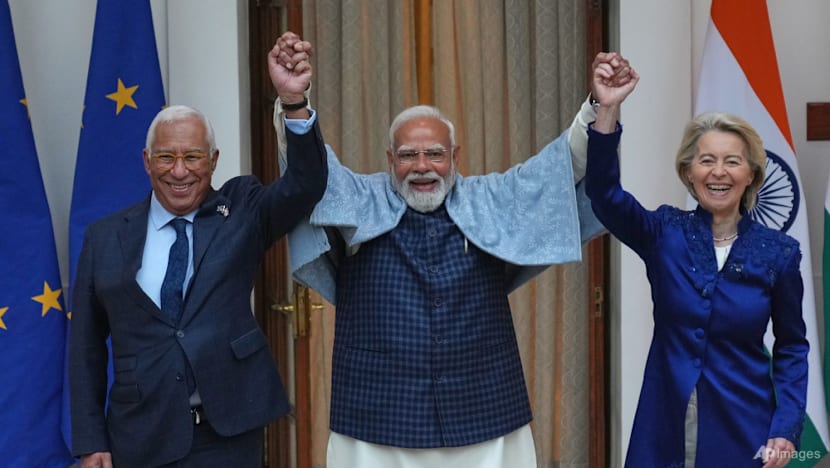 Indian Prime Minister Narendra Modi, center, welcomes European Council President Antonio Costa, left and European Commission President Ursula von der Leyen before their meeting in New Delhi, India, Tuesday, Jan. 27,2026. (AP Photo/Manish Swarup)
Trump has said that India will “move forward to reduce their Tariffs and Non Tariff Barriers against the United States, to ZERO” as well as purchase “over US$500 BILLION DOLLARS of US Energy, Technology, Agricultural, Coal, and many other products”.
Are weapon systems part of the agreement to reduce India’s traditional reliance on Moscow? Is unrestrained access to advanced AI chips on the table? Will US e-commerce platforms like Amazon be allowed to carry their own inventory? Once again, details are important.
Take agriculture. Will Modi relax the ban on genetically modified food crops when they aren’t allowed to be grown at home? India mixes 10 billion litres (2.6 billion gallons) of ethanol with gasoline annually - enough to absorb a hefty chunk of the corn harvested in the US Midwest. But as I have argued previously, US corn in Indian motorists’ gas tanks won’t be an easy sell.
It’s hard to preach the virtues of free trade to local farmers, when they aren’t allowed to benefit from it. After Russia invaded Ukraine in 2022, the government forced Indian wheat producers to withdraw from the global market to feed the local population. With a recent one-off exception, that ban on exports still remains in force. Opposition parties will scrutinise Modi’s giveaways on agriculture especially closely.
New Delhi drove a hard bargain with Brussels on a more liberal visa regime for its students to seek work in Europe. The reason isn’t hard to see. With the US taking a hard stance on foreign-born employees, India’s politicians and bureaucrats needed an alternative. Not just for their fellow citizens, but for their own children’s future outside the country.
However, for them - and Modi’s urban middle-class supporters - the draw of the US talent market remains undimmed by the surge in Immigration and Customs Enforcement crackdowns. With Indians accounting for 70 per cent of H-1B work visas, any concession from Trump on the US$100,000 fee per new employee will play well for Modi at home, provided he has managed to swing it.
Source: Bloomberg/sk