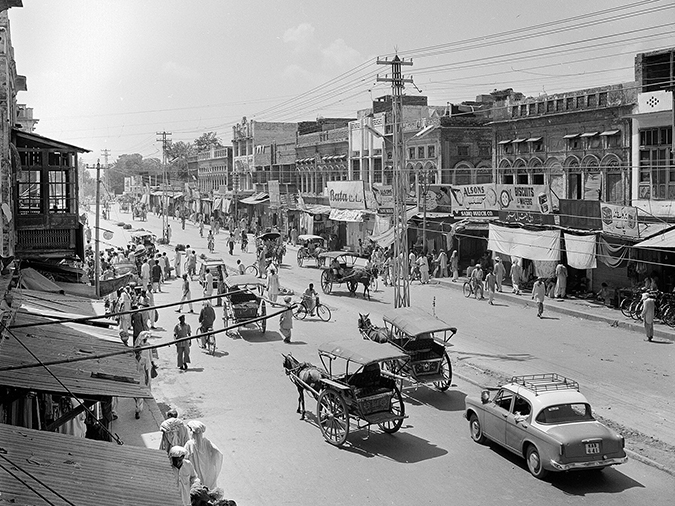
 Photo by Evans/Three Lions/Getty Images
What is a political novel? Too much fiction advertised as political is in fact merely ideological, rehearsing the all-too-optimistic assumptions of the median liberal reader. The few authors who strain to avoid doing so, the Houellebecqs and Naipauls adopting postures of abrasive truth-telling, often fail to recognise their own pessimism as ideological. Rare is the political novel animated by a sustained curiosity about how power actually works, one that leaves the reader with a clear sense of the author’s view of how the world operates – but no idea how he might vote.
In Other Rooms, Other Wonders (2009), Daniyal Mueenuddin’s debut collection of short stories, was jus…
Photo by Evans/Three Lions/Getty Images
What is a political novel? Too much fiction advertised as political is in fact merely ideological, rehearsing the all-too-optimistic assumptions of the median liberal reader. The few authors who strain to avoid doing so, the Houellebecqs and Naipauls adopting postures of abrasive truth-telling, often fail to recognise their own pessimism as ideological. Rare is the political novel animated by a sustained curiosity about how power actually works, one that leaves the reader with a clear sense of the author’s view of how the world operates – but no idea how he might vote.
In Other Rooms, Other Wonders (2009), Daniyal Mueenuddin’s debut collection of short stories, was justly praised as an instant classic. William Dalrymple declared it, in an effusion that was fully merited, “probably the best fiction ever written in English about Pakistan, and one of the best to come out of South Asia in a very long time”. Mueenuddin has taken his time over his second book, which comes out 17 years later. Spanning six decades and organised into four interlinked narratives, it traces the lives of a wealthy Pakistani family and those in their orbit, showing, patiently and unsentimentally, how authority, loyalty and ambition function within it. It is a political novel in the deepest sense; it will win awards, and it will deserve them.
This Is Where the Serpent Lives opens in Rawalpindi in the mid-1950s with Yazid, an abandoned orphan taken in by a tea-stall owner and gradually absorbed into the bazaar’s informal economy. Intelligent and acutely sensitive to status, Yazid rises through his initiative and physical strength. The novel then shifts to young Rustom returning to Pakistan in the late 1980s from an American education to take charge of the family’s neglected farm. Rustom brings with him liberal habits acquired abroad, and quickly discovers these are liabilities in his new life. Unable to navigate the local amalgam of custom, coercion and patronage, he is steadily outmanoeuvred so turns to his cousin, Hisham.
The third section turns inward, reconstructing the rise of Hisham himself. Hisham too has studied in the US, where he effectively stole his brother’s girlfriend, Shahnaz, a woman whose poise and intelligence mirror Hisham’s own appetite for dominance. The marriage that follows becomes the novel’s central arrangement of power. Back in Pakistan, Hisham and Shahnaz preside as indulgent patrons, their wealth underwriting a world of parties and favours. Yazid of the first section, now fully absorbed into their household, becomes both witness and instrument, his loyalty rewarded with proximity but never equality.
New year, new read. Save 40% off an annual subscription this January.
The long final section narrows its focus to Saqib, the ambitious son of a gardener, whom Yazid mentors and Hisham sponsors as a kind of social experiment. Intelligent, elegant and keenly attuned to opportunity, Saqib embodies the promise and the risks of mobility within this system. His desire to rise is far from naive, but as his ambitions sharpen he begins to test the system’s limits.
What these characters and stories demand of the reader, however, is not sympathy for individuals but a recalibration of the moral assumptions with which they are judged. One may see Mueenuddin’s vision as a sustained departure from the moral intuitions typical of what the anthropologist Joseph Henrich has influentially called “Weird” societies – Western, Educated, Industrialised, Rich, Democratic – whose psychological habits are so familiar in the West that they tend to pass for common sense. In such societies, moral reasoning tends to privilege abstract rules over relationships, to treat personal loyalty as a deplorable source of bias, and to understand moral failure primarily in terms of private guilt rather than public loss of standing.
Mueenuddin’s Pakistan is organised around a different moral grammar. People are intelligible through their place in a web of dependencies; authority is justified by patronage rather than impartiality. The novel does not present this world as an atavistic aberration awaiting reform but as a coherent moral order in its own right. When that order collides with the Weird assumptions that characters such as Rustom, Hisham and Shahnaz have absorbed from their British and American education, it produces confusion, miscalculation and harm.
The qualities judged most harshly in their world are stinginess, disloyalty, the failure to look after one’s dependants and forgetting past favours. When Hisham and Shahnaz shoot off periodically to their flat in London, what they value most is the chance to do their own cooking; having servants is the privilege that comes with enormous responsibility.
One might call their world a corrupt one, but “corruption” denotes a departure from some established norm and the norms here are not those of a liberal bureaucracy. The political scientist Anatol Lieven once wrote that “if a public monument is ever erected to the Ideal Pakistani Politician, the motto ‘he dunks but he splashes’, originally coined by Mayor Richard Daley of Chicago, should be inscribed on its pedestal”. Mueenuddin’s is a world in which the greatest sin is not to dunk, but to dunk without splashing.
“The system did not just tolerate theft on a small scale,” Mueenuddin writes, “but assumed it.” Figures who steal, sometimes spectacularly, can still command allegiance; those who stand on procedure don’t survive long. If this system holds together at all, it is because of those who operate in between: drivers, fixers, managers, protégés, men entrusted with errands and with secrets. It is here, at this intermediate level, that power is most densely concentrated. Violence is always just off the page, rationed until it erupts in a final section that will live long in every reader’s memory.
The effect Mueenuddin produces is the one created by the great tragedies, but not because his characters are overdetermined puppets. They make choices and exercise discretion, but never freely. They are always asking: how much force is enough? How much money may I take before my theft counts as a betrayal? How much mercy may I extend without inviting contempt for weakness? Their attempts at decency, at being better or wiser than their fathers, usually come to nothing. There is still something here that deserves to be called the ethical life, but it is fragile, always improvised, and always hostage to bad luck: one poor harvest, one ill-chosen word is all it takes.
The novel is sceptical of attempts to stand apart from this world in moral repugnance. Mueenuddin offers no moral standpoint outside the system from which judgement might safely be passed. “I’ve still got that fussy American stomach,” one casualty of a liberal arts degree remarks. “I get queasy.” But American queasiness – transparency, good faith, procedural fairness – will inevitably be read only as weakness.
When Shahnaz, another liberal manqué, declares to her landowning politician husband, “It’s disgusting. All you men are disgusting. It’s horrible,” she is both correct and trying to avoid the disconcerting knowledge that her whole way of life – the Frank Lloyd Wright-style house by the Indus with its illuminated swimming pool – depends on someone, elsewhere, doing disgusting things so that she doesn’t have to. She consoles herself, not entirely truthfully, with the thought that she is at least not as horrible as they are.
Saqib, the ambitious gardener’s son who dominates the book’s last and finest section, is a test case for his society. He commands the reader’s affection and loyalty for the intelligence and restraint with which he attempts to get his 10 per cent out of a quixotic plan to grow out-of-season vegetables in polytunnels. It is a sign of how deeply Mueenuddin invites us into his characters’ outlook that we are thinking with Saqib: why ever not, when everyone else is taking his own 10 per cent? In another world, one in which we might speak without irony of “the career open to the talents”, what might this resourceful, ingenious young man not have achieved?
Saqib is neither simply “corrupt” nor a hapless victim of an unjust order. He plays by the real rules, not the official ones; he takes no more than others take; and he understands exactly what is at stake. That even such shrewdness and prudence may prove insufficient is what gives the book its claim to tragedy.
In his great essay on Gray’s “Elegy…”, William Empson describes a familiar manoeuvre by which poetry lends dignity to injustice making it feel natural, inevitable and beyond remedy: wasted talent is likened to flowers blushing unseen or gems buried in the ocean, and the reader is invited to accept social arrangements with the same massive calm with which one accepts death. The irritation such poetry provokes, Empson suggests, lies in the sense that a genuine tragic feeling – the sense of a wasted life – is being made to do ideological work, quietly discouraging the thought that things might be improved, even “in degree”.
Mueenuddin avoids this dodge. He neither sentimentalises wasted lives nor dignifies their frustration by recourse to Nature or Fate. The tragedy of his story (as distinct from its bleakness) does not come from his showing human powers to be necessarily squandered, but because they are expended with intelligence and energy inside systems that will not, cannot, use them. We might well decide “so much the worse for the system”. But we can reach that conclusion without knowing what new system might replace it. Mueenuddin has written a remarkable book, free of the cheap consolations of both optimism and pessimism.
Nikhil Krishnan is the author of “A Terribly Serious Adventure: Philosophy at Oxford 1900-60” (Profile)
**This Is Where the Serpent Lives **Daniyal Mueenuddin Bloomsbury, 368pp, £18
Purchasing a book may earn the NS a commission from Bookshop.org, who support independent bookshops
[Further reading: The world’s most powerful literary critic is on TikTok]
Related