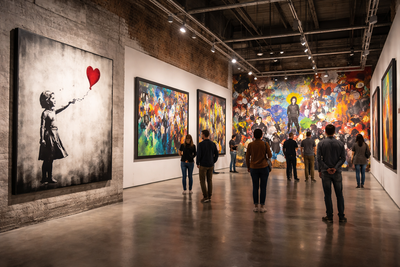
Street art was never designed to age gracefully. It lived in the open, on flyover pillars, abandoned factories, subway tunnels, exposed to rain, dust, municipal paint rollers, and the constant churn of city life. Its power came from surprise and urgency: an image glimpsed on a morning commute, a slogan that caught the eye before the traffic light changed. Yet today, that same visual language appears in climate-controlled galleries and prestigious collections. Works that once existed for weeks now last for decades. The question is not whether street art has entered museums; it has but how a form built on rebellion and public access made that leap.…
Street art was never designed to age gracefully. It lived in the open, on flyover pillars, abandoned factories, subway tunnels, exposed to rain, dust, municipal paint rollers, and the constant churn of city life. Its power came from surprise and urgency: an image glimpsed on a morning commute, a slogan that caught the eye before the traffic light changed. Yet today, that same visual language appears in climate-controlled galleries and prestigious collections. Works that once existed for weeks now last for decades. The question is not whether street art has entered museums; it has but how a form built on rebellion and public access made that leap. Scroll down to know more.
A movement born in the open
Street art grew out of multiple urban traditions rather than a single origin story. In 1970s and ’80s New York, graffiti writers transformed subway cars into moving galleries. Across Europe, stencil artists used quick, repeatable images to make political statements. In Latin America, muralism drew on longer histories of public art tied to social struggle.The common thread was visibility. Artists bypassed galleries altogether, placing work directly into neighbourhoods where anyone, regardless of education or income, could encounter it.
The street was not just a surface; it was part of the message.

By the early 1980s, however, some figures began crossing boundaries. Jean-Michel Basquiat carried graffiti’s raw energy onto canvas, while Keith Haring turned chalk drawings in subway stations into bold, graphic icons. Their success hinted that the art world was paying attention to what was happening outside its doors.
Fame, cameras, and the internet effect
The late 1990s and early 2000s accelerated everything. Digital cameras and online forums allowed murals to travel globally within hours, even if the originals were erased days later. A wall in Bristol or Berlin could suddenly reach millions.This new visibility brought collectors and controversy. Banksy became the emblem of the shift, his darkly comic stencils turning up on streets and, almost immediately, in auction catalogues. In some cases, entire sections of walls were removed by building owners hoping to sell the works, sparking debates over ownership and ethics. Was the art still “street” once it could be detached and monetised?
Artists like Shepard Fairey took a parallel route, producing posters and murals in public while also creating prints and studio pieces meant for collectors. The underground and the market began to overlap, sometimes uncomfortably. As prices climbed, museums followed. What had once seemed peripheral started to look historically significant.
When institutions took notice
Major cultural organisations began folding street-inspired work into their narratives of contemporary art. The Museum of Modern Art and Tate Modern staged exhibitions and acquired works connected to graffiti culture, often pairing portable canvases with large-scale installations designed specifically for museum spaces.Curators framed these pieces not as novelties but as part of a lineage of political posters, public murals, and avant-garde experimentation. Some invited artists to paint directly on museum walls or façades, acknowledging the movement’s roots while adapting it to institutional contexts. For visitors, the experience could feel surreal: an art form born in defiance now guarded by security staff and accompanied by wall labels.
What changes inside a museum?
Supporters of museum inclusion argue that preservation matters. Street art is famously fragile; documenting and conserving it allows future audiences to study works that would otherwise vanish. Institutions also provide historical framing, connecting contemporary murals to broader social movements and art traditions.
Sceptics counter that something essential is lost when the street disappears from the equation. A stencil protesting housing policy carries different weight in a threatened neighbourhood than in a white-walled gallery. Detached from its surroundings, a work can slide from provocation to décor.Many artists live in that tension rather than trying to resolve it. Some maintain two parallel practices, one ephemeral and public, the other collectible and archival. Others refuse galleries outright, insisting that the city remains their only legitimate exhibition space.
From margins to mainstream
The journey from walls to museums is not simply a story of co-option; it is also about recognition. Street art forced institutions to expand their definitions of what counts as serious art, bringing voices shaped by urban life and political urgency into spaces that once felt remote from both.Perhaps the movement’s greatest strength is its adaptability. Whether sprayed on corrugated metal or recreated inside a museum atrium, its best work still speaks directly to the present moment. Even under spotlights, street art carries a memory of where it came from, open air, public streets, and the belief that art should meet people where they are, not wait quietly for them to come looking.