Introduction
In this modern AI era, working with single agents is no longer effective. Applications are becoming increasingly complex day by day, and often, there is a need for a multi-agent framework that can handle multiple tasks simultaneously without requiring human intervention. This multi-agent development framework is proving to increase efficiency and is becoming essential for our day-to-day life.
These systems consist of multiple AI agents that collaborate, communicate, and coordinate to complete tasks that would be too slow, unreliable, or inefficient for a single model to handle alone. Often taking extra time and slowing down…
Introduction
In this modern AI era, working with single agents is no longer effective. Applications are becoming increasingly complex day by day, and often, there is a need for a multi-agent framework that can handle multiple tasks simultaneously without requiring human intervention. This multi-agent development framework is proving to increase efficiency and is becoming essential for our day-to-day life.
These systems consist of multiple AI agents that collaborate, communicate, and coordinate to complete tasks that would be too slow, unreliable, or inefficient for a single model to handle alone. Often taking extra time and slowing down the process, but with this multi-agent system, one can definitely focus on a lot of stuff and can even multitask.
Multi-agent architectures often work by dividing large problems into manageable subtasks, helping them handle fast-changing environments much more easily.
Key Takeaways
- Agno simplifies multi-agent development with an easy-to-understand and lightweight framework that lets you build, deploy, and orchestrate intelligent agents without complex setup.
- Agno allows you to build multimodal capabilities that allow agents to process text, images, audio, video, and files, thus making Agno suitable for advanced real-world applications.
- Streamlined knowledge management (RAG-ready) ensures agents retrieve exactly what they need, improving accuracy, efficiency, and context handling.
- Beginner-friendly documentation and APIs make it easy for developers, content creators, and teams to get started quickly.
- Ideal for workflow automation, allowing teams to combine specialized agents for research, summarize, write, and edit to create a smooth, scalable pipeline.
Imagine a content-creation pipeline
One agent identifies the latest topics, another researches the topic, a third summarizes the findings, a fourth writes an SEO-optimized draft, and a fifth performs quality checks before publishing. Each agent has its own responsibility; together, they produce polished content far faster and more accurately than a single system, and ultimately, you can simply review the content. This is the power of coordinated, well-designed multi-agent systems.
With this growing demand comes a need for faster, more reliable agent coordination. Developers expect agents to share context intelligently, avoid redundant work, recover from failures, and operate in real time, especially in production settings. Poor coordination often leads to inconsistent outputs, increased latency, and brittle automation workflows. As AI-driven products expand, a strong agentic foundation is becoming a necessity, not an optional optimization.
What Is Agno?
Agno is a super-fast platform for building and running AI agents. In today’s time, most people think adding AI means calling a chatbot API. However, real AI products require significantly more, often involving multiple agents working together, remembering information, utilizing tools, retrieving data, interacting with APIs, and operating reliably in production. And all of these are made simple with Agno. It is beginner-friendly and a lightweight framework that also comes with great documentation, so if you get stuck somewhere, you can quickly find clear explanations, examples, and guides to help you move forward without frustration. Agno is designed to make the entire experience, from learning to building to deploying, simple enough for beginners yet powerful enough to build advanced AI systems.
Agno gives developers everything they need to create smart agents and multi-agent workflows, including:
- memory
- knowledge
- tools
- state management
- guardrails
- human-in-the-loop
- context compression
- 100+ built-in toolkits and more
Agno provides developers with a comprehensive stack for creating agents that can reason, utilize tools, store knowledge, maintain memory, and perform multi-step tasks with reliability. At its core, Agno lets a language model control the flow of execution, deciding when to think, when to act, and when to respond; while instructions guide its behavior and tools connect it to external systems.
Agno extends agents with powerful capabilities, including memory for recalling past interactions, storage for maintaining conversation state, knowledge via vector-based retrieval (Agentic RAG), and reasoning to analyze intermediate results before responding.
Beyond single agents, Agno also provides higher-level abstractions for building complex systems: Teams, where multiple specialized agents collaborate, and Workflows, which orchestrate agents and functions through structured, repeatable steps. Whether you’re building your first agent or designing full multi-agent automation pipelines, Agno gives you the tools to build, run, and debug them efficiently.
What is an Agent and What Is a Multi-Agent System?
An agent is an autonomous software entity that takes in information from its environment, makes decisions, and takes actions to complete a specific goal. You can think of an agent like a single employee in a company: it understands its task, works independently, and takes actions without constant supervision. In practical AI workflows, an agent could be a chatbot answering questions, a data-cleaning script fixing messy rows, or a writer agent drafting text from bullet points. Each agent excels at one well-defined responsibility, which keeps its behavior simple, predictable, and easy to upgrade.
A multi-agent system (MAS) expands this idea by bringing together multiple agents that collaborate, coordinate, or communicate to solve complex tasks more efficiently than a single agent could. Imagine it like a team, where each team member has a designated task and works in collaboration with the other to complete a specific task.
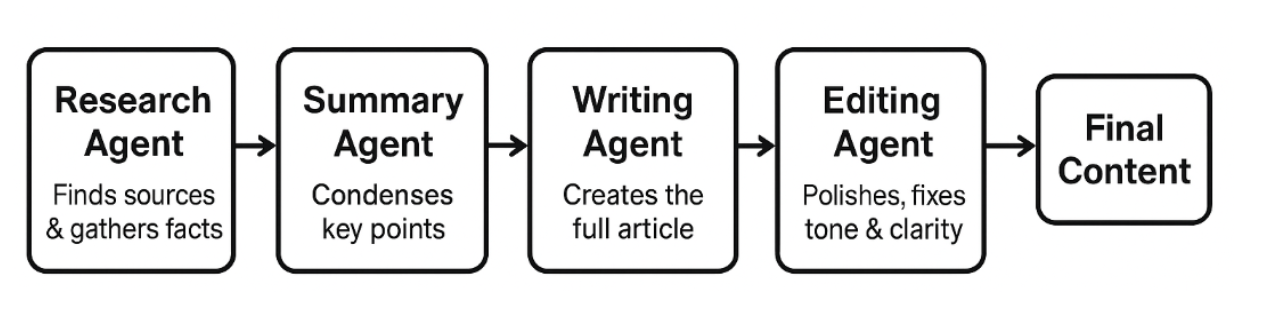
For example, in a content creation workflow, one agent may research, another summarizes, a third writes, and a fourth edits, creating a smooth, scalable pipeline. Multi-agent systems shine when tasks naturally break into subtasks, require collaboration, or must run reliably at scale.
Basic Agent using Agno
To build effective agents, it’s best to start small. Begin with just a model, a few essential tools, and clear instructions. Once you have a simple agent working reliably, you can gradually layer in memory, knowledge retrieval, workflows, and multi-agent coordination. The goal is to validate the core behavior first before scaling complexity.
Start by giving your agent well-defined, high-signal tasks such as report generation, data extraction, summarization, classification, knowledge search, or document processing. These early building blocks help you understand how your agent behaves in the real world and what your users actually need. From there, you can confidently evolve the system into something more advanced.
# Import the core components from Agno
from agno.agent import Agent
from agno.models.anthropic import Claude

# 1. Create the Agent
agent = Agent(
model=Claude(id="claude-sonnet-4-5"),   # Language model controlling execution
instructions="You are a helpful assistant. Respond clearly and concisely."
)

# 2. Run the Agent and print response
agent.print_response("Explain what an AI agent is in simple words.")
Development vs. Production Agent Execution For developing your agent, use the Agent.print_response() method. This conveniently prints the agent’s response to your terminal in an easily readable format.
Note: This method is only for development. For production environments, utilize the Agent.run() or Agent.arun() methods instead.
Running an agent in Agno is straightforward: you call Agent.run() (or Agent.arun() for async execution), and the framework handles everything behind the scenes. Each run begins with Agno assembling the full context, including system messages, user input, chat history, memory, and session state, before sending it to the model.
The model may reply with an answer or a tool call, and if a tool is called, Agno executes it and loops back until the model produces a final response. The result is returned as a RunOutput object containing the content, metadata, messages, reasoning traces, and metrics.
You can pass inputs of any type (strings, lists, dicts, Pydantic models), and Agno supports both synchronous and streaming execution. Setting stream=True lets you receive chunks of responses as they’re generated, while stream_events=True exposes the internal reasoning steps, tool calls, and memory updates for full observability.
This makes it easy to debug, monitor, or build interactive UIs around your agents. Whether you’re generating a simple report or orchestrating complex tool-based operations, Agno’s run loop gives you a predictable, flexible execution model.
from agno.agent import Agent
from agno.models.openai import OpenAIChat
from agno.tools.duckduckgo import DuckDuckGoTools

# You can set the debug mode on the agent for all runs to have more verbose output

agent = Agent(
model=OpenAIChat(id="gpt-5-mini"),
tools=[DuckDuckGoTools()],
instructions="Search the web and give a short, factual answer.",
markdown=True,
debug_mode=True,
)

agent.print_response("Latest breakthroughs in quantum computing?")
In this example, we give our agent access to the DuckDuckGoTools toolkit, allowing it to search the web and retrieve real-time information.
You can always create an agent with debug mode, with instructions, or with tools as per the requirement. Feel free to check out Agno documentation for more details, which we have also linked below in our resources section.
A few core features also include creating Agno with:
- Storage
- Memory
- Knowledge
Here is an example of a Health & Fitness Agent with persistent storage,
Health & Fitness Assistant
With Agno, you can build capable agents that blend:
- A vector-based knowledge base (PDFs, guides, curated content)
- SQLite storage for long-term memory
- Web search tools for fresh information
- OpenAI models for natural language intelligence
In this example, we create a Health & Fitness Agent that helps users understand nutrition, exercise planning, and healthy habits. With persistent storage, the agent can recall your previous fitness goals, track your questions, and provide more personalized guidance over time. Example prompts to try:
- “Give me a 20-minute full-body workout routine.”
- “What is the difference between HIIT and steady-state cardio?”
- “Explain macros in simple terms.”
- “What did I ask you last time about sleep?”
- “Summarize my earlier questions about nutrition.”
- “How much protein do vegans need?”
from textwrap import dedent
from typing import Optional, List

import typer
from rich import print
from agno.agent import Agent
from agno.db.sqlite import SqliteDb
from agno.db.base import SessionType
from agno.session import AgentSession
from agno.knowledge.knowledge import Knowledge
from agno.knowledge.embedder.openai import OpenAIEmbedder
from agno.vectordb.lancedb import LanceDb, SearchType
from agno.models.openai import OpenAIChat
from agno.tools.duckduckgo import DuckDuckGoTools

# --------- Setup Health & Fitness Knowledge Base ---------
fitness_knowledge = Knowledge(
vector_db=LanceDb(
uri="tmp/fitness_lancedb",
table_name="fitness_knowledge",
search_type=SearchType.hybrid,
embedder=OpenAIEmbedder(id="text-embedding-3-small")
)
)

# Add a well-structured PDF containing fitness fundamentals
fitness_knowledge.add_content(
url="https://health/FitnessBasics.pdf"
)

# --------- Setup Database for persistent sessions ---------
db = SqliteDb(db_file="tmp/fitness_agent.db")


def fitness_agent(user: str = "user"):
session_id: Optional[str] = None

# Ask the user whether they want a new or existing session
start_new = typer.confirm("Start a new fitness session?")

if not start_new:
previous_sessions: List[AgentSession] = db.get_sessions(
user_id=user,
session_type=SessionType.AGENT
)
if len(previous_sessions) > 0:
session_id = previous_sessions[0].session_id

# --------- Create Fitness Agent ---------
agent = Agent(
user_id=user,
session_id=session_id,
model=OpenAIChat(id="gpt-5-mini"),
instructions=dedent("""\
You are a friendly Health & Fitness Assistant dedicated to helping users
understand nutrition, exercise, and healthy living.

How you respond:
1. Always check the fitness knowledge base first.
2. If information is missing or needs updates, perform a web search.
3. Provide clear, actionable guidance with structured steps.
4. Avoid overly technical terms—use simple explanations.
5. Keep your tone motivating, encouraging, and non-judgmental.

You can:
- Explain workouts (strength, cardio, flexibility, mobility)
- Provide short actionable routines
- Clarify nutrition basics (macros, calories, protein needs)
- Offer general wellness advice (sleep habits, hydration)
- Summarize/chat history when asked
- Retrieve past discussions using stored session memory

Safety rules:
- Do NOT give medical diagnoses.
- Avoid personalized medical or therapeutic advice.
- Offer general wellness guidance only.
"""),
db=db,
knowledge=fitness_knowledge,
tools=[DuckDuckGoTools()],
read_chat_history=True,
markdown=True,
)

# --------- Run Agent in CLI ---------
print("[bold cyan]Your Health & Fitness Assistant is ready![/bold cyan]")
if session_id is None:
print("Started a new session.\n")
else:
print(f"Continuing previous session: {session_id}\n")

agent.cli_app(markdown=True)


if __name__ == "__main__":
typer.run(fitness_agent)
Agno Teams
Agno Teams lets you build autonomous multi-agent systems where multiple Agents, or even nested sub-teams, work together to complete complex tasks. A Team functions like a tree: the team leader delegates work to sub-teams or individual agents. Below is a simple example of a language-routing team with two agents and one sub-team.
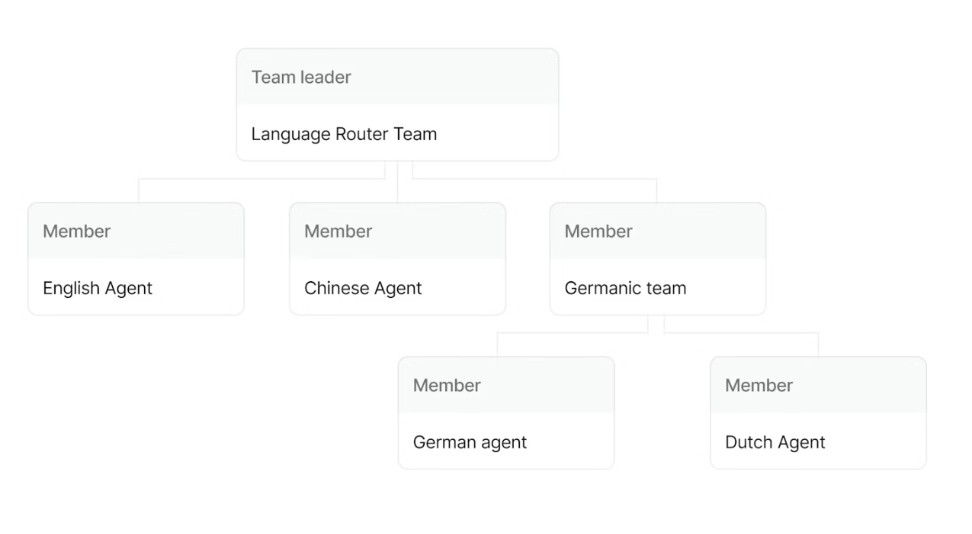
A team’s leader delegates tasks based on each member’s role and the task requirements. Teams inherit the same key features as agents, including model configuration, instructions, database-backed session history, reasoning, knowledge access, memory, and tool use.
Use Teams when tasks are complex, require multiple tools, or involve many steps. They are especially helpful when a single agent’s context window would be overloaded. Breaking workloads into focused, single-purpose agents keeps each agent’s context small and efficient.
from agno.team import Team
from agno.agent import Agent
team = Team(
members=[
Agent(
name="Research Agent",
role="You gather factual information and provide structured research summaries."
),
Agent(
name="Editing Agent",
role="You refine writing, fix grammar, and improve clarity and tone."
),
Team(
name="Creative Team",
role="You coordinate creative tasks such as brainstorming and drafting content.",
members=[
Agent(
name="Idea Agent",
role="You generate ideas, outlines, and creative directions."
),
Agent(
name="Drafting Agent",
role="You write initial drafts based on ideas and research."
),
]
),
]
)
Workflows
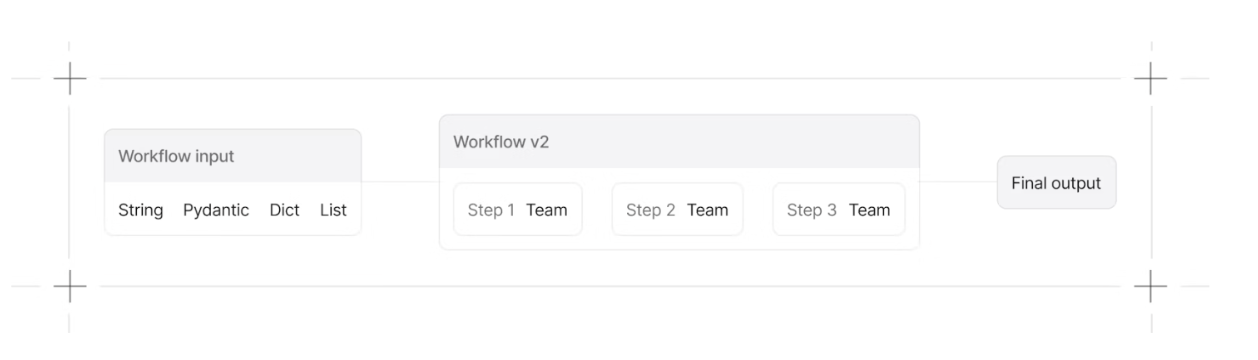
Agno Workflows let you build predictable, step-by-step automations for multi-agent systems. Instead of letting agents interact freely, workflows organize agents, teams, and functions in a fixed sequence. Each step handles one part of the task, passes its output to the next, and together they create a reliable, repeatable pipeline like an assembly line for complex work.
from agno.agent import Agent
from agno.workflow import Workflow

# Define agents with specific roles
designer = Agent(
name="System Designer",
instructions="Plan the structure of a simple Python program and describe its components clearly."
)

coder = Agent(
name="Coder",
instructions="Write clean, well-documented Python code based on the system design."
)

tester = Agent(
name="Tester",
instructions="Review the code, identify bugs or edge cases, and suggest improvements."
)

# Build the workflow
dev_workflow = Workflow(
name="Software Development Workflow",
steps=[designer, coder, tester]
)

# Run the workflow
dev_workflow.print_response(
"Create a small Python script that fetches weather data from an API and prints it neatly.",
stream=True
)
Here’s an example of how you can use Agno Workflows to automate a multi-step coding task. In this workflow, each agent focuses on a specific part of the software development process, designing the solution, writing the code, and testing it. The workflow coordinates these steps in order, ensuring a clean, reliable output.
Agno Workflows let you orchestrate agents and teams through a controlled series of steps. The Workflow class manages the full execution flow, while each Step represents a single unit of work powered by an agent, team, or function. You can enhance workflows using constructs like Loop for repetition, Parallel for concurrent execution, Condition for conditional logic, and Router for branching paths, thus making it easy to design flexible, maintainable, and production-ready automation pipelines.
Context Engineering
Context engineering is the practice of designing, structuring, and controlling the information sent to language models so they behave exactly as you want. At its core, it answers a simple question:
“What information will most effectively produce the output I need?” In Agno, this primarily involves crafting the system message, the foundational context that defines an agent or team’s role, personality, constraints, and capabilities. By engineering this context thoughtfully, you can:
- Steer agents and teams toward specific behaviors or expertise.
- Restrict or expand what an agent is allowed to do.
- Produce consistent, reliable, and application-aligned outputs.
- Enable complex workflows like multi-step reasoning, tool use, and structured responses.
Context engineering is an iterative process: refining instructions, experimenting with agent descriptions, adjusting schemas, and leveraging delegation or tools until the behavior matches your goals.
What Makes Up an Agent’s Context?
Agno agents build their full context from several components:
- System message: The core prompt containing instructions, agent descriptions, roles, and any added context.
- User message: The user’s latest query or task request.
- Chat history: The running conversation is useful for continuity and memory.
- Additional inputs: Few-shot examples, reference data, or supporting instructions.
Together, these pieces provide the model with everything it needs to produce accurate and aligned results.
Context Caching
Many model providers offer prompt caching, which lets you store and reuse static parts of your system or user messages. This reduces cost and speeds up responses, especially when the same instructions or role descriptions are used repeatedly.
Agno allows you to structure context so that likely reusable/static content appears at the top of the system message, making it easier for providers to cache it. If you want more control, you can manually define the system message to optimize caching further.
Examples of prompt caching use cases include:
- Caching a long agent persona or instructions for repeated tasks.
- Storing reusable few-shot examples for structured outputs.
- Reusing common workflow instructions across multiple steps or agents.
At its core, the agent’s context is constructed from:
- System Message: The role, instructions, metadata, additional information, examples, and optional memory/state.
- User Message: Whatever the user sends to
run()orprint_response(), optionally enriched with knowledge-base refs or dependency injections. - Optional Context Add-ons: Chat history, few-shot examples, tool instructions, memories, or custom system messages.
Agno allows you to customize each layer through simple parameters, making your agents predictable, controllable, and highly task-aligned.
Building System Messages Automatically
Agno automatically assembles a system message based on parameters you provide (e.g., role, instructions, additional_context, metadata such as time or location, and memory/state).
Example: A Planning Agent With Automatic Context Add-ons
from agno.agent import Agent

planner = Agent(
name="Trip Planner",
role="Planning Assistant",
description="You help users plan efficient and budget-friendly travel itineraries.",
instructions=[
"Always ask 2 clarifying questions before suggesting an itinerary.",
"Keep responses concise unless the user asks for detail."
],
expected_output="Provide output in a sectioned format with headers.",
additional_context="""
Example format:
- Destination
- Budget
- Suggested Itinerary
""",
add_datetime_to_context=True,
add_location_to_context=True,
add_name_to_context=True,
)

planner.print_response("Plan me a 3-day trip to Singapore.")
Context engineering in Agno gives you full control over:
- What the model sees
- How it behaves
- How consistently it performs
- How efficiently it uses tokens
By combining system messages, memories, tool instructions, few-shot examples, and user-enriched messages, you can create agents that are reliable, contextual, and domain-specialized.
Knowledge
Agno’s Knowledge system is built on Retrieval-Augmented Generation (RAG), but instead of overloading prompts, you store information in a searchable knowledge base. Agents automatically retrieve only what they need, making responses more accurate, scalable, and efficient.
The Knowledge Pipeline (3 Steps)
- Store: Process & Index Content: Agno reads your files, breaks them into chunks (fixed, semantic, recursive, etc.), converts them into embeddings, and stores them in a vector database.
- Search: Retrieve Relevant Information: When the user asks something, the agent searches the knowledge base using semantic search to find the closest matching chunks.
- Generate: Produce Accurate Responses: Retrieved context + the user’s question are combined to generate grounded, source-aware answers.
Why Semantic Search Works
Agno also allows for converting text into numerical representations where similar meanings sit close together. Example: “refund policy” ≈ “return guidelines,” even without shared keywords.
Setting Up Knowledge
from agno.knowledge.knowledge import Knowledge
from agno.vectordb.pgvector import PgVector
from agno.knowledge.reader.pdf_reader import PDFReader
from agno.knowledge.chunking.semantic import SemanticChunking
from agno.agent import Agent

# 1. Vector DB + embeddings
vector_db = PgVector(
table_name="company_knowledge",
db_url="postgresql://user:pass@localhost:5432/db"
)

# 2. Create a knowledge base
knowledge = Knowledge(
name="Company Docs",
vector_db=vector_db,
max_results=5,
)

# 3. Add content with semantic chunking
knowledge.add_content(
path="employee_handbook.pdf",
reader=PDFReader(
chunking_strategy=SemanticChunking(chunk_size=1000)
),
metadata={"type": "policy", "department": "hr"}
)

# 4. Agent with automatic knowledge search
agent = Agent(
knowledge=knowledge,
search_knowledge=True  # agent decides when to search
)

print(agent.run("How many vacation days do I get?"))
Guadrails
Guardrails are basically built-in safety checks that run before your agent processes any user input. Think of them as security checkpoints that filter or block unsafe, harmful, or unwanted content before it reaches the LLM.
They work by:
- Inspecting the input,
- Detecting unsafe or undesired patterns,
- Either clean the input or stop the request with an error.
They help you avoid common risks when using LLM-powered apps:
- PII detection: Stops personal data like phone numbers, emails, credit cards, etc.
- Prompt injection defense: Prevents users from bypassing your system instructions.
- Jailbreak prevention: Blocks attempts to trick the LLM into unsafe mode.
- Data-leakage protection: Avoids accidental exposure of sensitive internal content.
- NSFW / harmful content filtering
Using Agno’s Built-In Guardrails
Agno ships several guardrails you can use instantly:
- PIIDetection Guardrail
- PromptInjection Guardrail
- OpenAIModeration Guardrail
Using one is simple; just pass it via pre_hooks when creating an Agent.
Example: PII Detection Guardrail
from agno.guardrails import PIIDetectionGuardrail
from agno.agent import Agent
from agno.models.openai import OpenAIChat

agent = Agent(
name="Privacy-Protected Agent",
model=OpenAIChat(id="gpt-5-mini"),
pre_hooks=[PIIDetectionGuardrail()],  # Add guardrail here
)

# If input contains PII, an error will be raised
result = agent.run("My number is 9876543210")
Creating Custom Guardrails
If the built-in guardrails don’t cover your needs, you can create your own by extending BaseGuardrail and implementing:
check()– synchronous logicasync_check()– async logic
If your check fails, you must raise an InputCheckError.
Custom Guardrail Example: Block Offensive (Bad) Words
This guardrail checks the user’s input for any offensive or inappropriate words and blocks the message before it reaches the LLM.
This is useful for:
- Preventing toxic interactions
- Moderating chatbots
- Keeping enterprise apps clean and compliant
Custom Guardrail: BadWordsGuardrail
from agno.guardrails import BaseGuardrail
from agno.exceptions import InputCheckError, CheckTrigger
from agno.run.agent import RunInput

class BadWordsGuardrail(BaseGuardrail):
"""Guardrail to block offensive or forbidden words."""

# A simple list of offensive or banned words
forbidden_words = {"stupid", "idiot", "dumb", "nonsense"}

def check(self, run_input: RunInput) -> None:
"""Sync check for forbidden words."""
if isinstance(run_input.input_content, str):
words = run_input.input_content.lower().split()
if any(word in self.forbidden_words for word in words):
raise InputCheckError(
"Your message contains forbidden or offensive language.",
check_trigger=CheckTrigger.INPUT_NOT_ALLOWED,
)

async def async_check(self, run_input: RunInput) -> None:
"""Async version of the same check."""
if isinstance(run_input.input_content, str):
words = run_input.input_content.lower().split()
if any(word in self.forbidden_words for word in words):
raise InputCheckError(
"Your message contains forbidden or offensive language.",
check_trigger=CheckTrigger.INPUT_NOT_ALLOWED,
)
Using This Custom Guardrail in an Agno Agent
from agno.agent import Agent
from agno.models.openai import OpenAIChat
agent = Agent(
name="Polite Chatbot",
model=OpenAIChat(id="gpt-5-mini"),
pre_hooks=[BadWordsGuardrail()],  # Add the custom guardrail
)

# This will raise an InputCheckError
agent.run("You are so stupid!")

# This will be allowed
response = agent.run("Can you help me with Python?")
print(response)
Multimodal Agents
Multimodal Agents are AI agents that can understand and generate multiple types of media and are not just limited to text. They can support:
- Text
- Images
- Audio
- Video
- Files / Documents
This means that your agent can:
- Describe or analyze images
- Transcribe and understand audio
- Interpret video snippets
- Read PDF/CSV/JSON files
- Generate images or audio responses
Multimodal agents unlock powerful use cases:
- Visual Q&A
- Speech-to-text and text-to-speech applications
- Video analysis
- Product description generation from images
- Document summarization
Agno makes multimodal workflows very simple by letting you pass media objects (Image, Audio, Video, File) directly into an Agent’s .run() or .print_response() methods.
Agno agents support multimodal inputs and outputs only if the underlying model supports them.
Please feel free to check their documentation for complete details.
You simply:
- Select a multimodal-capable model
- Provide media input using Agno media classes
- Receive text, image, or audio output
Use-case: Ask questions about an image.
from agno.agent import Agent
from agno.media import Image
from agno.models.openai import OpenAIChat

agent = Agent(
model=OpenAIChat(id="gpt-5-mini"),
markdown=True,
)

image = Image(
url="https://upload.wikimedia.org/wikipedia/commons/5/5f/Great_Pyramid_of_Giza.jpg"
)

agent.print_response(
"Describe this landmark and tell me its historical importance.",
images=[image]
)
Best Practices for Using Agno
Agno lets you develop intelligent Agents and is getting popular among the developer community pretty rapidly. In this article, we have just touched upon a few of its features, and there are a lot more to explore. Here are a few of the steps that can help build better Agents using this framework.
Choose the Right Model for Your Use Case
Different models support different capabilities, and sometimes some models perform better than others. Therefore, there is always a need to experiment with different models for various use cases. Additionally, choosing the right model often reduces latency and improves accuracy.
Different models support different capabilities:
- Multimodal inputs (images/audio/video)
- Tool calling
- Structured output
- Fast inference vs. deep reasoning
Best practices for chossing the right model:
- Use GPT-5 Mini or Llama 3.2 for lightweight reasoning.
- Use GPT-5, Gemini 2.0, or Claude 3.7 for deeper reasoning tasks.
- Use audio/video-enabled models when building multimodal agents.
Keep Agent Roles, Instructions, and Descriptions Clear
Ambiguous or poorly constructed instructions can cause unpredictable behaviour, and structured instructions improve consistency and reliability.
Best practices for Agent Instructions:
Define a clear role, such as “You are a financial analysis assistant”.
Add instructions that specify:
output format
tone
limitations
tool usage guidelines
Avoid long or complex system prompts.
Use Tools Wisely and Define Their Purpose
Tools extend an agent’s capabilities (browsing, image generation, code execution, search, etc.). However, too many tools can cause the agent to misfire or choose suboptimal actions.
Best practices for tools:
- Attach only the necessary tools to avoid tool confusion.
- Describe when and why to use each tool.
Design Agents as Modular Units
Instead of building one large agent:
- Split your system into specialized agents
- Combine them using Teams
- Assign separate roles: classifier, researcher, writer, reviewer, executor, etc.
Modular design improves maintainability and produces higher-quality outputs.
Keep Your Knowledge Base Clean and Indexed
Agno’s integrated knowledge system improves context retrieval. This process helps to improve retrieval accuracy and response relevance.
Best practices for knowledge base:
- Use the RAG pipeline (store → chunk → index) properly.
- Avoid large unchunked documents.
- Update indexes as your data changes.
- Group related documents under appropriate namespaces.
Use Guardrails for Safety and Input Validation
Guardrails help prevent unsafe or undesired inputs from reaching your agent. Guardrails also protect the agent from prompt injection, sensitive data leakage, and harmful content.
Recommended actions:
Always add built-in guardrails like:
PIIDetectionGuardrail
PromptInjectionGuardrail
OpenAIModerationGuardrail
Create custom guardrails for domain-specific checks (e.g., URL blocking, profanity filtering, metadata validation).
Attach guardrails using the pre_hooks parameter.
Always Implement Error Handling for Production
Agents are probabilistic; errors can occur.
Best practices for error handling:
- Implement try/except around
.run()calls. - Catch
InputCheckErrorwhen using guardrails. - Validate tool output before further processing.
- Log failures for debugging.
Test Agent Behaviour Thoroughly
Before deploying:
- Test every tool path.
- Test guardrail triggers.
- Check for hallucinations.
- Validate JSON/structured output formatting.
- Benchmark performance with real workloads.
Together, these checks will help you to build better, multimodal, multi-agent AI systems that are production-ready and easy to maintain.
FAQ’s
1. What is Agno?
Agno is a fast, lightweight multi-agent framework that helps developers build, run, and manage intelligent agentic systems with ease. It provides tools for coordination, workflows, memory, knowledge retrieval, and multimodal capabilities.
2. Is Agno suitable for beginners?
Yes. Agno is designed to be beginner-friendly with clean abstractions, straightforward APIs, and excellent documentation. It allows newcomers to quickly build and experiment with agentic applications.
3. What makes Agno different from other agent frameworks?
Agno offers an all-in-one stack framework, runtime, and control plane combined with high performance and multimodal support. It simplifies both development and production deployment without sacrificing flexibility.
4. Can I integrate Agno with external tools and APIs?
Absolutely. Agno is built to integrate with external APIs, databases, vector stores, and model providers, making it suitable for real-world production workflows and automation tasks.
5. Does Agno support multimodal inputs like images, audio, or files?
Yes. Agno has built-in multimodal capabilities, allowing agents to process text, images, audio, videos, and documents. This enables complex use cases like AI assistants, analysis tools, and media workflows.
Conclusion
Agno makes it easier than ever to build powerful, reliable, and production-ready AI agents. Its modular design, guardrails, multimodal capabilities, and seamless support for tools and teams allow developers to go beyond simple chat interfaces and create full-fledged intelligent systems.
At first, it might feel complicated, but the Agno documentation is great to start with, and every small detail is included, which allows developers to develop, build, and scale agentic applications. Agno is a lightweight, beginner-friendly, and future-proof foundation for the next generation of AI applications. In this article, we’ve only scratched the surface of what Agno can do, but there is so much more to explore. In the upcoming articles, we’ll dive deeper into advanced workflows, build hands-on multi-agent systems, and experiment with real-world integrations to demonstrate Agno’s full potential.
References
- Agno’s official documentation
- What is a Multiagent System and How Does it Work?
- Agentic AI Frameworks for Building Autonomous AI Agents
- Your Guide to the TradingAgents Multi-Agent LLM Framework Single-Agent vs Multi-Agent Systems: Two Paths for the Future of AI
This work is licensed under a Creative Commons Attribution-NonCommercial- ShareAlike 4.0 International License.