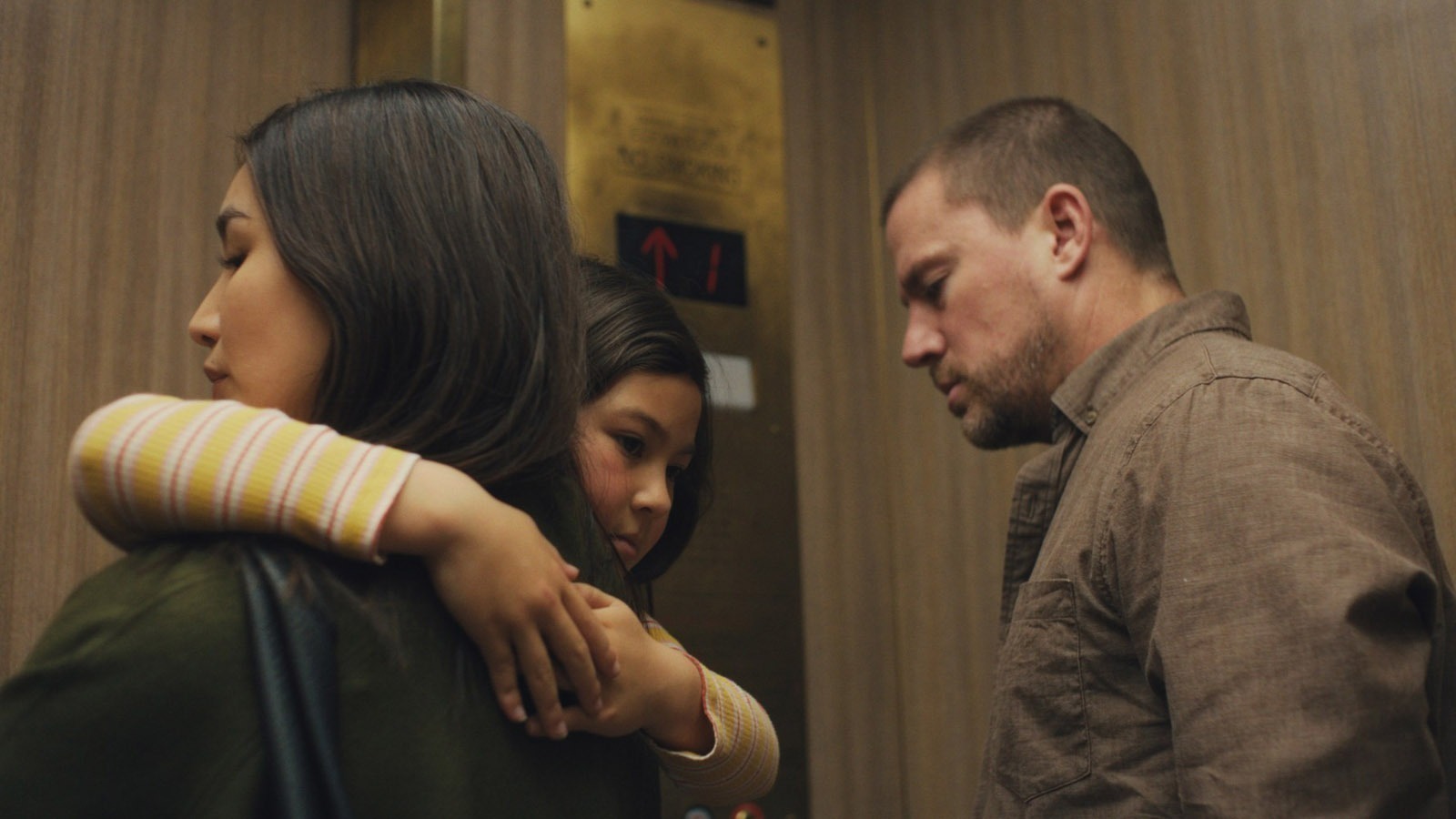
 Gemma Chan, Mason Reeves, and Channing Tatum in Beth de Araújo’s Josephine (2026)
Launching a fresh slate of movies and, over the weekend, awarding the standouts, this year’s Sundance also “became, in effect—and affect—an eleven-day farewell,” writes the New Yorker’s Justin Chang. As the event prepares to move to Boulder, Colorado, returning filmmakers and veteran critics spent those eleven days swapping stories of slipping and sliding over the ice and through the snow from screening to screening in Park City, Utah—and sh…
Gemma Chan, Mason Reeves, and Channing Tatum in Beth de Araújo’s Josephine (2026)
Launching a fresh slate of movies and, over the weekend, awarding the standouts, this year’s Sundance also “became, in effect—and affect—an eleven-day farewell,” writes the New Yorker’s Justin Chang. As the event prepares to move to Boulder, Colorado, returning filmmakers and veteran critics spent those eleven days swapping stories of slipping and sliding over the ice and through the snow from screening to screening in Park City, Utah—and sharing memories of the festival’s late founder and lodestar, Robert Redford. Sundance 2026 was, as Manohla Dargis puts it in the New York Times, “openly, unsurprisingly elegiac.”
“It is unclear just how planned it was, but there could have been no better film than The Only Living Pickpocket in New York to be the final fiction feature to debut in the Eccles Theatre, one of the festival’s most storied venues,” writes Mark Olsen in the Los Angeles Times. Noah Segan’s directorial debut, which screened in the noncompetitive Premieres program, stars John Turturro, Steve Buscemi, and Giancarlo Esposito. As mentioned last week, Buscemi, a Sundance regular, was instrumental in bringing recognition to the work of William Greaves, and during the Q&A, Turturro “spoke movingly” of Redford, who had directed him in Quiz Show (1994).
Sundance “gave a voice to those who didn’t have a voice,” said Esposito. “We didn’t come to sell a film to a big studio. We came to share our small movie with human beings that could really see themselves in a mirror on the screen.” Redford’s vision was “priceless” and “will stick with me for the rest of my life. My interactions with this man who started this festival will always be a beacon of light in my creative process.”
U.S. Dramatic Competition
Beth de Araújo’s Josephine, the winner of both the Grand Jury Prize and the Audience Award in the U.S. Dramatic Competition, premiered on the second day of the festival and remained one of the most talked-about titles in Park City throughout the festival. The Berlinale will be screening a good handful of Sundance 2026 films, but Josephine is the only one selected for the main competition.
Newcomer Mason Reeves plays eight-year-old Josephine, who runs ahead of her father (Channing Tatum) in San Francisco’s Golden Gate Park and witnesses a brutal rape. The camera does not blink, and in the Guardian, Adrian Horton argues that “the intensity of the incident is key, for it underscores the inadequacy of every adult’s response.” Josephine is “predominantly about the aftermath, with a solid Gemma Chan and a career-best Tatum as her well-meaning but ill-equipped parents,” and De Araújo “manages to believably steer the bruised family through near-horror into a bravura final courtroom scene. There’s a chilling but thankfully restrained horror to Josephine’s inward retreat, as her inchoate anger boils over in increasingly erratic, alarming ways.” Reeves delivers what the Hollywood Reporter’s David Rooney calls “a remarkably assured performance, utterly natural and unforced, bouncing between fragility and resilience like a ragdoll one minute and a pugnacious fighter the next.”
The jury of three filmmakers—Janicza Bravo, Nisha Ganatra, and Azazel Jacobs—presented the Directing Award to Josef Kubota Wladyka for Ha-chan, Shake Your Booty!, starring Rinko Kikuchi as Haru, a middle-aged woman throwing herself into ballroom dance competitions in Tokyo. This is a “surprisingly buoyant, unsentimental film about grief,” writes Caryn James in the Hollywood Reporter, and Wladyka “shifts from poignant emotion to comedy to surreal scenes that take us inside Haru’s fantasies just as gracefully as the dialogue shifts from Japanese to Spanish and English. Ha-chan, Shake Your Booty!—the title, cringey though it may sound, is knowingly ironic in context—is a small delight.”
The Waldo Salt Screenwriting Award went to Liz Sargent for Take Me Home, which now heads to the Perspectives program in Berlin. Anna Sargent stars in her sister’s first feature as a woman with a cognitive disability caring for her elderly parents. As Ritesh Mehta writes for Filmmaker, “this is a family of mutual caregivers whose routines are shattered during a central Florida heat wave. How Anna navigates her new emotional reality forms the story’s core, and in striving to locate her character’s need for autonomy, Sargent delivers a performance of tremendous interiority, vulnerability, pathos, and humor.”
A Special Jury Award for Debut Feature went to Stephanie Ahn’s Bedford Park. “Sparked by the literal collision of two Korean American families, this dreamy feature debut opens on a short-tempered meet-cute that promises a precise and deeply personal love story,” writes Alison Foreman at IndieWire. Bedford Park is a “depiction of American life filtered through a specificity that feels rare, romantic, and essential right now.”
Set in Tehran’s arts scene, Maryam Ataei and Hossein Keshavarz’s The Friend’s House Is Here won a Special Jury Award for Ensemble Cast. As Angie Han notes in the Hollywood Reporter, the film was “shot underground and smuggled across the border amid Iran’s recent protests and crackdowns, just weeks before its Sundance debut. Yet the film’s predominant mood is one not of despair but of defiance, placing its faith in the enduring powers of friendship and creativity.”
U.S. Documentary Competition
Days before winning the U.S. Grand Jury Prize: Documentary, Gabriela Osio Vanden and Jack Weisman, the codirectors of Nuisance Bear, got hitched in the Egyptian Theatre, the movie palace that opened one hundred years ago on Park City’s Main Street. Nuisance Bear, shot in and around Churchill, Manitoba, the “Polar Bear Capital of the World,” is “no cuddly nature documentary,” writes Elizabeth Weitzman at TheWrap. Osio Vanden and Weisman “use the image of a mama bear and her cubs to draw us in, and then they pull straight back to the animals’ unsettling reality. Though their ancestors have migrated along the shores of Canada’s Hudson Bay for thousands of years, this generation faces all new challenges. It’s no spoiler to note that most of them come in human form.”
Jury members Natalia Almada, Justin Chang, and Jennie Livingston gave his competition’s Directing Award to J. M. Harper for Soul Patrol. At the Film Stage, Dan Mecca finds the doc to be “a compelling account of the Vietnam War’s first Black special operations team, told fifty years later. An onslaught of mixed mediums, it is fascinatingly incomplete in certain moments, fully realized in others.”
Matt Hixon won the Jonathan Oppenheim Editing Award for his work on Barbara Forever, Brydie O’Connor’s “sincere ode to the queer iconoclast” Barbara Hammer, as Sam Bodrojan notes at IndieWire. “O’Connor’s film is worthy of its subject matter, faultlessly curated and illuminating in the instrumentation of its material.”
Jason Osder and William Lafi Youmans’s Who Killed Alex Odeh? won a Special Jury Award for Journalistic Excellence. Building on the reporting of Israeli journalist David Sheen, the film probes the unsolved murder of the Palestinian American activist. As Scott Renshaw points out in the Salt Lake City Weekly, evidence has linked the 1985 assassination to “three specific men affiliated with the ultra-right-wing Jewish Defense League. The film explores this history of the JDL and its founder, Rabbi Meir Kahane, and the influence of his extremism on Israeli politics up to and including the current leadership . . . But the real infuriating success of this story is watching Sheen, Osder, and Youmans put together pieces that were already put together by law enforcement forty years ago, blocked by the peculiarities of America’s relationship with Israel, allowing people to literally get away with murder.”
Abby Ellis’s *The Lake,*chronicling the fight to save Utah’s Great Salt Lake, won a Special Jury Award for Impact for Change. In her review for Variety, Tomris Laffly notes that the film reminds us that “when it comes to environmental battles, winning slowly is the same as losing. Science, in this case, requires us to sprint first and do the marathon later, not the other way around. On these grounds alone, The Lake is so much more than a regionally isolated issue documentary. Its lessons should apply to every single environmental fight around the world.”
This competition’s Audience Award went to David Alvarado’s American Pachuco: The Legend of Luis Valdez. “It’s not an overestimation to say that Latino storytelling in the U.S. owes plenty to what Valdez did with his Teatro Campesino, a community theater company initially tied to the United Farm Workers movement and Cesar Chavez, and later on as a director on theater’s biggest stages, as well as in Hollywood with the landmark film La Bamba,” writes Carlos Aguilar for Variety.
World Cinema Dramatic Competition
Jurors Ana Katz, So Yong Kim, and Tatiana Maslany presented the World Cinema Grand Jury Prize: Dramatic to Visar Morina’s Shame and Money, the story of a Kosovar family forced to leave their village and find work in the capital, Pristina. Vulture’s Bilge Ebiri finds that the film’s “power lies in its hyper-realistic depiction of the everyday challenges of economic survival and its psychological toll. Still, its perspective is unlike any I’ve seen in recent years.”
Andrius Blaževičius won the Directing Award for How to Divorce During the War. It’s February 2022 in Vilnius, Lithuania, when Marija (Elena Jakštaitė), a successful executive, tells her husband, Vytas (Marius Repšys), a once-promising film director, that she wants out of their marriage. Then Putin invades Ukraine. “While this is the most sedate, lowest-key farce you’ll ever see, a farce it still is,” writes Victor J. Morton in the Salt Lake City Weekly. “Everything and everyone falls apart, even the divorce, but families are broken and also damaged in repair because a war’s effects aren’t neat moral determinations, even if you aren’t Andrei Tarkovsky—but basically are.”
A Special Jury Award for Creative Vision went to Filipiñana. For Filmmaker, Elissa Suh talks with Rafael Manuel about his debut feature, “an extended yet precise parable about class, memory, and quiet violence in his home country, the Philippines—filtered through the microcosm of a golf course on the outskirts of Manila during a scorching summer day.” Set to screen in the Berlinale’s Perspectives program, Filipiñana is executive-produced by Jia Zhang-Ke.
Olive Nwosu’s Lady, featuring newcomer Jessica Gabriel’s Ujah as a taxi driver working with a loosely knit clan of sex workers, won a Special Jury Award for Acting Ensemble. In Variety, Guy Lodge finds that “scenes of the women at rest, gossiping and needling each other, crackle with warmth and lived-in specificity both in writing and performance. Ujah’s tightly controlled portrayal loosens by fine, still-wary degrees, as if uncertainly trying on sisterhood for size.”
The Audience Award here went to Myrsini Aristidou’s Hold onto Me, with newcomer Maria Petrova as eleven-year-old Iris, who reunites with her long-lost father, Aris (Christos Passalis). “Of course,” writes Marya E. Gates at RogerEbert.com, “their newfound closeness swiftly becomes threatened by the ghosts of Aris’s past, in the form of some underworld baddies. You might think you know how the events of this last act will unfold, but Aristidou’s film finds new paths to forge, and I found myself holding my breath more than once as I watched these two work through the hurdles that life throws at them. I also enjoy a filmmaker bold enough to end her film without any traditional closure. More of that, please.”
World Cinema Documentary Competition
Biljana Tutorov and Petar Glomazić’s To Hold a Mountain won the World Cinema Grand Jury Prize: Documentary. As a portrait of Gara and Nara, shepherds in the remote highlands of Montenegro, the film “ultimately reveals itself as a paean to female strength and resistance, both to the abusive men who’ve tried to break Gara and other women in her family and the NATO forces determined to transform their ancestral land into a military training ground,” writes Derek Smith at Slant.
Jurors Toni Kamau, Bao Nguyen, and Kirsten Schaffer gave the Directing Award to Itab Azzam and Jack MacInnes, whose One in a Million also won this competition’s Audience Award. Shot over the course of ten years, the film tracks the journey of the Syrian refugee Isra’a to Germany by way of Turkey, and then back to Aleppo. “Beyond the usual growing pains and adolescent joys and push-pull with grown-ups,” writes Sheri Linden in the Hollywood Reporter, “Isra’a’s story involves the fallout of war, the experience of exile, and the enigma of cultural identity as something both bedrock and fluid. A distillation of formative years for Isra’a and turning points for her family, One in a Million feels both ultra-specific and universal.”
Another film shot against the backdrop of the Syrian Civil War over a period of several years—in this case, thirteen—is Birds of War, the winner of a Special Jury Award for Journalistic Impact. Lebanese BBC correspondent Janay Boulos and Syrian photographer and activist Abd Alkader Habak tell their own love story. At Ioncinema, Oscar Aitchison finds that the film is “mostly a guerilla-style affair, which adds to the immediacy.”
The winner of a Special Jury Award for Civil Resistance is a film about a community putting a stop to immigration officials’ attempts to snap up two South Asian men from the homes where they had lived for a decade. At the A.V. Club, Jacob Oller writes that “even though the protest at the heart of Felipe Bustos Sierra’s Everybody to Kenmure Street takes place in Glasgow, in a world that might seem far-fetched to us in the U.S., a place where masked agents of the state aren’t allowed to murder at will, it’s still an invigorating and inspiring ICE-breaker around what is possible with targeted community action.”
Next and More
Former Sundance director John Cooper and Trevor Groth, a longtime programmer for the festival, juried the Next program created in 2010 for innovative low-budget films, and the Innovator Award went to The Incomer. Reviewing this “winningly weird comedy” for the Daily Beast, Nick Schager writes that Scottish writer and director Louis Paxton’s debut feature “has a wittiness that’s almost as odd as its heart is big, and in star Gayle Rankin, he finds a perfect match for his strange-and-sweet sensibilities. All of which shine through this bizarro story about a brother and sister whose solitary lives on the isle they call home are disrupted by the arrival of a bureaucrat tasked with evicting them.”
In TheyDream, the winner of the Next Special Jury Award for Creative Expression, William David Caballero uses miniatures, motion-capture animation, home videos, and audio recordings to “preserve snippets of family history, awash in both wisdom and regrets,” writes Gayle Sequeira at the top of her interview with the director for Documentary Magazine. “Moving around tiny figurines of his family enables him to direct circumstances he had little sway over in real life. The act of creation is his antidote to loss.”
Adam and Zack Khalil’s Aanikoobijigan [ancestor/great-grandparent/great-grandchild], the winner of the Audience Award: Next, “engages in pointed, poetic formal experimentation,” writes Chase Hutchinson at the Playlist, and “proves to be a clear-eyed confrontation with why it is that tribal repatriation specialists must currently work to recover Indigenous human remains that were taken and locked away in libraries, museums, and archives. Piece by piece, the film becomes a portrait of quiet, ordinary courage.”
Nuisance Bear and Take Me Home are among the awarded features that began as short films. A. V. Rockwell, Liv Constable-Maxwell, and Martin Starr presented this year’s Short Film Grand Jury Prize to Ben Proudfoot and Stephen Curry for The Baddest Speechwriter of All, a portrait of Clarence B. Jones, a lawyer and speechwriter who worked with Martin Luther King Jr. during the Civil Rights Movement.
“We came to Park City to argue, to coalesce around favorites, to hate on the overrated,” writes Joshua Rothkopf in the Los Angeles Times. “It was fitting that this year’s most mentioned title was Josephine . . . It’s a film that all but demands a conversation. Independently made, an actors’ showcase, and undeniably outside the mainstream, Josephine could only have launched at Sundance. That annual feast seems movable—we’ll see you in Boulder.”
Don’t miss out on your Daily briefing! Subscribe to the RSS feed.