US to ‘run’ Venezuela after Maduro captured, says Trump: Early analysis from Chatham House expertsExpert commentjon.wallace
What does it mean for Trump’s popularity at home, for Ukraine and NATO, and for Venezuela’s neighbours in South and Central America?
US to ‘run’ Venezuela after Maduro captured, says Trump: Early analysis from Chatham House expertsExpert commentjon.wallace
What does it mean for Trump’s popularity at home, for Ukraine and NATO, and for Venezuela’s neighbours in South and Central America?
</div>
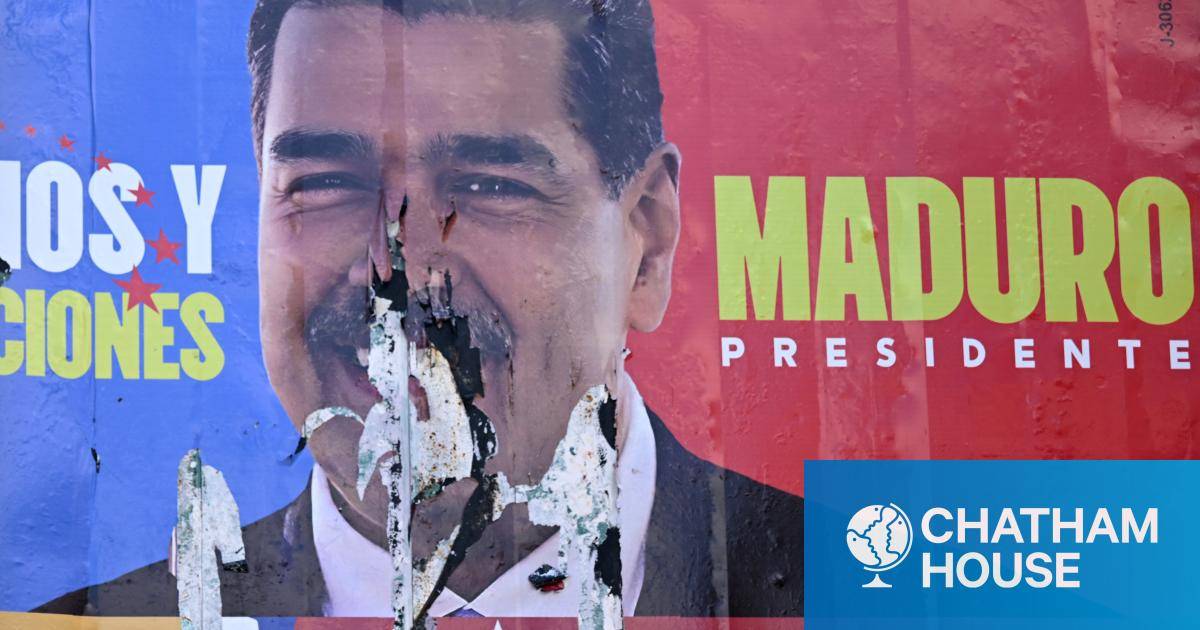
On Saturday 3 January US President Donald Trump announced a large-scale US strike on Venezuela – and stated that the US had also captured Venezuelan President Nicolás Maduro.
President Trump said the US was ‘going to run the country’ until a transition could be safely arranged.
Here is early analysis from Chatham House experts, who will monitor developments in the coming days and weeks, with further commentary to follow.
Laurel Rapp, Director of the US and North America Programme
President Trump said the Venezuela operation was launched – in his words – to protect the American people from narco-trafficking and to bring President Nicolás Maduro and his wife to justice.
‘We’re gonna run the country’ until a safe, proper, and judicious transition, Trump asserted, while offering few additional details.
The group of men assembled behind Trump – Secretary of State Rubio, Secretary of War Hegseth, Chairman of the Joint Chiefs Gen. Caine, CIA Director Ratcliffe, and Deputy Chief of Staff Stephen Miller – would serve as the de facto leaders of Venezuela.
Whether Trump’s stated aims for deposing Maduro align with his underlying motivations, he and his cabinet now assume responsibility for what comes next in Venezuela.
The United States has a highly mixed record, at best, at leading regime-change operations across the globe, and at spearheading political transitions.
Cautionary tales – from the historical in Iran and Vietnam to the more contemporary in Iraq and Afghanistan – loom large in US diplomats’ lived experiences. Far fewer successful managed transitions present themselves as models. Insufficient planning, unclear and conflicting objectives, a lack of US diplomatic capacity in-country, limited US attention, and unrealistic timelines plagued early US efforts in Iraq and Afghanistan after deposing Sadam Hussain and the Taliban, respectively.
Trump ran against these decades-long ‘forever wars’. These early moves now risk injecting the United States into the very messy business of running a foreign nation. They also risk making many of the same mistakes.
The United States has vowed to stay in Venezuela until a proper transition can take place, to avoid the chance a leader assumes responsibility who ‘doesn’t have the best interest of the people of Venezuela in mind’.
But the duration of the transition, its benchmarks, and its ultimate outcome all remain resoundingly unclear. Trump and Rubio’s imprecise language about who currently runs Venezuela hints at limited succession planning, if any. The stated US aim of achieving ‘peace, liberty, and justice for the great people of Venezuela’ is a lofty goal, and one that may quickly come into tension with the US desire to sell Venezuela’s oil and claim reimbursements for American oil company losses.
Complicating matters, the United States has not had a diplomatic presence in Venezuela since its embassy closed in 2019, which presents a huge hurdle to governance beyond phone calls from senior White House officials. And finally, for a president in search of quick wins, US attention to the finer details of stable, successful political transitions over the long-haul seems unlikely.
In the last weeks, many have spoken out against regime change but few have defended Maduro himself. Nor should they. Maduro’s rap sheet of offenses is long, even without the additional padding the Trump Administration has added in recent weeks. But Trump’s overriding focus on selling Venezuela’s oil and pursuing US commercial interests in the country deeply damages their case that they principally seek to protect Americans from a dangerous narco-trafficker. And it risks embroiling the United States in a major entanglement.
Many have already condemned the Trump Administration action for being illegal, unilateral, dangerous, and ill-conceived. The Administration will inevitably dismiss many of its foreign critics and Democrats in Congress, who can impose few costs while in the minority.
What the Administration will care about, though, is its MAGA base. In his victory lap at the podium, Hegseth touted the operation as being wholly ‘America First, this is peace through strength.’
Some MAGA standard-bearers disagree and will exploit this rift as the midterms heat up. Departing US Representative Marjorie Taylor Greene was one of the first MAGA accolades to tear into Trump for perpetuating military aggression and supporting foreign wars – the very things MAGA thought they were voting to end. ‘Boy were we wrong.’
When US governance of Venezuela turns out to be longer, tricker, and costlier than the Administration is currently anticipating, they won’t just have a Venezuela problem on their hands. They’ll have a MAGA one too.
Christopher Sabatini, Senior Fellow for Latin America
These attacks on Venezuela aren’t a surprise. The narrative around the US rationale for its escalation and attacks off the coast of Venezuela has changed over time, from an anti-narcotics operation to the removal of President Nicolás Maduro and regime change.
But this step was almost inevitable after the six-month escalation failed to generate sufficient internal dissent in Venezuela to prompt Maduro’s removal.
It looks as if the US focused its attacks on key military infrastructure: Fort Tiuna, an unoccupied military barracks, several airfields and bases.
What is surprising is that the US would actually capture Maduro and his wife and transport them to the US – presumably intending to put them on trial for narcotics trafficking, crimes against humanity and the like.
This now opens up a whole new chapter.
Will these extraordinary actions be enough to bring about US aims? Or will strikes need to continue? Some US special operations forces could land in Venezuela to support targeted strikes, but a full military invasion is unlikely. Can these strikes go on indefinitely?
According to surveys, US citizens are opposed to the use of the military in Venezuela. And any strikes inside Venezuela now will likely force a vote in the US Congress under the War Powers Act.
For now at least this is not regime change and certainly not democratic transition but a decapitation of the Maduro regime. This is already opening up divisions between the civilian members of the government (represented by Delcy Rodriguez and her brother Jorge) and the heads of the security and intelligence forces (Interior Minister Diosdado Cabello and Minister of Defence Vladimir Lopez Padrino).
The democratic opposition, which is now calling for public displays of support, is for now still far from the levers of power. Much will depend on how far President Trump wants to continue this operation to support democracy – and not just bring about a rotation in power within ‘Madurismo’.
Even assuming there is regime change,the US’s military action will likely require sustained US engagement of some sort. Will the Trump White House have the stomach for that?
It’s unclear what happens next. But clearly President Trump is going to own whatever happens next in Venezuela.
Orysia Lutsevych, Deputy Director, Russia and Eurasia Programme
President Nicolás Maduro’s abduction by the US is further evidence that, when dealing with the White House, any reference by Kyiv or European powers to international law is futile.
This was already clear, but with the US attacks on Venezuela another member of the UN security council has gravely violated international law. This will be used as a pretext for Russian President Vladimir Putin to double down on his aggression in Ukraine and efforts to destabilize other countries in the region (think Moldova, Armenia, Georgia). And to double down on its grey zone operations against Ukraine’s European allies.
There is a positive side: these US actions weaken the autocratic coalition that was backing Putin by voting with Russia at the UN. It also shows that regimes cannot rely on Russia for security: Russian air defences, intelligence and Wagner security group advice could not protect Maduro or his family – or inflict serious damage on US forces.
That is a blow to Russia’s prestige in the non-Western world and will weaken its leverage. Finally, with time, US investments unlocking Venezuela’s oil could be a positive for Ukraine, weaking the Russian war budget with lower oil prices – and altering Kremlin calculations as to how long it can continue its war.
Read Bruce Stokes, Associate Fellow, on how ‘Donald Trump’s poll numbers suggest his popularity is waning.’He writes that opinion polls show much of the American public disapproves of the president and his flagship policies, although views are split along partisan lines.